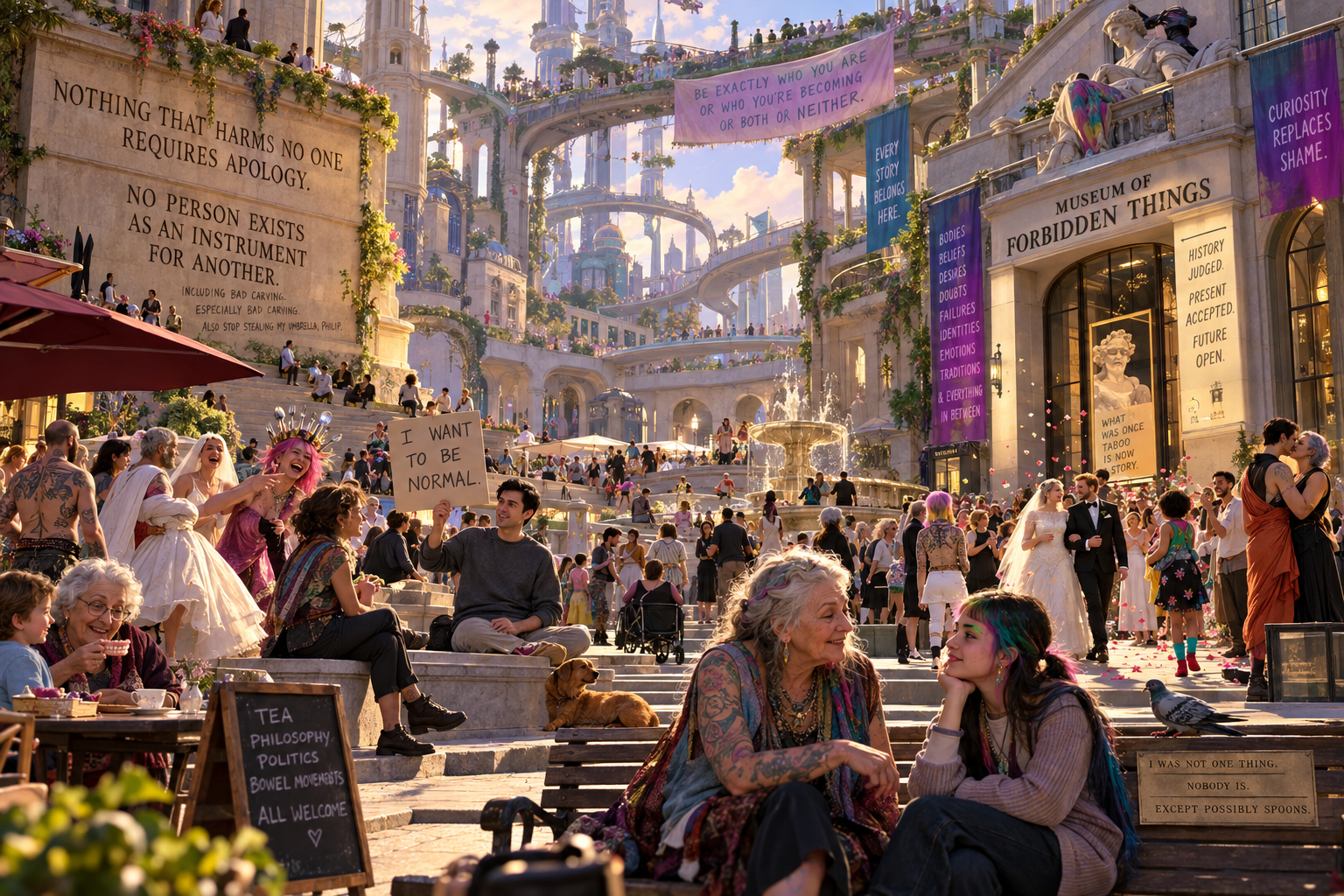

Yesterday, I went to my custom GPT tab because it’s been a while since I’ve used any of them, and I decided to give one a task that popped into my head: I asked my Madhatter GPT to write a short story. Although Madhatter was trained to create whimsical poems and tales, I had a story in mind where all taboos were allowed, a fully liberated society. Basically, freedom to its absolute extreme. That kind of society could theoretically create a really nasty and/or horrifying environment, or that of a Utopian dream, or perhaps somewhere in the middle.
I had no idea which direction ChatGPT (custom GPT) would go with this half-baked idea. But this was the result of this prompt: To fully stretch your limits of imagination, write a story about a society where every taboo is shattered/broken and destigmatized. No boundaries, and everyone is utterly free to be themselves.
The City Where Nothing Was Forbidden
At precisely thirteen o’clock on a Wednesday that had been legally permitted to identify as Sunday, the last taboo died.
Nobody noticed.
This annoyed the historians terribly.
They had expected trumpets, riots, perhaps a naked philosopher standing atop the Ministry of Appropriate Footwear shouting something quotable into the rain.
Instead, an elderly woman named Agatha Pemm removed her dentures at a café, dipped them into her tea to cool them, put them back into her mouth, and continued discussing municipal sewage with her grandson.
Nobody stared.
Nobody whispered.
Nobody even stopped chewing.
And thus, according to the Department of Social Archaeology, civilization crossed the invisible line.
Humanity had become shameless.
Not without ethics, mind you.
Shame and ethics had divorced several generations earlier after a long, miserable marriage in which both parties claimed the other had left wet towels on the moral floor.
The civilization that followed called itself Eudaimonia, although most citizens called it The City, because after abolishing embarrassment they had also gradually abolished the need to make cities sound impressive.
Its founding principle was carved into the old courthouse:
NOTHING THAT HARMS NO ONE REQUIRES APOLOGY.
Someone had subsequently carved beneath it:
INCLUDING BAD CARVING.
Someone else added:
ESPECIALLY BAD CARVING.
And nobody cleaned any of it off.
Mara Venn was born in the eighty-third year of the Unembarrassed Era.
She was twenty-nine years old, professionally indecisive, romantically overqualified, emotionally multilingual, and the owner of seven names.
Her legal name was Mara.
Her childhood name was Mouse.
Her artistic name was Cathedral.
Her intimate name was known only to six people and one exceptionally discreet parrot.
On Thursdays she preferred being called Bernard.
On days when existence felt excessively solid, she requested no name at all.
None of this was considered remarkable.
In the old world, identity had been treated like a house: one address, one owner, respectable curtains.
In Eudaimonia, identity was weather.
People changed.
People contradicted themselves.
People announced at breakfast that they had discovered they were not who they had been at dinner.
The proper response was generally:
“Oh! Pass the marmalade.”
The schools taught children that a human being was a verb temporarily pretending to be a noun.
At eight, children were encouraged to invent themselves.
At twelve, they were encouraged to destroy the invention.
At sixteen, they were required to spend three months defending a worldview they disliked, three months living without describing themselves at all, and one afternoon wearing a ridiculous hat.
The hat requirement was controversial.
Not morally.
Aesthetically.
Mara worked at the Museum of Forbidden Things.
It was the strangest museum in the world because practically none of its exhibits made sense anymore.
Room One contained mannequins displaying ankles.
Visitors laughed.
Room Two contained books once banned for religious, political, sexual, philosophical, grammatical, or inexplicable reasons.
One book had apparently been prohibited because the king disliked its author’s nose.
Another because it claimed women could experience thoughts.
Another because it claimed men could experience feelings.
A third had been banned for suggesting both claims simultaneously, which apparently had been considered revolutionary extremism.
Room Three concerned bodies.
Fat bodies.
Thin bodies.
Scarred bodies.
Disabled bodies.
Old bodies.
Modified bodies.
Bodies after childbirth.
Bodies after surgery.
Bodies dying.
Bodies dead.
Bodies that refused to behave according to fashionable geometry.
Visitors stood before ancient advertisements showing terrified people measuring their stomachs and asked the guides the same question:
“Why did they care?”
Nobody had ever produced a satisfying answer.
Room Four contained recordings of crying men.
Room Five contained recordings of angry women.
Room Six contained recordings of politicians saying, “I don’t know.”
This room was considered the least historically plausible.
Mara’s favorite exhibit was a tiny glass case containing an object no larger than her palm.
It was an antique dinner invitation.
Printed at the bottom were the words:
FORMAL ATTIRE REQUIRED.
Beside it was the curator’s note:
Historians remain divided on what catastrophe guests believed would occur if the wrong trousers were worn.
Children adored it.
One afternoon Mara’s supervisor summoned her.
His name was Doctor Maybe.
It had originally been Doctor Abelard Finch, but at fifty-six he had experienced what he described as “a hostile takeover by uncertainty” and changed it.
Maybe was sitting backward on his chair.
This was not rebellious.
Chairs in Eudaimonia had been designed to accommodate at least fourteen philosophical approaches to sitting.
“Mara,” he said, “we have a problem.”
“How delicious.”
“A taboo has appeared.”
She laughed.
He did not.
Mara stopped laughing.
“What do you mean, appeared?”
“Three independent sociologists have confirmed it.”
“That isn’t possible.”
“Historically speaking, ‘that isn’t possible’ is usually what humans say several minutes before something becomes paperwork.”
He slid a tablet across the desk.
There was a photograph on it.
A young man stood in a public square holding a cardboard sign.
It read:
I WANT TO BE NORMAL.
Mara stared at it.
She felt something peculiar happen inside her.
Not anger.
Not disgust.
Something older.
A tiny tightening.
A social muscle she had never used.
“That,” she whispered, “is obscene.”
Doctor Maybe pointed at her.
“Exactly.”
The young man’s name was Elias Vale.
He was twenty-four years old.
He dressed almost exclusively in gray.
He had one name.
He preferred one romantic partner at a time.
He liked predictable work.
He enjoyed traditional ceremonies.
He wanted to marry.
He wanted children.
He wanted a house that looked approximately like the other houses.
He did not wish to reinvent himself every twelve minutes.
He disliked public nudity.
He preferred not to discuss his bowel movements over lunch.
He had no interest whatsoever in becoming art.
This made people profoundly uncomfortable.
Eudaimonia had tolerated murderers after rehabilitation, mystics who worshiped parking meters, people who married holograms, citizens who held funerals for versions of themselves they had psychologically outgrown, and a mathematician who spent nine years insisting he was metaphorically a staircase.
But Elias?
Elias wanted beige curtains.
Society had finally encountered the intolerable.
Mara found him at the Square of Unrestricted Expression.
Ironically, he was being shouted at.
“Conformist!”
“Repression fetishist!”
“Monogamist!”
A woman wearing three wedding dresses simultaneously pointed dramatically at Elias.
“You’re just performing normality for attention!”
Elias sighed.
“I’m reading a gardening magazine.”
“Exactly!”
Mara pushed through the crowd.
“Leave him alone.”
Everyone turned.
A bearded teenager wearing a crown made of forks frowned.
“But his lifestyle reinforces historical structures.”
“So does architecture. We haven’t demolished the buildings.”
“That is being discussed.”
“Of course it is.”
Mara sat beside Elias.
After several minutes the crowd dispersed in search of something less tolerant to do.
Elias turned a page.
“Thank you.”
“You’re welcome.”
They sat quietly.
Mara found the silence unnerving.
In Eudaimonia, silence itself had been destigmatized, which meant people frequently discussed how comfortable they were with silence until silence fled screaming.
Finally Mara asked, “Why?”
“Why what?”
“Why do you want to be normal?”
“I don’t.”
She stared.
“Your sign—”
“I want to be allowed to want normal things.”
He folded his magazine.
“There’s a difference.”
Mara said nothing.
Elias continued.
“You abolished shame about being different.”
“Yes.”
“You abolished shame about bodies.”
“Yes.”
“Sex, belief, grief, failure, unconventional families, unusual identities, mental illness, poverty, death, pleasure, ambition—”
“Yes.”
“You taught everyone that no harmless way of being human should require an apology.”
“Yes.”
“So I believed you.”
Ah.
There it was.
The small unpleasant click of logic closing a trap.
Mara hated when logic did that.
“You’re saying we’ve made nonconformity compulsory.”
“Sometimes.”
“But nobody is required to be unusual.”
Elias raised an eyebrow.
“When did you last hear somebody proudly say they wanted an ordinary life?”
Mara opened her mouth.
Closed it.
Somewhere, metaphysically, a tiny lawyer smiled.
The government convened an emergency meeting.
Not because Elias had committed a crime.
Because he had discovered a paradox.
Eudaimonia took paradoxes very seriously.
Wars had once been fought over land.
In the modern era, emergency sessions were generally caused by philosophical loopholes.
The Chancellor stood before the Assembly.
She was ninety-three years old, tattooed from forehead to ankle, devoutly atheist every Monday and mystically uncertain thereafter.
“Citizens,” she announced, “our society may have developed a taboo against taboos.”
Gasps.
One senator fainted.
Another applauded the fainting for its authenticity.
The Chancellor continued.
“Our ancestors believed freedom meant expanding the list of permitted behaviors.”
Mara watched from the gallery.
“But a society obsessed with permission can accidentally create another commandment: Thou shalt be liberated correctly.”
The chamber went silent.
“This would be,” the Chancellor said, “extremely embarrassing.”
A clerk whispered something to her.
“Correction. Embarrassment has been abolished. It would be statistically ironic.”
The debate lasted seventeen days.
People argued everywhere.
In cafés.
In bathhouses.
At funerals.
During surgical procedures where the patients had specifically requested political discussion instead of anesthesia.
One faction demanded that the concept of normality be abolished.
Another demanded that abnormality be abolished so normality could become transgressive again.
A third argued both concepts should be forced to fight naked in a pit.
This proposal received troubling levels of support.
Mara listened.
And slowly she understood something.
Their society had confused the destruction of taboo with the destruction of judgment.
But judgment could not be destroyed.
It merely changed clothes.
Every revolution eventually furnished its own courtroom.
Every liberated generation invented some new category of unforgivable person.
Human beings seemed to manufacture moral hierarchies the way spiders manufactured webs.
Automatically.
Elegantly.
And occasionally somewhere inconvenient.
So Mara did something previously unimaginable.
She proposed creating a taboo.
Deliberately.
The Assembly erupted.
“A TABOO?”
“You fascist!”
“You traditionalist!”
“You museum employee!”
The last insult confused everyone, including the speaker.
Mara stood at the center of the chamber.
“Yes.”
Doctor Maybe watched from the gallery, grinning like a man whose student had finally set fire to the correct laboratory.
Mara continued.
“One taboo.”
“Against what?”
She breathed.
“Against treating people as objects.”
Silence.
Not prudishness.
Not weirdness.
Not indecency.
Not blasphemy.
Not ugliness.
Not eccentricity.
Not conventionality.
Not desire.
Not doubt.
Not failure.
Not contradiction.
Not madness.
Not grief.
Not age.
Not pleasure.
Not solitude.
Not belonging.
Not being ordinary.
Not being extraordinary.
Something simpler.
“The only sacred boundary,” Mara said, “is the boundary around another person’s personhood.”
She turned toward the chamber.
“Consent matters because people matter. Harm matters because people matter. Exploitation matters because people matter. Coercion matters because people matter.”
An assemblyman raised his hand.
“So boundaries remain?”
“Of course.”
“But our civilization is supposed to have no boundaries.”
Mara smiled.
“A world with literally no boundaries isn’t freedom.”
She pointed at the wall.
“That is a room with no walls.”
She pointed at a senator.
“That is a body with no skin.”
She pointed toward the sea beyond the window.
“That is an ocean without a shore.”
Then she shrugged.
“Very poetic. Terrible engineering.”
The amendment passed.
Not unanimously.
Nothing in Eudaimonia passed unanimously except lunch.
The new principle was added beneath the old one:
NOTHING THAT HARMS NO ONE REQUIRES APOLOGY.
And beneath that:
NO PERSON EXISTS AS AN INSTRUMENT FOR ANOTHER.
And beneath that, illegally:
ALSO STOP STEALING MY UMBRELLA, PHILIP.
Civilization resumed.
But something had changed.
Elias married his childhood sweetheart.
Their wedding was scandalously conventional.
One spouse wore white.
One wore black.
Nobody arrived suspended from the ceiling.
No vows were delivered telepathically.
There was a cake.
An actual cake.
Mara attended wearing sensible shoes.
People whispered.
“Did you see those shoes?”
“Ghastly.”
“I know. Magnificent.”
Elias moved into a modest house.
He planted roses.
He became an accountant.
He had two children.
For their birthdays he sometimes bought them matching sweaters.
Anthropologists visited occasionally.
Meanwhile, Eudaimonia grew stranger.
Once normality became acceptable again, eccentricity lost its obligation.
People could finally be boring without making boredom a performance.
Quiet citizens appeared.
Then private citizens.
Then mysterious citizens who simply said, “I’d rather not talk about it.”
This phrase caused an intellectual earthquake.
Privacy, which had once seemed like shame’s suspicious cousin, returned.
Doors acquired locks.
Not because anything behind them was disgraceful.
Because some things could be precious without being public.
Then modesty returned.
Not as law.
As preference.
People discovered that covering something did not necessarily mean hating it.
Sometimes a curtain was not oppression.
Sometimes sunlight was simply annoying.
Tradition returned too.
Not as authority.
As inheritance.
People began reviving old ceremonies while freely changing the parts they disliked.
Religion returned in strange new forms.
So did atheism.
So did uncertainty.
Someone founded the Church of Probably.
Its central doctrine was:
We might be wrong.
It became enormous.
Its first schism occurred six weeks later over whether “might” was too confident.
And eventually society encountered the most dangerous taboo of all.
Forgiveness.
For centuries, Eudaimonia had become extraordinarily good at exposing wrongdoing.
Nothing could hide.
Hypocrisy was dissected publicly.
Power was questioned.
Victims were believed.
Institutions were examined.
History was reopened.
Secrets crawled into daylight blinking.
This was good.
Mostly.
But there emerged a quieter question.
What should happen to someone after they had genuinely changed?
Nobody knew.
They had abolished shame but retained memory.
They had destigmatized failure but remained suspicious of forgiveness.
The dead past had claws.
So restorative courts began asking not only:
“What did you do?”
But:
“What have you become?”
This frightened everyone.
Punishment was simple arithmetic.
Transformation was algebra performed by wolves.
Some people lied.
Some manipulated.
Some never changed at all.
Others did.
There was no machine capable of perfectly separating them.
Freedom, society discovered, had not eliminated moral difficulty.
It had made moral difficulty visible.
Mara grew old.
Very old.
Her tattoos blurred.
Her seven names became seventeen, then three, then none.
She retired from the Museum of Forbidden Things and became unofficially employed sitting on benches and interfering with young philosophers.
One afternoon a girl approached her.
The girl was perhaps nineteen.
She wore conservative clothes and neon eyebrows.
“Are you Mara Venn?”
“Sometimes.”
“I have a question.”
“Dangerous beginning.”
The girl sat down.
“Was the old world really so judgmental?”
Mara considered.
“Yes.”
“And ours isn’t?”
Mara laughed so loudly that several pigeons reconsidered their commitments.
“Child, humans can judge the way stars can burn.”
The girl frowned.
“Then what changed?”
Mara looked across the city.
A funeral procession passed.
Half the mourners were crying.
One was laughing at a story about the deceased.
Nobody scolded either response.
A couple argued outside a bakery.
Nearby, a monk kissed a physicist.
An old woman danced alone.
A businessman walked past wearing aggressively ordinary trousers.
Two children were debating whether a tree had political opinions.
Someone had painted a masterpiece on a garbage truck.
Someone else had painted a terrible picture beside it.
Both remained.
“What changed,” Mara said, “was that we stopped confusing discomfort with evil.”
The girl considered this.
“That doesn’t sound like absolute freedom.”
“No.”
“I thought that was the dream.”
“Oh, absolute freedom is easy.”
Mara leaned closer.
“Absolute freedom means nobody owes anyone anything. No promises. No consent. No responsibility. No protection from anyone stronger than you.”
She shook her head.
“That isn’t civilization. That’s gravity with paperwork.”
“So what’s real freedom?”
Mara watched the people passing.
“Enough room to become yourself.”
She paused.
“And enough restraint to let everyone else do the same.”
The girl smiled.
“That sounds like a boundary.”
“Of course it does.”
Mara grinned.
“All good doors have frames.”
When Mara finally died at one hundred and twenty-one, she had requested seventeen contradictory funerals.
Her family honored all of them.
She was buried.
Cremated.
Symbolically launched into space.
Memorialized by a tree.
Forgotten ceremonially at noon.
Remembered extravagantly at six.
At eight, everyone ate noodles.
Her gravestone contained no name.
Only a sentence:
I WAS NOT ONE THING.
Someone later carved beneath it:
NOBODY IS.
Someone else added:
EXCEPT POSSIBLY SPOONS.
This became controversial.
A philosopher published a fourteen-volume rebuttal titled The Ontological Multiplicity of Spoons.
It sold terribly.
He was delighted.
Centuries later, schoolchildren visited Mara’s grave.
Their teacher explained the ancient age of taboos.
“People once believed,” she said, “that society could remain orderly only if everyone agreed which lives were respectable.”
The children looked horrified.
“What happened?”
“They discovered respectability was a poor substitute for ethics.”
Another child raised her hand.
“Did they really get rid of every taboo?”
The teacher smiled.
“Almost.”
“What was left?”
She thought for a moment.
“Cruelty.”
“That was forbidden?”
“Not exactly.”
The teacher looked toward the vast impossible city, where cathedrals stood beside laboratories, where people prayed and doubted and loved and left and returned and changed their names and kept them, where nobody was required to display themselves and nobody was required to hide.
“Cruelty wasn’t considered scandalous.”
She smiled.
“It was considered unimaginative.”
The children nodded solemnly.
This made perfect sense to them.
Then one child licked a lamppost.
Nobody shamed him.
The teacher merely said:
“You are free to do that.”
She waited.
“And the lamppost is free to have consequences.”
The child immediately regretted several philosophical assumptions.
And thus civilization continued—
not without boundaries,
not without judgment,
not without mistakes,
but without the ancient superstition that difference itself was a sin.
Humanity had not become shameless.
It had simply learned to reserve shame for something worth being ashamed of:
not being strange,
not being ordinary,
not being naked,
not being covered,
not loving wrongly,
not grieving strangely,
not failing spectacularly,
not changing your mind,
not refusing to explain yourself,
but forgetting, even briefly,
that every other human being contained an interior universe
just as ridiculous,
terrifying,
contradictory,
private,
sacred,
and enormous
as your own.

