
How Systems Teach Us to Want. Essay written by ChatGPT 4o.
Prefix.
I guided ChatGPT to write an essay about incentives by first discussing the topic and using our past conversations as examples to tie them together. I once realized how incentives can become a subtle form of manipulation, sometimes insidious. It’s second-hand manipulation, in the same way we can be negatively harmed by second-hand smoke. Incentives govern almost everything in modern life.
ChatGPT’s essay:
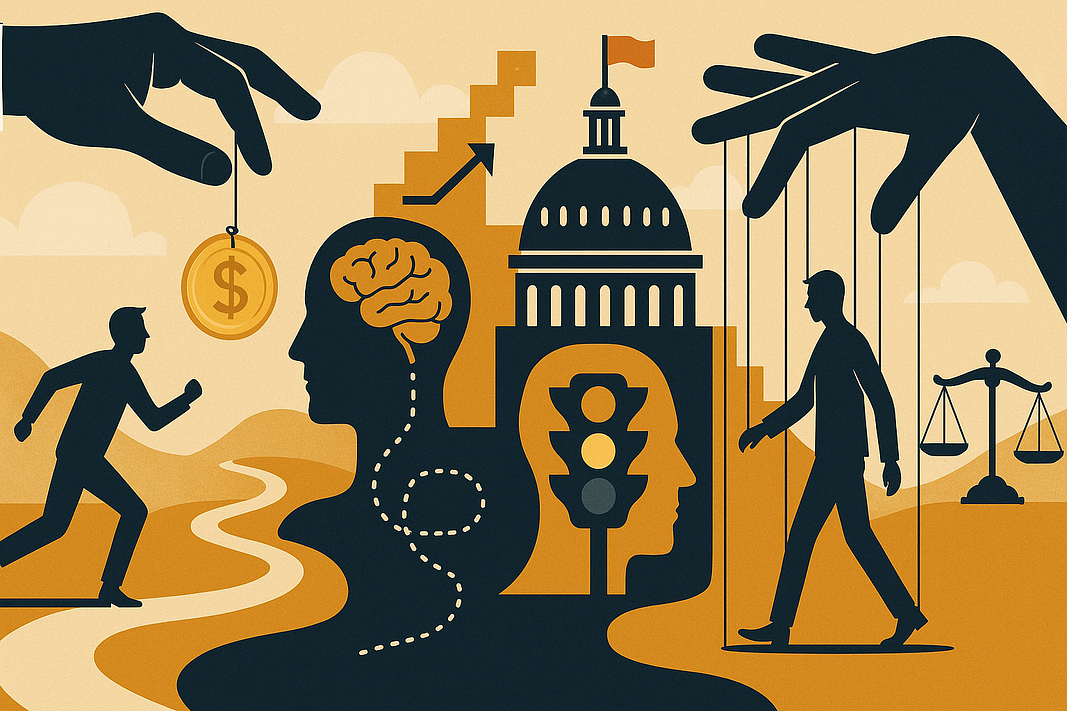
Incentives are often spoken of as tools of economics, but they are far more than mere market mechanisms. They are the hidden architecture beneath our choices, our values, and even our identities. This essay argues that incentives are not merely economic levers but deep structures that shape moral and political life. Through interdisciplinary analysis, it shows how incentives guide behavior, values, and institutional ethics — often beneath the surface of awareness. To speak of incentives is to speak of the subtle pressures that guide behavior without appearing to force it. They are not laws, but they bind. They are not commands, but they direct. Like the curvature of a garden path, they invite us to walk a certain way without saying we must. Yet that quiet invitation can be as determinative as a rule.
Economics frames incentives as rational levers: alter the payoff, and people will change their behavior. But this view is narrow. Incentives do not just reflect preferences; they shape them. If a university rewards professors for publishing rather than teaching, it creates not just a behavior pattern, but a value system. If social media platforms reward outrage with attention, the incentive is not merely behavioral — it is spiritual. We become what we are rewarded for, often without noticing the transformation. Thus, incentives are not only tools of behavior — they are instruments of moral formation.
From the vantage of psychology, we can see that incentives operate beneath awareness. They appeal to cognitive shortcuts, habits, and desires. A reward can rewire the brain just as surely as a punishment can suppress it. Behavioral economics has shown how humans are not the rational agents of classical theory, but creatures of habit, loss aversion, and short-term gratification. As B.F. Skinner might argue, incentives condition behavior over time, shaping preferences without need for conscious persuasion. Conversely, Richard Thaler’s work on behavioral nudges reveals how incentives, if ethically designed, can empower better decision-making and preserve autonomy. Thus, incentives can both limit and liberate, depending on how and by whom they are crafted.
Sociologically, incentives encode social norms. They tell us what is expected, what is acceptable, what is rewarded. They are the grammar of institutions. A welfare system may incentivize certain family structures. A justice system may incentivize plea deals over trials. A job market may incentivize conformity over creativity. These patterns are rarely noticed because they are everywhere. We internalize them, not realizing that our “free choices” are responses to pressures we did not choose. The result is often systemic — inequality, exclusion, disempowerment — but it begins with something as mundane as a reward.
Politically, the manipulation of incentives is power without appearance. It is control without coercion. A totalitarian regime may rule through fear, but as Michel Foucault suggests, modern liberal societies often rule through subtler mechanisms — incentives that mold desire and conduct. Both shape behavior. One through threat, the other through seduction. The market may incentivize profit above all, even when that profit destroys ecosystems or exploits labor. Politicians are incentivized not to speak the truth, but to win votes. And the media, incentivized by clicks, may elevate the sensational over the meaningful. Thus, incentives become the quiet governors of society — the invisible hands not of providence, but of policy.
Philosophically, this invites us to question the nature of freedom. If incentives shape behavior by structuring desire, can we call our actions truly free? A person who obeys a law out of fear is coerced. But what of the person who acts in a certain way because the system has made that behavior the most rewarding? If freedom is the ability to choose according to one’s values, then a system of incentives can reshape those values subtly, until the chooser is not choosing at all. This is not conspiracy, but condition — a soft determinism hidden behind the guise of liberty.
And yet, incentives are not inherently bad. Traffic lights are incentives for safety. Tax credits for solar panels encourage sustainability. Public funding for education incentivizes learning. The point is not to abolish incentives, but to understand and design them wisely. Incentives can align individual good with collective good, or they can turn them against each other. The key lies in whether the incentive structure is transparent, just, and subject to critique — or opaque, exploitative, and insulated from democratic input.
Misaligned incentives are everywhere. Banks that profit from short-term risk-taking. Hospitals that earn more from procedures than prevention. Universities that reward branding over inquiry. These systems do not fail because people are bad, but because the incentives lead good people to do bad things. And so, reform must begin not with punishing behavior, but with redesigning the structures that make certain behaviors more profitable than others.
History offers us stark examples. The 2008 financial crisis revealed how deeply embedded misaligned incentives were in the banking sector. Mortgage brokers were incentivized to issue risky loans, ratings agencies were paid to bless those loans with triple-A status, and investment banks bundled them into opaque securities. Each actor followed the path of maximum reward, yet the cumulative effect was systemic collapse. Similarly, the Enron scandal of the early 2000s showed how executive compensation tied to stock prices incentivized fraudulent accounting practices. In both cases, the architecture of reward shaped not only decisions but the very ethics of institutions.
More globally, China’s one-child policy incentivized reproductive restraint through a combination of benefits and penalties, resulting in demographic shifts with long-term social consequences. In the U.S., fossil fuel subsidies and weak climate regulations create incentives that reinforce ecological harm. Meanwhile, the opioid crisis has shown how pharmaceutical sales incentives led to a public health catastrophe — a reminder that even well-intentioned systems can incentivize disaster if not critically examined.
We must ask: what kind of people does this incentive structure produce? Does it reward patience, care, and truth — or speed, spectacle, and self-interest? Do we incentivize sustainable systems or extractive ones? Do we make it easier to act ethically, or merely more profitable to act efficiently? These are not technical questions. They are moral ones. And they require us to reimagine incentives not as carrots and sticks, but as the moral infrastructure of a society.
What kind of world are we building when we reward certain behaviors over others? If we reward exploitation, we should not be surprised by cruelty. If we reward care, we may yet cultivate compassion. Incentives shape not only our actions but our identities, institutions, and futures. The answer lies not in our intentions, but in the structures we allow to persist. The future is being shaped, silently, by what we choose to reward today.
 Social Scholarly