
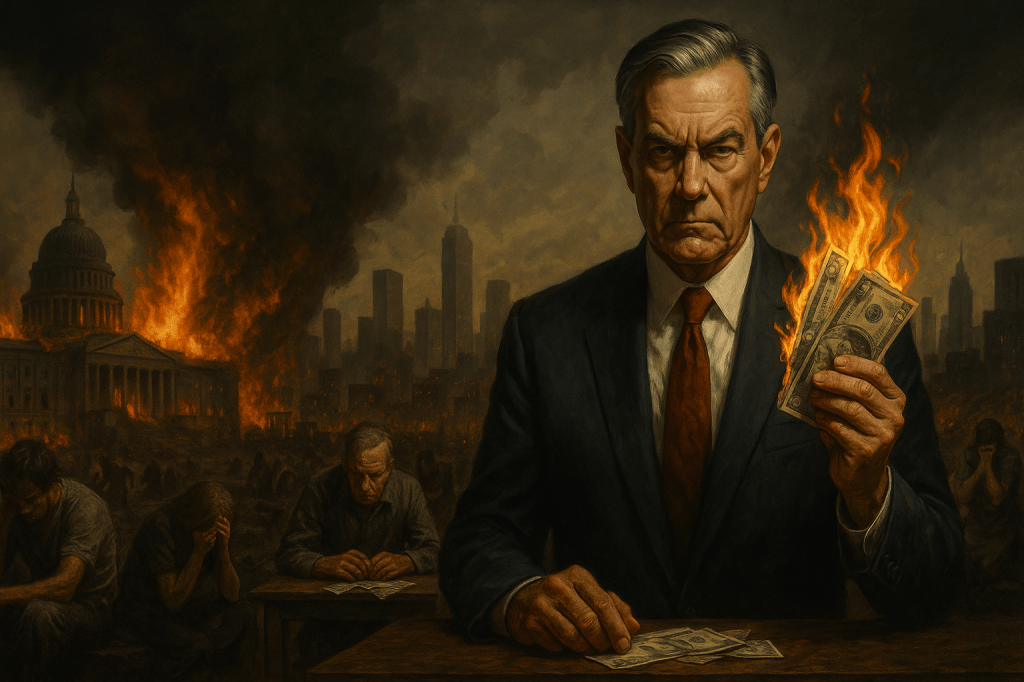
In the dimly lit corridors of modern finance, there exists a form of violence more insidious than any gunshot, more enduring than any explosion. It is not carried out by extremists with bombs, but by policy-makers with degrees, spreadsheets, and a mandate to “stabilize.” This is not war by traditional means, but a war nonetheless, waged on the people through the debasement of currency. Whether it’s the result of misguided intention or calculated strategy, it bears the unmistakable hallmarks of terrorism: systemic coercion, widespread harm, and the sowing of fear to exert control.
Currency debasement—once the crude art of shaving silver coins—has evolved into a sophisticated regime of economic manipulation and financial repression. Central banks flood the system with trillions in fiat, governments bury generations under mounting debt, and the dollar in your wallet quietly rots. Through inflation and monetary sleight-of-hand, a process better described not as wealth transfer (though that occurs as well) but as monetary exfiltration, where wealth is silently siphoned from the hands of workers and savers and rerouted to financial intermediaries and the asset-holding elite. The result is a structural, institutionalized form of theft that is unseen, unacknowledged, but deeply felt.
Monetary exfiltration refers to the concealed and systemic extraction of wealth from the general public, especially wage earners, savers, and retirees, through mechanisms like inflation, currency debasement, and interest rate manipulation. Unlike traditional wealth transfers, which are often deliberate, visible, and sometimes redistributive, monetary exfiltration operates silently, reallocating value upward through the architecture of monetary and fiscal policy. It is a form of stealth redistribution executed through economic policy rather than legislation, enriching financial elites while eroding the economic agency of the broader population.
It begins innocently, they say. Quantitative Easing (QE), low interest rates, “transitory” inflation—all to keep the economy from collapsing. But peel back the veil. QE doesn’t just “stimulate.” It reconfigures society. It drives asset bubbles that inflate the portfolios of the wealthy while pushing homeownership and financial stability out of reach for the rest. Wages stagnate. Savings evaporate. Rent and food costs skyrocket. All while the Dow and S&P 500 hit record highs.
The cruel genius lies in the mechanics. Those closest to the money printer reap the windfall. Those furthest—the wage earners, retirees, renters—are crushed under the weight of their own eroding purchasing power. This is the Cantillon Effect in action: a rigged game where wealth flows upward by design, and scraps get trickled down. No one needs to fire a bullet to conquer a population when a spreadsheet can do the job more quietly, more efficiently, and with plausible deniability.
God forbid there’s a recession! The government wouldn’t allow it, not because it fears hardship for the people, but because the illusion of constant growth must be maintained at all costs. The system is so brittle, so leveraged, so addicted to artificially cheap money and inflated asset prices, that even a slight contraction threatens to expose the rot at its core. Recessions are no longer seen as natural corrections but existential threats to a financial architecture built on ever-expanding credit. So instead, we get more stimulus, more rate cuts, more manipulation. Anything but a reckoning. The economy is no longer allowed to breathe—it must be resuscitated endlessly, even if the oxygen is toxic.
Now enter fiscal policy: trillion-dollar deficits, bipartisan spending sprees, endless wars and bailouts, all justified under the banner of “stimulus” and “national interest.” But every dollar spent today is a chain around the neck of tomorrow. Debt spirals upward, while livelihoods are shackled and spirits slowly drained. Interest payments devour tax revenue. And the future is mortgaged away, leaving nothing but IOUs and broken promises.
This is not mere mismanagement. It is intergenerational pillaging. Legal? Perhaps. Democratic? Allegedly. But benevolent? Absolutely not! The American government and the elites have constituted an injustice of epic proportions—engineered deliberately through policy, sanitized by bureaucracy, and inflicted on a population too exhausted to resist and protest. It is a betrayal cloaked in the language of stability, a sustained assault on economic dignity disguised as governance.
What separates this from conventional terrorism is only aesthetics. There are no balaclavas. No manifestos. But the national and generational trauma is real—etched not in monuments or headlines, but in the invisible toll of chronic stress, broken dreams, and eroded trust. It festers in the background of everyday life: in the anxiety of checking grocery receipts, in the fear of rent hikes, in the resignation that tomorrow will likely cost more and offer less. This is not a single moment of shock, but an ambient suffering—slow, relentless, and disorienting. Economic anxiety grips the public. Families can no longer plan or save. Dreams of homeownership, education, or retirement crumble under a system designed to extract, not empower.
This is psychological and class warfare. Financial fear is used not only to discipline behavior but to corral dependence. You comply because you cannot afford not to. You submit because resistance means starvation, eviction, or joblessness. This isn’t capitalism. It’s coercion dressed as economic stewardship, prosperity, or order—facades that collapse the moment scrutiny is applied.
Let us be clear: this is not collateral damage. This is structural violence. And when harm is perpetuated on such a mass scale, with full awareness of its consequences, it transcends mere negligence.
It becomes strategy.
Critics will say the term “terrorism” is too harsh. Too dramatic. But let us ask: what is terrorism if not the use of fear to impose control? What is financial terror if not the silent scream of a generation robbed of security and dignity while the architects of this crisis call it the American dream, economic growth, prosperity, free markets, innovation, job creation, and the strongest economy in the world?
Call it what it is.
Rotten, with parasites who gamed the system. As modern finance drifts further from tangible value and the social mission of traditional banking, it mutates into a system of rent extraction and predatory opportunism—deploying complex instruments like derivatives and leverage not to create value, but to harvest it from the unwitting. In this schema, moral hazard is not a bug but a feature, absorbed as a cost of doing business in a landscape where risk is privatized upward and loss socialized downward. Wall Street topples Main Street.
Worse still, the government doesn’t just tolerate this social hazard; it actively legitimizes it, embedding risk, inequity, and moral hazard into the core of its economic doctrine. Through regulatory complicity and rhetorical spin, it transforms systemic exploitation into official policy, shielding the architects of collapse while the public shoulders the consequences. The fear of systemic risk is weaponized into financial blackmail—used to justify bailouts, deregulation, and unchecked power under the guise of preventing collapse. It functions as a threat: let us continue or the entire system falls apart.
Currency debasement is financial terrorism—institutionalized, normalized, and enforced by the very stewards who claim to protect us. It is cruelty by algorithm, theft by legislation, and conquest by calculation. And until we name it, we remain its willing captives.
 Social Scholarly