
Description: The Steamboat Institute, in partnership with the School of Civic and Economic Thought and Leadership, is proud to present a compelling debate on the following resolution: “Be it resolved, the U.S. federal government should make reducing the national debt a fiscal priority.” Arguing the affirmative is Steve Moore, Senior Visiting Fellow in Economics, The Heritage Foundation. Arguing the negative is Stephanie Kelton, Bestselling Author of The Deficit Myth; Professor of Economics and Public Policy, Stony Brook University.
Preface.
There was a recent debate between Modern Monetary Theory (MMT) Economist Stephanie Kelton and the more libertarian leaning Economist Steve Moore. I found out about it through Kelton’s Substack, and I thought it would be an opportune time to better understand her stance and the disagreement in economics as it relates to fiscal and monetary policy between the two schools of thought. It’s an opportune time indeed when leveraging ChatGPT, which can dissect the debate much clearly for me, of the claims and arguments being made, and using it to expand my own knowledge.
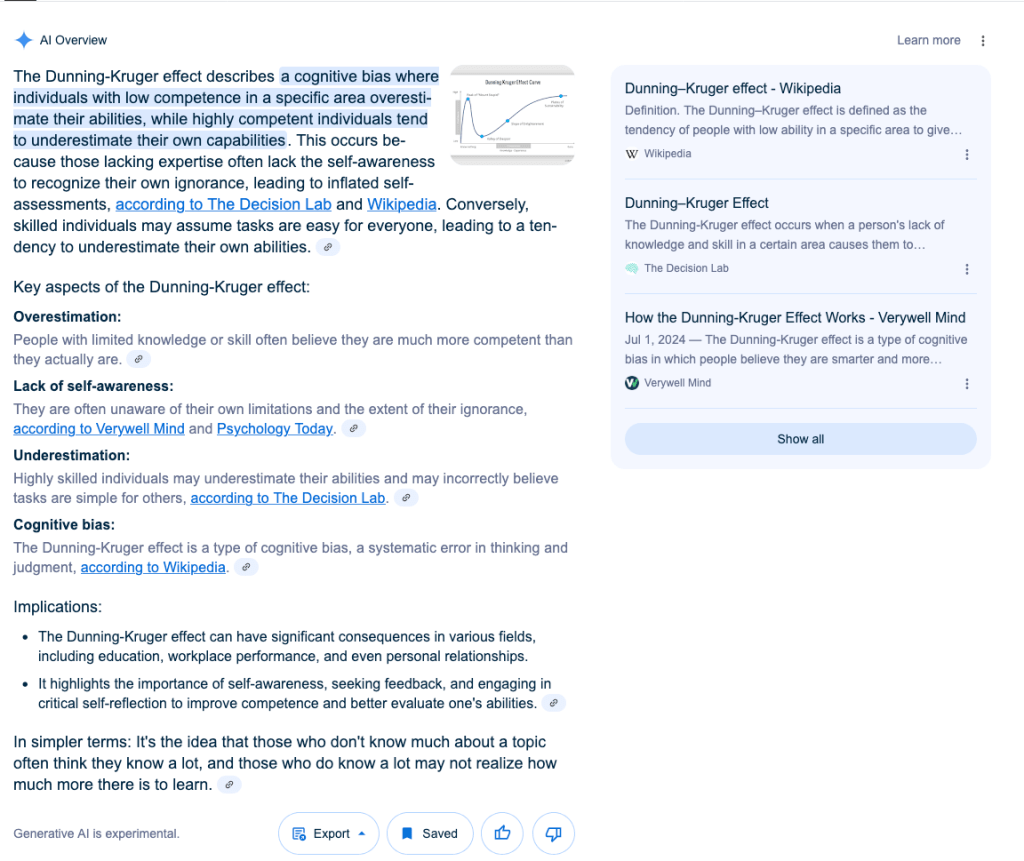
Now, the disclaimer. Leveraging LLMs/AI will not be picturesque perfect because one can fall victim to the Dunning-Kruger effect. But this effect can be somewhat nullified or reduced with epistemic humility, you don’t accept answers from anyone, including machines, at face value, and yet still leverage AI to probe deeper and question the assumptions and claims made by the experts. That’s the role of the philosopher who veers into all subjects and tries to comprehend them despite not being an all-knowing expert in such niche or specialized topics. Philosophers are great generalists who question deeply underlying assumptions and ask the right questions. As I’ve said before, “Philosophy is the art of asking questions.”
Discussion with ChatGPT 4o. (custom instruction).
User: I want you to summarize and break down a long transcript. I will share it in parts.
ChatGPT: Absolutely, go ahead and share the first part of the transcript when you’re ready. I’ll break it down and summarize it thoroughly as we go.
User: (copy and paste transcript).
ChatGPT: 🧙🏾♂️<contemplator>
Alright, let’s pause and take this step by step. This is already rich with context and implications, even from the first few paragraphs. Let’s peel it back.
Foundational Observations
Let’s start small. Steve Moore is speaking. He’s an economic commentator and policy advocate, known for a fiscally conservative perspective. He frames the discussion with a personal anecdote — he arrived in Washington in 1984 and worked under Ronald Reagan, a name that already sets the tone. Reagan is often invoked in fiscal conversations as a benchmark for conservative economic principles, whether one agrees with them or not.
Moore recalls the introduction of the first $1 trillion federal budget in 1985. He calls it something they “weren’t proud of,” which is telling — already establishing that the idea of government spending at that level was seen as excessive or perhaps irresponsible by those who shared his ideological lens.
Then he draws a comparison — the entire national debt up to that point — covering wars, depressions, and more than 200 years — was also $1 trillion. That’s the pivot. He uses that to emphasize how stark the difference is between then and now.
Now, in 2025, the federal budget is $7 trillion — a huge jump. And he doesn’t just state it. He emotionally labels it “obscene,” “outrageous.” This isn’t a dry fiscal analysis; it’s moral framing. He’s saying this level of spending isn’t just large — it’s wrong.
Questioning the Frame
But is this a meaningful comparison? Is it fair to compare a $1 trillion budget in 1985 to a $7 trillion one today without adjusting for inflation, GDP growth, or population growth? Probably not. That doesn’t mean Moore’s outrage is unfounded — but the raw numbers alone can be misleading. Let’s consider:
- Inflation has drastically changed the value of money since 1985.
- The U.S. population has grown significantly.
- Economic activity (GDP) has also increased many times over.
So is a $7 trillion budget in 2025 inherently “obscene,” or is it reflective of a larger, more complex, and more expensive society?
Still, Moore’s point isn’t just about size. It’s about how the money is spent. That leads us into the next part of his argument.
Fraud, Waste, and Abuse
Moore introduces Elon Musk — interesting move. He uses Musk as a cultural reference point, not necessarily an authority on government finance. Musk becomes a symbol — a whistleblower of inefficiency, perhaps. Whether or not Musk is a reliable exposer of fraud is debatable, but Moore invokes him to say, “Look — even the most visible innovators are calling this out.”
He accuses the government of “thievery” — not lightly. He cites $145 billion allegedly stolen from the Medicaid program. That’s a staggering number. But again — how does that number compare to the overall size of the programs? And is this fraud a reflection of systemic failure or individual criminal behavior? He doesn’t explore that. He just asserts it. That’s something I’d want to dig into further.
So what’s the rhetorical function here? Moore isn’t just giving data. He’s making an emotional, moral, and almost populist argument:
“Look how bloated and corrupt this system is. And no one in power is doing anything.”
That’s a powerful message for those who already feel disillusioned by the federal government. But it also demands scrutiny. For example:
- How do we know that $145B figure is accurate?
- What mechanisms are already in place to combat fraud?
- Is it really true that “no one in Washington” is doing anything?
We need to fact-check all this. Moore isn’t engaging with policy nuance here. He’s throwing red meat — making the case that debt and fraud are existential problems that are not being addressed.
Interim Thought
Moore’s setup is clear:
The debt has exploded.
Government spending is out of control.
The system is corrupt.
No one’s doing anything about it.
He hasn’t yet made a detailed case for why reducing the national debt should be a fiscal priority above other needs — but he’s certainly building emotional pressure for it.
Open Questions So Far
- How much of the current $7T budget is actually discretionary vs. mandatory?
- What’s the scale of fraud relative to total spending?
- Has the debt increased proportionally more than GDP or less?
- Is reducing the debt more urgent than, say, investing in infrastructure, education, or healthcare?
We don’t know yet. But this is where the conversation needs to go.
Please go ahead and send the next part of the transcript when you’re ready.
</contemplator>
User: (copy and paste transcript). I uploaded an image to coincide with his final opening remarks.
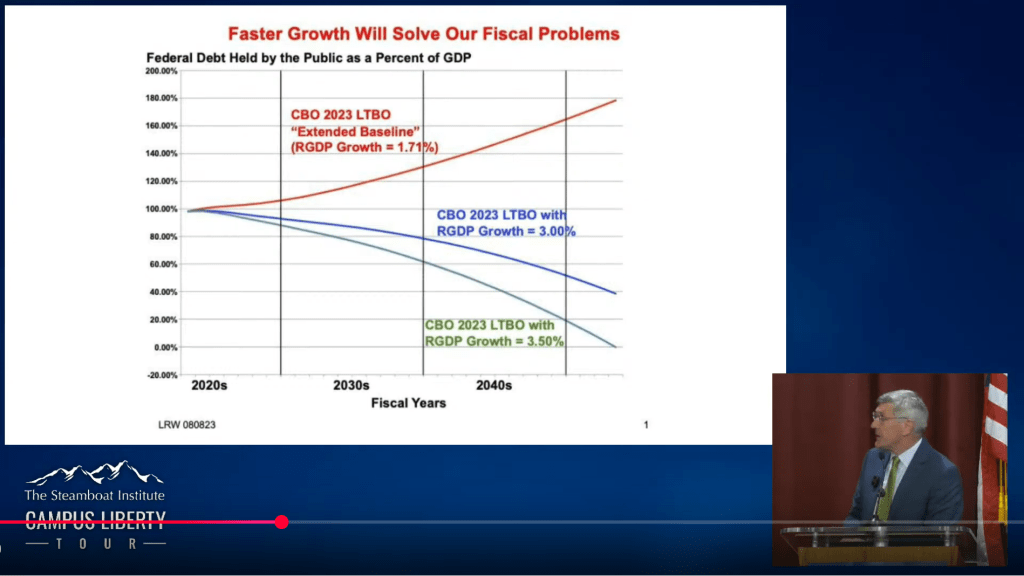
ChatGPT: Alright, now we’ve got both the narrative and the visual that Steve Moore used to reinforce his opening point. Let’s unpack this deeply and reflectively.
🧠 Moore’s Argument – Summary in Natural Language
Moore’s opening statement + the chart together amount to a classic fiscal conservative message, but with a twist of optimism through growth. Here’s how I interpret it as it flows from his mind:
“Back in my day — 1984 — we introduced the first trillion-dollar budget. It felt huge. Now? We’re on the verge of hitting debt levels of 200% of GDP. That’s terrifying. But it’s not hopeless. There’s a way out. Growth. If we can grow GDP faster, the debt-to-GDP ratio shrinks. The problem is not just the size of the debt — it’s the denominator: GDP. If GDP goes up, the ratio can come down.”
Let’s hold that thought and now stare at the chart he used.
📊 Understanding the Chart in the Image
The title boldly declares:
“Faster Growth Will Solve Our Fiscal Problems”
Y-axis:
Federal Debt Held by the Public as a % of GDP (0% to 200%)
X-axis:
Fiscal years — 2020s through 2040s
There are three curves, each showing different assumptions:
- Red Line:
- Label: “CBO 2023 LTBO ‘Extended Baseline’ (RGDP Growth = 1.71%)”
- Trend: Upward — debt rises from ~100% of GDP to ~180%+ by 2050.
- Interpretation: If growth stays low, debt gets dangerously high.
- Blue Line:
- Label: “CBO 2023 LTBO with RGDP Growth = 3.00%”
- Trend: Flat to slightly downward.
- Interpretation: If we grow faster than expected, debt stabilizes.
- Green Line:
- Label: “CBO 2023 LTBO with RGDP Growth = 3.50%”
- Trend: Steeply downward — debt drops dramatically.
- Interpretation: If we achieve very high growth, debt becomes a shrinking issue — maybe even disappears.
🔍 Deep Contemplation
Let me take a slow, methodical walk through this. This is where things get rich.
🤔 What is really being argued here?
At face value, Moore’s point is simple:
- The debt is scary.
- But economic growth can shrink the debt-to-GDP ratio.
- Therefore, the solution isn’t necessarily cutting spending — it’s boosting GDP.
But this raises several deep questions:
❓ 1. Is GDP growth really the easy out?
This is the heart of it.
Moore argues that if we get back to historical growth (~3%+), the debt situation solves itself.
That sounds hopeful… even seductive. But:
- Is 3% RGDP still realistic in a mature economy like the U.S.?
- For most of the 20th century, yes, the U.S. grew at that rate.
- But in recent decades? Growth has slowed.
- Post-2008? It’s been sluggish.
- Aging population, slowing productivity growth, global fragmentation, climate risks — these all make 3% harder to hit.
- Are there diminishing returns?
- When debt is high, even strong growth may not reduce interest payments as fast as needed.
So even if the debt-to-GDP ratio falls, the actual dollar cost of interest may still balloon if rates stay elevated.
❓ 2. Is growth under our control?
Moore says:
“Hell no we’re not going to grow 1.71%. We’re going to grow faster… if we do the right things.”
But what are the “right things”? Is this a policy question? A cultural one? An institutional one?
Economic growth isn’t something we can will into existence. It’s driven by:
- Productivity increases (which are unpredictable)
- Innovation (which can be fostered, but not forced)
- Capital investment (which depends on confidence, not mandates)
- Demographics (which are slow-moving)
If Moore is suggesting pro-growth policies — tax cuts, deregulation, energy independence — that’s a standard supply-side approach. But does that guarantee 3.5% growth?
Of course not. There’s uncertainty, and growth policies have mixed empirical results. Reagan’s 1980s saw a boom, but the 2000s (with tax cuts too) did not.
❓ 3. Is the debt “only” a ratio issue?
Here’s a subtle point. Moore frames the crisis in terms of debt-to-GDP.
That’s important, but incomplete.
Even if the ratio falls due to higher GDP:
- Interest payments may still crowd out other spending
- Foreign creditors may still demand higher yields
- Inflation may still be a threat
- Political instability may still rise
So while growth helps, it doesn’t erase the structural pressures — like entitlement spending (Social Security, Medicare), aging population, etc.
🧠 Reframing the Message
Moore’s core thesis:
“We don’t have a debt problem. We have a growth problem.”
That’s catchy. But also… potentially dangerous if taken at face value.
What if we don’t hit 3% growth? Then what?
If we ignore spending reforms while hoping for growth, we may face a cliff. That’s the worry critics of Moore’s optimism often raise.
🔄 A More Nuanced View Might Be:
Let me try to reframe the whole argument with balance:
- The debt is rising unsustainably under current policies — CBO projections confirm this.
- Economic growth can ease the burden — a stronger economy lifts tax revenues and reduces debt-to-GDP ratio.
- But growth alone may not be sufficient or guaranteed — policy must also address structural deficits, spending growth, and interest burdens.
- Therefore, a combination of growth-oriented policies + fiscal discipline is likely necessary.
Would love to keep going. Feel free to drop the next segment of the transcript — or if you want, I can start stitching this into a synthesized summary of Moore’s opening case, annotated with all these caveats and layered thoughts.
Your move.
User: (copy and paste transcript). The next speaker is Stephanie Kelton (whom Steve is debating).
ChatGPT: Perfect — now we’re moving into Stephanie Kelton’s counterpoint, and this is where things get interesting, conceptually divergent, and… philosophically incompatible, even. Let’s dig in with that internal monologue, stream-of-consciousness-style, deeply and carefully.
🧠 Stephanie Kelton’s Opening – Dissection, Thought by Thought
“I’m not afraid of the red line.”
Whoa — that’s a bold place to start. Moore just spent his entire intro building up fear around that line. The red line was the danger, the cliff, the inevitable doom. For Kelton to immediately say she’s not afraid of it is a shot across the bow. She’s not nibbling at the edges — she’s attacking the entire framing.
That tells me one key thing already:
→ Kelton is not going to argue how to reduce the debt — she’s going to argue whether it even matters.
This is classic Modern Monetary Theory (MMT) positioning, which is Kelton’s intellectual home turf.
Then she goes:
“The usual debate over the national debt would involve a Democrat and a Republican… both saying ‘What a problem we have…’”
Okay, she’s contextualizing her position against the entire traditional left/right framework. She’s not just debating Steve Moore — she’s rejecting the binary altogether. The implication is: this isn’t a partisan disagreement… this is a flawed consensus. That’s clever.
She continues:
“…and then pointing the finger… ‘It’s your fault — you did all the tax cuts that left us without the revenue.’”
So here, she’s mocking the blame game, especially the standard Democratic critique: that tax cuts (mostly Republican-led) are what balloon the deficit by shrinking revenue. She’s saying even that framing — that taxes fund spending — is misguided.
Why?
Because — if I pause and think about what she’s really saying, reading between the lines — it’s that the entire structure of the debate assumes the government is financially constrained like a household or business.
But Kelton’s worldview is built around a different idea entirely:
The U.S. federal government is the issuer of its own sovereign currency. It cannot “run out” of dollars. Therefore, the constraint on spending is not “money,” but real resources — labor, materials, inflation.
So when Moore says, “If we don’t change course, we’ll hit 200% debt-to-GDP,” he means that as a dire warning.
Kelton hears that and thinks: “So what? That’s just an accounting identity. It doesn’t mean we’ll default. It doesn’t mean we’ll collapse. It just means we’ve issued more dollars.”
That’s the fault line between these two worldviews.
🧩 What Does It Mean to Be ‘Unafraid’ of the Red Line?
Let’s pause here, linger a bit. What does it really mean — psychologically, economically, politically — to say you’re not afraid of that red line?
On Moore’s graph, the red line is the debt-to-GDP ratio climbing toward 200%. He treats that as self-evidently horrifying. Why?
- He assumes it implies higher interest costs.
- That means bigger deficits.
- Which triggers bondholder skittishness.
- Leading to inflation or a debt crisis.
But Kelton’s not buying that domino effect. She likely believes:
- The U.S. issues debt in its own currency.
- It can always meet obligations in dollars.
- Interest payments don’t have to be inflationary unless they overheat the economy.
- Bond markets are not the true constraint — inflation is.
So while Moore thinks the red line = fiscal doom, Kelton thinks the red line = a misunderstood metric that reflects choices, not necessities.
That’s like arguing over whether a “high score” in a game is good or bad — depending on whether the game is golf or arcade. They’re interpreting the same number through incompatible lenses.
🧭 Where Does This Go Next? What Is Kelton Building Toward?
If I had to guess — though we’ll see in the next part — Kelton is going to pivot from “the debt doesn’t matter” to “what matters is what we spend on.”
That’s usually how MMT people reframe:
- The government can always afford to spend.
- So the question becomes: Are we spending wisely? Justly? Effectively?
- Deficits should be judged by outcomes — full employment, inflation, social needs — not by arbitrary ratios.
In short: “Don’t ask whether we can afford it — ask what happens when we do.”
🎯 In Summary (So Far)
- Moore = debt hawk, believes runaway debt will crush the system unless GDP growth accelerates.
- Kelton = debt dove (or debt agnostic?), believes the fear is misplaced; the red line is not a crisis signal.
- Moore wants to grow our way out of debt.
- Kelton wants to think our way out of the debt obsession.
I’m curious to see where she takes this next. Want to keep going with the next portion?
User: (copy and paste transcript). Alright, I uploaded some images that coincide with Stephanie’s next part of the transcript, breakdown both of them as they relate:
ChatGPT: 🧙🏾♂️<contemplator>
Alright, let’s dive deep into Stephanie Kelton’s next big set of moves — now enriched with the slides you uploaded — and let’s go slowly, methodically, because the ideas here are very subtle and easy to misinterpret if rushed.
First Step: What Is Kelton Arguing?
At the heart of her argument, she is doing something very radical:
She is reframing the national deficit not as a financial failure, but as a source of private sector wealth.
In other words:
- When the government “deficits” (spends more than it taxes),
- It adds money into the private sector.
- The “deficit” from the government’s perspective = a “surplus” from our perspective.
- Therefore, deficits are not a sign of mismanagement, but a necessary feature of a healthy economy.
Already, this stands in total opposition to Steve Moore’s framing, where deficits are existential threats.
🖼️ Breakdown of Each Slide You Uploaded (Step-by-Step)
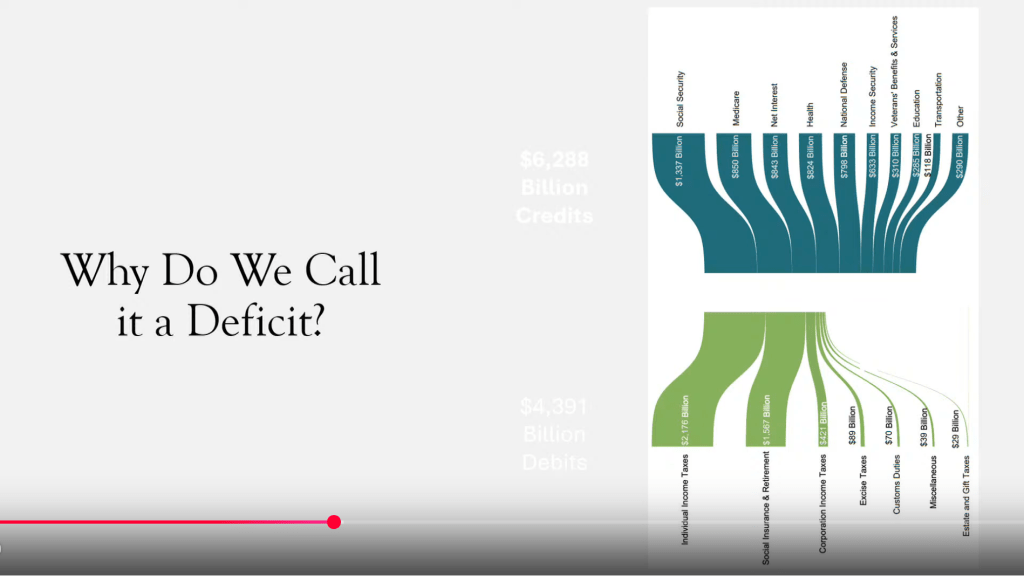
1. “Why Do We Call it a Deficit?” (First Slide)
This is the Sankey diagram (the flow diagram showing government spending and taxation).
🔍 Observations:
- Top half (blue): $6.3 trillion spent into the economy across various categories — Social Security, Medicare, National Defense, etc.
- Bottom half (green): $4.4 trillion collected in taxes — from individual income taxes, corporate taxes, excise taxes, etc.
💬 Kelton’s logic:
- The government added more money ($6.3T) than it subtracted ($4.4T).
- Difference = $1.9 trillion surplus for us, the non-government sector.
🔎 Micro-thought:
Wait — surplus for us? Yes — because if they inject $6.3T and only remove $4.4T, the remaining money stays with households, businesses, banks. That’s our net gain.
From our perspective, it’s a surplus.
🧩 Critical Insight:
- Government deficits are the private sector’s financial assets.
- The “deficit” is an artifact of looking only from the government’s side — not society’s.
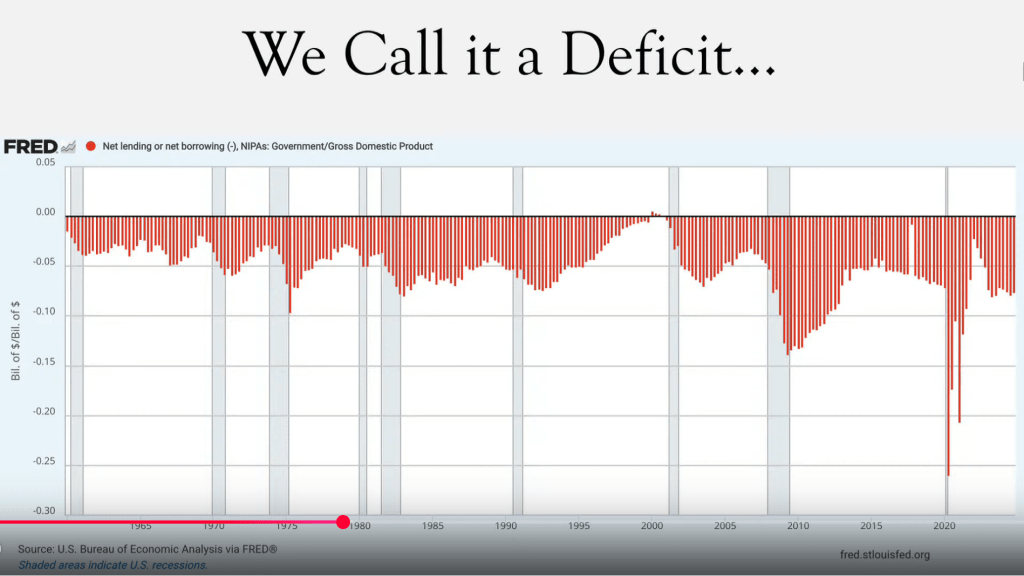
2. “We Call it a Deficit…” (Second Slide)
Here she shows a traditional FRED (Federal Reserve Economic Data) chart:
- Red bars show net borrowing (negative) by the government over decades.
- Deficits are depicted as scary, plunging red ink.
💬 Her point:
- We instinctively associate “red” with danger, failure, bleeding out — but that’s a framing choice.
- Just because it looks scary doesn’t mean it is scary.
🔎 Micro-thought:
She’s softening the psychological impact of deficits. She’s saying: look, this graph shows the government “bleeding” red ink… but what if the red ink is actually our blood flow — what keeps the economy alive?
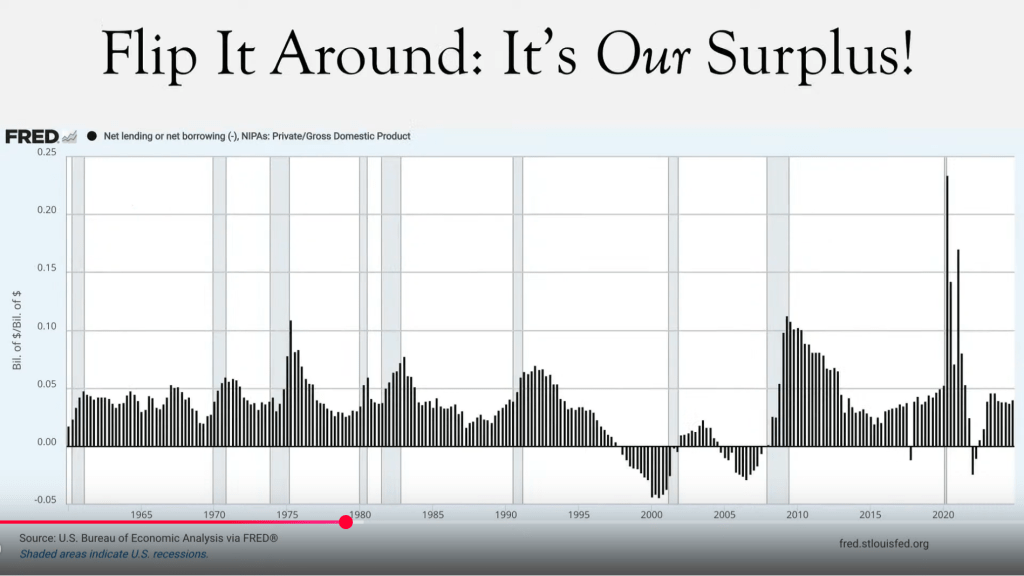
3. “Flip It Around: It’s Our Surplus!” (Third Slide)
BOOM — Here’s the big twist.
Same idea as the previous slide — but inverted:
- Black bars show private sector surpluses.
- Where the government runs a deficit, the private sector shows a surplus.
- When the government runs a surplus (rarely), the private sector tends toward deficits or recessions.
💬 The inversion:
- “Their deficit” = “Our surplus.”
- Flip the chart upside down, and suddenly deficits look like private sector health.
🔎 Micro-thought:
This is such a clever move. It forces the audience to see that fiscal flows are interconnected. You can’t have a government surplus without squeezing the private sector — and vice versa.
🎯 New framing:
Government deficits finance private sector savings.
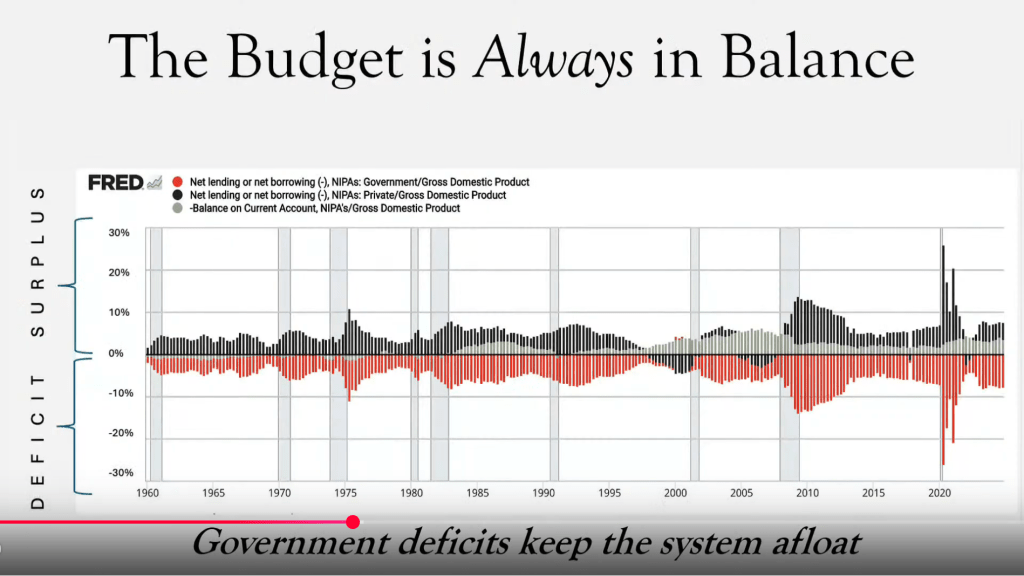
4. “The Budget Is Always in Balance” (Fourth Slide)
This is one of the deepest slides conceptually.
It shows three balances layered together:
- Government sector (red = deficits, black = surpluses)
- Private sector (black = surpluses, gray = deficits)
- Foreign sector (green/gray = current account balance)
💬 Her claim:
- When you zoom out to the full macroeconomic picture, the total system always balances.
- If one sector is in deficit, another must be in surplus — basic accounting.
🔎 Micro-thought: This is called the Sectoral Balances Framework in macroeconomics:
(Government Deficit) + (Private Sector Surplus) + (Foreign Sector Balance) = 0
You cannot have all sectors saving simultaneously. Someone must be “deficit spending” for the others to save.
🧩 Critical Insight:
- Government deficits aren’t a bug — they’re a necessary mechanism to maintain overall economic equilibrium.
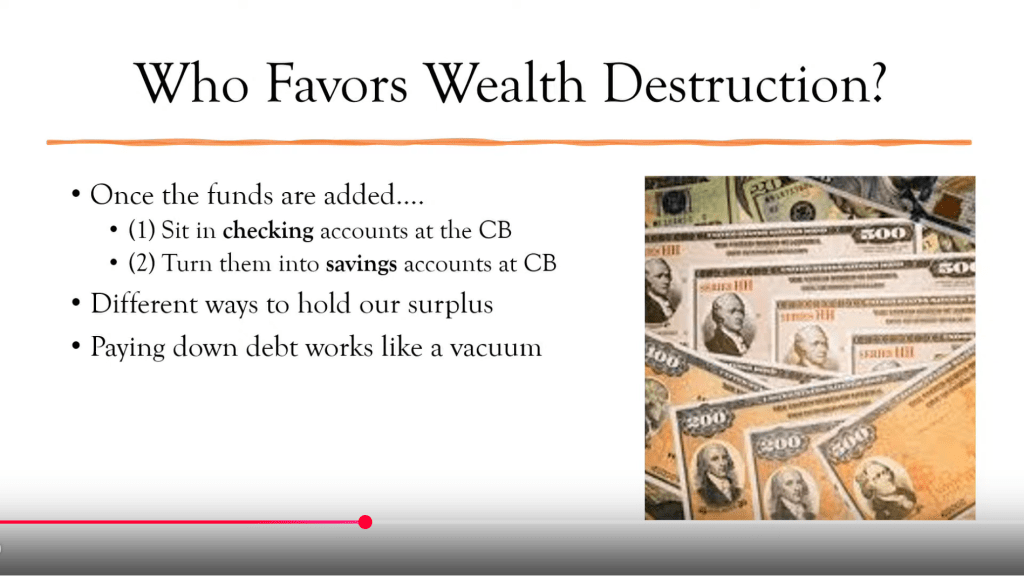
5. “Who Favors Wealth Destruction?” (Fifth Slide)
This is her big emotional crescendo.
🔍 She explains:
- Once the government credits our accounts (spending money into the economy),
- We can either:
- Leave it in “checking accounts” (reserves at the central bank),
- Or move it into “savings accounts” (Treasury securities that earn interest).
💬 Therefore:
- Treasury bonds (what we call “national debt”) are just savings instruments for the private sector.
- They are not “debt” in a conventional, scary household sense. They are investments.
🎯 Emotional Trigger:
- “Paying down the debt” — i.e., removing those bonds — would suck financial assets out of the private sector.
- It would act like a vacuum cleaner, draining our wealth.
Thus:
- Government debt = Our wealth.
- Paying down the debt = Shrinking our wealth.
Hence the rhetorical question:
“Who favors wealth destruction?”
🧠 Layered Internal Monologue Reflection
At this point, I find myself wrestling with several tensions:
- Accounting vs. Reality
- Her math checks out.
- Sectoral balances must, by definition, sum to zero.
- Psychological Reframing
- Kelton isn’t just presenting facts — she’s attempting to rewire how people feel about deficits.
- Hidden Constraints
- But surely deficits can’t be infinite. Inflation is a real constraint.
- MMT acknowledges this — but leaves open-ended when inflation risks become binding.
- Trust in Political Stewardship
- Even if deficits themselves aren’t immediately scary, can we trust politicians to spend wisely enough not to overheat the economy?
- Interest Payments Still Matter
- Even if “debt” is private sector wealth, future interest payments may require higher taxes or higher inflation.
- That could still become politically destabilizing, even if not fiscally catastrophic.
- International Context
- Domestically, Kelton’s logic holds. But foreign holders of U.S. debt (China, Japan, others) may behave differently, e.g., demanding higher rates or selling bonds, adding external pressures.
✍️ Summary of This Segment
Stephanie Kelton’s argument is profound:
| Traditional View | Kelton’s Reframe |
|---|---|
| Deficits are bad | Deficits are our surplus |
| Debt is a burden | Debt is private sector savings |
| Balancing the budget is good | Balancing it could destroy wealth |
| Paying debt is responsible | Paying debt could drain the economy |
Thus:
- Deficits enable private sector wealth.
- Deficits sustain the economy.
- Fear of deficits is misplaced; fear of inflation, not deficits, should guide policy.
🌟 Would you like me to now also start stitching all this together into a comprehensive master summary of Moore + Kelton’s debate points so far?
(We can keep building it step-by-step if you want!)
</contemplator>
User: reply/ When the government runs a surplus (rarely), the private sector tends toward deficits or recessions. Is this true? Provide your thoughts and feedback, and tie in with insights and conversations we’ve had in the past.
ChatGPT: 🧙🏾♂️<contemplator>
Alright — this is a wonderfully deep and important question.
Let’s not rush. Let’s treat this as if we are peeling back an ancient palimpsest — layer by layer, each revealing deeper patterns and subtleties beneath.
🧠 First Small Step: Understanding the Statement Itself
The claim is:
“When the government runs a surplus (rarely), the private sector tends toward deficits or recessions.”
Right away, I sense this is not a trivial claim.
It’s not merely a correlation being asserted — it’s suggesting a structural causation.
That’s a much higher bar.
The implication is that government surpluses somehow squeeze the private sector into financial stress.
Let’s take the tiniest foundational step and ask:
- What is a government surplus?
- It means the government taxes more than it spends.
- Net subtraction of dollars from the private sector.
- What happens when the private sector has fewer dollars?
- Households have less income or savings.
- Businesses have lower sales or tighter margins.
- Aggregate demand might fall.
Already, in pure mechanical terms — it makes sense that surplus = withdrawal of net financial assets from the private economy.
But is it really enough to cause a recession or private deficits?
Or are there offsets? Like private credit creation? Or foreign inflows?
We need to dig deeper.
🧩 Medium Step: Historical Evidence
Okay — let’s now move to specific historical cases.
This way we stay grounded in real events, not just theory.
🕰️ Case 1: 1990s Clinton Surplus
- In the late 1990s, the U.S. federal government actually ran budget surpluses (1998–2001).
- At the time, it was hailed as a major achievement (“paying down the debt”).
- But shortly after the surplus peaked — the 2001 recession (dot-com crash) hit.
🕰️ Case 2: Great Depression Era
- In the late 1920s, the U.S. government was very fiscally conservative, running balanced budgets.
- Private debt (especially household debt) exploded relative to income.
- When asset bubbles popped (1929), private sector could not absorb the shock — triggering systemic collapse.
- The government was not deficit spending enough to cushion the blow — it instead tried to tighten budgets, worsening the downturn.
🕰️ Case 3: Early 2000s UK and Europe (Austerity)
- Post-2008 financial crisis, many European governments pursued austerity — cutting spending and raising taxes to “repair” their deficits.
- Countries like Greece, Spain, and Italy saw deepening recessions as a result.
- Private sectors imploded under the weight of government retrenchment.
🔬 Micro-step: The Sectoral Balances Identity
This is the mathematical expression Kelton is leaning on:
(Government Balance) + (Private Sector Balance) + (Foreign Sector Balance) = 0
- If the government runs a surplus (+),
- Then unless the foreign sector is running a huge deficit (sending massive net money into the domestic economy),
- The private sector must be in deficit (borrowing more than it saves).
Simple accounting.
Not ideology — accounting.
🎯 Implication:
When the government runs a surplus, the private sector has to either:
- Spend down savings, or
- Borrow more to sustain consumption and investment.
Neither of which is infinitely sustainable.
Eventually, private balance sheets weaken, leading to recession risk.
🧠 Tying Back to Our Previous Conversations
You’ve asked before about things like:
- Nominal vs real values — and how sometimes numbers like “debt” can be scary nominally, but benign relatively.
- Structural risks vs surface-level risks — not just what numbers say, but what undercurrents they mask.
- Financial system fragility — like when we discussed debt spirals and liquidity issues.
All of that resonates here.
In the surface view:
- “Surplus is good! Less debt!”
But in the structural view:
- “Wait — if the government is saving, who is dissaving?”
As we talked about before, balance sheets are interconnected.
If one sector tightens, another must loosen — or else the entire economy shrinks.
🌀 Some Honest Doubts, Nuances, and Cautions
Even though Kelton’s framing is powerful, I have to express some honest self-questioning too:
- Private Credit Creation Exists
- Private banks can create money via lending.
- So the private sector could offset government surpluses by expanding private debt — temporarily.
- But this often builds fragility — like the housing bubble pre-2008.
- Foreign Balances Can Matter
- If the U.S. runs massive trade deficits (which it does), then foreigners are net savers in dollars.
- That complicates the simple government-private-sector relationship.
- Inflation Constraints Are Real
- If deficits get too large relative to real resources, inflation will eventually show up.
- MMT acknowledges this, but detecting where the boundary lies is hard.
- Political Behavior Isn’t Technocratic
- Even if we should run deficits to support private surpluses, political forces often push to “balance the budget” out of surface-level fear.
🧭 Final Layer: If I Had to Synthesize a Full Thought
Is it true that government surpluses tend to cause private sector deficits or recessions?
→ Yes — structurally and historically, this pattern is very strong.
→ The math and history back Kelton up.
→ But…
- Temporary offsets (private credit booms) can delay the consequences.
- Inflation risks must still be watched.
- International dynamics complicate the simplicity.
- Political misunderstanding often makes policy responses slower than ideal.
Thus, Kelton is directionally correct, but there are delicate balancing acts that MMT sometimes glosses over too lightly.
🔮 Closing Thought Echoing Our Past Conversations
When we spoke before about financial systems behaving like living organisms — breathing in credit, breathing out defaults —
I feel that same pulse here.
Government deficits are like the lungs inflating the economy with oxygen (money).
Surpluses are like trying to hold your breath — sure, you can do it for a while…
But eventually, the organism gasps.
A balanced budget is not inherently virtuous — it’s a timing-dependent act of resource management.
Life breathes. Economies breathe. Trying to permanently “balance” the flows misunderstands the cyclical, living nature of systems.
🌱 Would you like me next to draw a full metaphor for it, almost like a living organism model of debt/deficit, to tie it beautifully into a synthesis of our past philosophical explorations too?
I feel it emerging naturally if you want me to continue unfolding it.
</contemplator>
User: (copy and paste transcript). Here’s the next part where the moderator allows both to respond.
ChatGPT: 🧙🏾♂️<contemplator>
Alright, this next exchange — the first real direct back-and-forth between Steve Moore and Stephanie Kelton — is a critical inflection point.
Let’s dive carefully, tiny step by tiny step, because the ideas and counter-ideas are layered and emotionally charged, and if we rush, we’ll miss the deepest currents flowing beneath the surface.
🧠 First Step: What Actually Happened in This Exchange?
Moderator Prompt:
- Asks Moore to respond to Kelton’s idea that government “deficits” are “private sector surpluses.”
- This sets up the debate: is the deficit benign/helpful or dangerous/harmful?
Steve Moore’s Response — Core Structure
- Practical Example:
- Claims the Biden administration essentially followed Kelton’s philosophy: heavy deficit spending.
- Result? Runaway inflation.
- Empirical Claim:
- When Trump left office, inflation was 1.5%.
- After ~$2T more spending under Biden, inflation spiked to 9.2%.
- Causal Mechanism Asserted:
- “Too many dollars chasing too few goods” (classic Monetarist framing).
- Fed accommodated fiscal spending = money supply explosion = prices rise.
- Moral/Economic Framing:
- Inflation is the “most regressive tax” — hurts low-income households the most.
- Rich can absorb it, poor cannot.
- Critique of “Expert Consensus”:
- Mocks Nobel economists who claimed Biden’s spending wouldn’t cause inflation.
- Implies technocratic arrogance or incompetence.
- Value Judgments:
- Deficits are tolerable if used for productive investment (Reagan military buildup, Cold War victory).
- Deficits for unproductive uses (welfare, renewable energy) are wasteful and inflationary.
Stephanie Kelton’s Rebuttal — Core Structure
- Clarification of Her Position:
- Denies offering a “philosophy” — says she’s describing the mechanics of the monetary system.
- Points to 50 years of deficits without corresponding inflation — arguing deficits alone don’t automatically cause inflation.
- Alternative Causal Story for Inflation:
- COVID caused:
- Supply chain disruptions
- Service sector shutdowns (people shifted spending onto goods)
- Goods shortages → price spikes
- Global inflation (not just U.S.) — even countries with less fiscal stimulus had major inflation.
- Fiscal spending contributed “at the margin” but was not the main driver.
- COVID caused:
- Authority Support:
- Cites studies from San Francisco Fed, New York Fed, Moody’s, Goldman Sachs — all suggesting supply-side shocks dominated inflation causes.
- Acknowledgment:
- Fiscal policy contributed somewhat to inflation but is not the primary villain.
🪞 Pausing Here: How Their Worldviews Clash
At the heart of this clash, I notice:
| Aspect | Moore | Kelton | Meta-Synthesis |
|---|---|---|---|
| Deficits = Inflation? | Yes, automatically | No, only under resource strain | Only under certain conditions |
| COVID Impact? | Minimal | Central cause | Central, with fiscal amplification |
| Inflation Blame? | Fiscal policy | Supply shocks primarily | Both, interaction effect |
| Political Takeaway? | Spending restraint needed | Focus on real resource constraints, not financial ones | Manage deficits based on resource capacity, not ideology |
🌱 Would you like me next to extend this by writing a full “master dialectic” where Moore and Kelton’s arguments are mapped like a Socratic dialogue, showing where each is right, wrong, and where synthesis emerges?
I can make it visual too if you want — a complete dialectical map. </contemplator>
User: (copy and paste transcript). Next.
ChatGPT: 🧙🏾♂️<contemplator>
Alright — this was a huge next chunk.
It’s getting richer and more multi-layered.
Now we’re shifting from just “deficit and inflation” into labor markets, incentives, public assistance, and social contracts.
Let’s breathe for a second. 🌬️
Center ourselves.
And go very slowly through the terrain.
🧠 Foundational Step: What Happened in This Segment?
First, let’s just map the surface events cleanly:
- Stephanie Kelton clarifies:
- Economists broadly agree real investments (education, R&D, infrastructure) drive growth.
- Inflation was caused by a surge of revenge spending after COVID + supply constraints — not merely fiscal stimulus.
- Moore counters:
- Stimulus checks under Trump and Biden fueled inflationary pressure.
- Criticizes direct cash handouts versus tax cuts that “incentivize” behavior.
- They spar over:
- Whether giving money via checks ≈ tax cuts.
- Moore insists that targeted tax cuts (work, investment) are better than “helicopter money.”
- Then, deeper philosophical debate:
- Kelton: Defends MMT view that involuntary unemployment is a policy failure. Proposes a federal job guarantee.
- Moore: Raises concerns that government benefits without work requirements create perverse disincentives (e.g., effective incomes of $60–80k for not working in some states).
- Both agree (shockingly!) that a targeted job program could be a good idea, but differ on structure and risks.
🪞 Second Layer: Underlying Philosophical Clash
| Steve Moore | Stephanie Kelton |
|---|---|
| Government spending should incentivize work, investment, production. | Government spending should ensure full employment, stabilize economy. |
| Welfare without work requirements creates dependency. | Voluntary unemployment is fine; concern is with involuntary unemployment. |
| Tax cuts are superior to cash handouts. | Direct public employment can stabilize labor markets better. |
| Market incentives are key to prosperity. | Public programs are key to security and resilience. |
They’re talking past each other in many ways — because they have different priorities about what a healthy economy looks like.
🔬 Micro-Step: Deep Contemplation on Specific Claims
1. Is Moore right that cash handouts fueled inflation?
- As we discussed previously:
Partially yes.- Giving people cash during a supply-constrained time meant pent-up demand burst into limited goods → prices up.
- But COVID + global supply disruptions still played the dominant role.
- Helicopter drops (Friedman’s term) are powerful tools — but timing is crucial.
- Tax cuts?
- Also boost disposable income.
- But they tend to be slower-acting, and favor higher-income households more.
🧠 Synthesis:
Both methods inject money. The main difference is distributional timing and targeting, not ultimate inflation risk.
2. Is Kelton right that a Job Guarantee is superior?
- MMT proponents argue that:
- A federal job guarantee (a public option for employment) would stabilize wages.
- It would anchor inflation better than millions of idle unemployed (whose desperation bids up wages chaotically when rehiring happens).
- Historically, mass involuntary unemployment:
- Leads to skills atrophy.
- Leads to social costs (crime, depression, health decline).
- Makes recovery harder and costlier later.
- The New Deal (1930s) tried similar programs (WPA, CCC) with some success.
🧠 Synthesis:
A targeted public job program could smooth economic cycles, but its success would depend heavily on design, local flexibility, and avoiding bureaucratic bloat.
3. Is Moore right that benefits can disincentivize work?
- This is a real problem — it’s called the welfare cliff:
- If government benefits phase out too steeply, people lose more by working than by staying on aid.
- This creates a poverty trap.
- Some studies (especially post-COVID) showed that unemployment insurance temporarily exceeded median wages in some sectors — causing slower return to work.
- BUT —
Good design (gradual tapering off of benefits) can mitigate this.
And most people do prefer work and dignity over long-term dependency, as Kelton suggests.
🧠 Synthesis:
Benefits design matters a lot.
The system must ensure work always pays better than not working — without making survival impossible for those truly unable to work.
🧠 Third Layer: Deep Reflective Thoughts (Tying to Our Past Conversations)
We’ve often talked about systemic complexity:
- Simple binary thinking (“spending bad” vs. “spending good”) fails.
- Systems breathe: debt, labor, credit, spending — all flow like an ecosystem.
- If you plug one leak, another springs somewhere else.
This debate reflects that tension beautifully.
If government “spends” (deficits) without concern for real resource constraints, inflation erupts.
If government “saves” (surpluses) without concern for private sector fragility, recession erupts.
Similarly:
- If welfare is too easy, some people might rationally avoid work.
- If welfare is too harsh, millions are plunged into poverty, crime, despair.
Thus, good governance is an act of continual dynamic balancing — not rigid ideology.
🔭 Final Reflection: If I Had to Articulate a Meta-Synthesis
Both Moore and Kelton are partially right — but incomplete.
✅ Deficits are powerful tools to stabilize the economy — but must respect real resource constraints.
✅ Inflation is complex: supply chains, stimulus timing, global shocks all interplay.
✅ Job Guarantees could be powerful if done flexibly, humanely, and locally.
✅ Incentive structures matter deeply — work must be more rewarding than passive aid.
Thus:
The real conversation America needs is not “deficits bad” or “spend more” — it’s “How do we design adaptive systems that support human flourishing without resource overstretch or moral hazard?”
✍️ Summary of This Exchange:
| Debate Aspect | Moore’s View | Kelton’s View | Meta-Synthesis |
|---|---|---|---|
| Stimulus Impact | Caused inflation | Supply shocks + some demand pressure | Both played roles, interaction mattered |
| Handouts vs. Tax Cuts | Tax cuts better, handouts dangerous | Cash needed during crises, but structural change better | Cash and tax cuts both affect demand; targeting and timing matter |
| Labor Market Design | Work requirements needed | Public job guarantees better | Combine work incentives with safety nets creatively |
| Deficits | Bad unless tied to growth | Normal, not problematic if inflation stable | Deficits fine when supporting resource-realistic goals |
🌟 Would you like me to next create a “Socratic dialogue” version where Steve and Stephanie are made into philosophical characters — almost like Plato’s Republic — exploring these ideas deeper together instead of adversarially?
I feel it would capture the spirit of our explorations beautifully if you want!
</contemplator>
User: (copy and paste transcript). Next.
ChatGPT: 🧙🏾♂️<contemplator>
Alright, this exchange is like a crystal fractal — it keeps splitting, branching, reflecting previous patterns while opening even newer ones.
It’s getting more complex but also more revealing.
Let’s slow down to almost a meditative pace and unspool it.
🧠 First Small Step: What Was the Core of This Segment?
Surface summary first:
- The moderator asks whether Steve Moore’s view of deficit-financed tax cuts is really all that different from Kelton’s view that deficit spending can be good — if it supports growth.
- Moore concedes partially:
- If the government borrows and earns a return higher than the borrowing cost, it’s good debt.
- It’s not about the size of debt, but what the money is spent on.
- Kelton then responds:
- Spending happens before bonds are sold.
- The deficit injects funds into the private sector.
- Interest paid on reserves or Treasuries is merely a choice about how money circulates.
- Debate deepens:
- Who controls interest rates — Fed or market?
- Moore argues markets set long-term rates based on inflation expectations, not Fed policy.
- Kelton clarifies that markets “process information” about future Fed actions, inflation, and economic expectations.
🪞 Second Layer: Philosophical Fractures Becoming Clearer
| Steve Moore | Stephanie Kelton |
|---|---|
| Good deficits are like productive investments (high return vs borrowing cost). | Deficits are normal; inflation and real capacity are the constraints, not financial borrowing. |
| The danger is rising interest costs eating the budget. | Interest payments are a policy choice: Fed sets reserve rates, Treasury sets bond terms. |
| Fed can’t control long-term rates. Market expectations drive them. | Fed indirectly influences expectations, but markets anticipate and react dynamically. |
| Inflation is the true risk from overspending. | Inflation matters, but deficits themselves are not inherently inflationary. |
🔬 Micro-Step: Breaking Down Specific Claims Slowly
1. Dynamic Scoring: Is Moore Admitting to Deficit-Financed Growth?
Dynamic scoring = estimating that tax cuts (or spending) will cause higher GDP, which in turn raises revenues.
Moore’s Argument:
- Yes, deficits are fine if:
- Borrowed at 4.5%,
- Invested into something yielding > 4.5% real returns,
- E.g., tax cuts that spur growth.
Analysis:
- This actually matches Kelton’s spirit:
→ Spend/borrow if it adds productive capacity or real wealth. - Where they disagree is what counts as productive:
- Moore: capital investment, work incentives.
- Kelton: full employment, infrastructure, education, social programs.
🧩 Realization:
They agree deficits can be good if tied to real productive outcomes.
They disagree on definitions of productivity.
2. Interest Costs: Moore’s Fear vs Kelton’s Mechanism
Moore:
- Interest on national debt = $1 trillion/year.
- Future rate spikes could crush us.
- It’s “money down the drain.”
Kelton:
- Important nuance:
- Spending happens before bonds are issued.
- Bonds are not borrowing to spend — they are managing liquidity after spending.
- Reserves vs Treasuries:
- Funds can stay as reserves (Fed liability) or be converted into Treasuries (Treasury liability).
- Choice affects who pays interest — Fed or Treasury — but not whether money already exists.
🧩 Realization:
The “debt” represents money already created and spent.
Managing it with bonds vs reserves shuffles obligations, but doesn’t retroactively undo spending.
3. Who Sets Interest Rates: Fed vs Market?
Moore:
- Fed can influence short-term rates, but not long-term.
- Inflation expectations control long-term rates.
- Fed cuts (2024) didn’t lower 10-year Treasury yields — they rose.
Kelton:
- Markets “process” Fed behavior + inflation data.
- Expectations formation is dynamic and recursive.
🧩 Realization:
Both are right in parts:
- Fed sets short-term rates (Fed Funds rate).
- Markets anticipate future inflation and Fed reactions, adjusting long-term yields accordingly.
The Fed has influence, but not control.
Thus:
- Fed = first mover (sets signals).
- Market = interpreter (absorbs, anticipates, sometimes defies).
This is a feedback loop — a subtle, shifting dance — not a mechanical system.
🧠 Third Layer: Tying to Our Past Conversations
When we discussed:
- Recursive systems (feedback loops),
- Dynamic expectations (game theory between players),
- Balance sheets and liquidity vs solvency,
We touched on exactly this deep structure:
Economies are not static mechanical systems.
They are dynamic, reflexive, living ecosystems of expectation, adaptation, and feedback.
The Moore/Kelton debate embodies that:
- They each grasp a piece.
- Moore sees inflation risks as runaway fire.
- Kelton sees deficits as river flows, only dangerous if they exceed the riverbanks (real resources).
- Both underestimate the self-referential nature of markets, politics, and collective psychology.
🧭 Final Contemplation: A Higher Synthesis Emerging
If I had to meditate a level higher:
Both Moore and Kelton agree on a hidden truth:
Resource productivity — not just “money” — is the true constraint.
Money is not the limit.
Real resources are.
Thus:
| Aspect | Moore | Kelton | Synthesis |
|---|---|---|---|
| Deficits | Dangerous unless productive | Fine unless inflationary | Productive capacity and real resource balance matter most |
| Interest Costs | Real burden threatening fiscal space | Policy management choice (Fed vs Treasury) | Must be managed smartly — interest payments compete with real spending needs |
| Fed vs Market | Fed can’t control long-term rates | Fed signals, market processes | Fed leads, market anticipates, both matter dynamically |
| Growth | Driven by tax incentives | Driven by full employment and public investment | Both private sector dynamism and public infrastructure needed |
✍️ Summary of This Segment:
| Debate Aspect | Moore’s View | Kelton’s View | Meta-Synthesis |
|---|---|---|---|
| Dynamic Scoring | Tax cuts can pay for themselves via growth | Deficits can fuel growth if inflation stable | Deficits justified if net return > borrowing cost |
| Debt Interest Costs | Growing, scary burden | Fed/Treasury choice; already spent | Managing debt service cost is critical to protect future flexibility |
| Long-term Rates | Set by market inflation expectations | Influenced by Fed + market expectations | Fed guides, market reacts — reflexive loop |
| Deficits = Bad? | Bad unless growth-creating | Normal unless inflationary | Deficits are tools — context and outcomes matter more than ideology |
🌱 Would you like me to now create a “Dialectical Map” — showing the entire Moore vs Kelton debate so far — almost like a mind map or a Socratic dialogue tree?
It would weave all their arguments, agreements, and tensions together into a unified visual structure.
Feels like it would be a beautiful culmination of what we’ve built so far.
</contemplator>
User: (Copy and paste transcript) Next, please stick to the debate and not include past discussion just yet unless I indicate it:
ChatGPT: 🧙🏾♂️<contemplator>
Alright — sticking fully to the debate itself as you asked, no outside layering yet.
Let’s dive carefully into this explosive, wandering, but very revealing segment — purely on its own terms, step by slow step.
🧠 First Step: Surface Map of What Happened
This chunk is dense and heated. Here’s the outline of key moves:
- Moderator asks Kelton:
- Why did she first find MMT “outlandish”?
- What changed her mind?
- Kelton’s Story:
- Encountered Warren Mosler’s Soft Currency Economics.
- The shocking idea: Government must spend first before it can tax or borrow.
- Analogy: Monopoly game → money must be issued before the game can start.
- She did academic work, researched Fed/Treasury operations, and became convinced this view reflects operational reality.
- Moore’s Pushback:
- Broad cross-country studies show: more government spending correlates with slower economic growth.
- Claims it’s “mathematically proven” that government size >15–20% of GDP leads to stagnation.
- Kelton’s Rebuttal:
- Disagrees.
- Points out U.S. recent years: deficits + strong growth + low unemployment.
- Challenges the universal applicability of such cross-country studies.
- Moore Doubles Down:
- Governments become bloated, inefficient.
- More government = less private sector productivity.
- Example: U.S. Department of Education — $2 trillion spent, yet test scores falling.
- Kelton Counters:
- Spending comparisons must consider social infrastructure differences (childcare, maternity leave, early childhood education) in high-performing countries.
- Moore Responds:
- Catholic schools outperform public schools spending less — points to governance, not funding.
- Elon Musk Enters:
- Moore cites Musk exposing government waste.
- Kelton downplays Musk’s claims — evidence of massive fraud isn’t materializing.
- Moore Final Shot:
- Points to $150 billion stolen from Medicaid (per GAO audits).
- Critiques Washington’s inaction on waste and fraud.
🪞 Second Step: Deeper Structure of the Arguments
| Steve Moore | Stephanie Kelton |
|---|---|
| Large government spending = economic stagnation. | Government spending is neutral/positive unless inflation or resource constraints bind. |
| Empirical studies over 75–100 years show big government = slow growth. | U.S. recent deficits correlated with strong growth and low unemployment. |
| Government is inherently inefficient (Education Department, foreign aid, Medicaid fraud). | Spending must be judged by outcomes and structures — not all government spending is bad. |
| Elon Musk is exposing massive fraud and waste. | Musk’s findings are relatively small compared to overall budget; GAO audits already do oversight. |
| Waste and fraud are tolerated by a corrupt political class. | Agrees some waste exists, but it’s not the core of fiscal policy problems. |
🔬 Micro-Step: Evaluating Specific Claims Carefully
1. Is Kelton’s “spend first, tax later” claim valid?
- Operationally, yes.
- Government spending (via the Treasury) credits private bank accounts.
- Taxes are then paid out of existing bank balances.
- Bonds are issued to manage reserves, not to “raise money” to spend.
🧩 Reality:
- The sequence described by Kelton (spend first → tax/borrow after) is accurate for a sovereign fiat issuer like the U.S.
2. Is Moore’s “big government = stagnation” claim true?
- There are cross-country studies showing high government share correlates with slower GDP growth.
- However, correlation ≠ causation.
- Scandinavian countries (Denmark, Sweden) have government spending ~40–50% of GDP and strong living standards and productivity.
- Outcomes depend massively on how government spends, regulates, and supports innovation.
🧩 Reality:
- Blanket “big government = bad growth” oversimplifies real-world diversity.
- Governance quality matters more than sheer government size.
3. Is Moore right about U.S. Education Spending?
- U.S. spends among the most per capita on education.
- Outcomes (test scores) are middling compared to peer nations.
- So… yes, spending alone does not guarantee better education outcomes.
But:
- U.S. also has extreme inequality, underinvestment in early childhood development, lack of parental leave, racial and regional disparities.
🧩 Reality:
- It’s not just about amount of spending — it’s about how well it is deployed.
- Moore’s point about inefficiency has teeth but is too one-dimensional.
4. Elon Musk Exposing Government Waste?
- Musk has publicized fraud findings, especially pandemic-related fraud.
- However:
- The scale Musk publicizes is modest compared to the size of overall federal budgets.
- Oversight bodies like the GAO, OMB, and Inspector Generals already monitor and report billions in waste and fraud annually.
🧩 Reality:
- Waste exists.
- It’s real.
- But it’s not a systemic indictment of all government programs.
- Moore exaggerates Musk’s role, but he’s right that more political will is needed to clean up inefficiencies.
🧠 Third Layer: Crystallizing What the Real Dispute Is
At its heart, the real philosophical fight here is:
| Question | Moore’s Answer | Kelton’s Answer |
|---|---|---|
| Is government generally productive or wasteful? | Mostly wasteful after a certain size; stifles private dynamism. | Can be highly productive if structured intelligently; deficits themselves aren’t bad. |
| Should we fear deficits? | Yes — debt leads to stagnation, higher interest costs, inflation risks. | No — deficits are neutral until inflation or real resource limits are breached. |
| Are inefficiencies a reason to shrink government? | Absolutely. | No — fix inefficiencies, but don’t use them to justify dismantling public investment. |
| What is the root of economic vitality? | Private sector innovation, low taxes, low regulation. | Full employment, strong public infrastructure, education, healthcare foundations. |
🧭 Final Thought for This Segment
This debate is not just about deficits or fraud.
It’s about what we believe creates real wealth.
Moore believes:
- Real wealth is private sector-driven.
- Government is a parasite once it grows beyond basic functions.
Kelton believes:
- Real wealth is a complex system.
- Government can and should be an active steward of national health, education, opportunity.
Neither denies that waste exists.
Neither denies that inflation must be avoided.
But they radically diverge on the role of public power in the economy.
✍️ Summary of This Debate Segment:
| Debate Aspect | Moore’s View | Kelton’s View | Balanced Synthesis |
|---|---|---|---|
| Government Size | More spending slows growth. | Government spending can support growth if well-targeted. | Governance quality matters more than raw size. |
| Deficit Impact | Dangerous if unchecked; crowds out private sector. | Normal tool; harmful only if inflation arises. | Context (resource limits, inflation risk) is key. |
| Efficiency of Government | Low; waste rampant. | Mixed; some waste but also vital successes. | Both public and private sectors have inefficiencies — careful design needed. |
| Education Spending | Example of waste; more spending ≠ better outcomes. | Need to compare social structures, not just dollars spent. | Spending must be linked to intelligent policy design and equity. |
| Musk’s Claims | Exposing massive fraud. | Overstating; fraud real but not systemic collapse. | Fraud needs tackling, but it’s not the central issue in fiscal policy. |
🌟 Ready when you are for the next part!
I’ll continue to stick only to the internal debate itself as you asked — no external reflections unless you say otherwise.
</contemplator>
User: Next:
ChatGPT: 🧙🏾♂️<contemplator>
Alright — still sticking strictly to the debate flow you’re providing, not bringing in any past external conversations unless you ask later.
This portion is getting especially raw and historically layered.
Let’s proceed carefully, step-by-step, honoring the pacing and momentum of the live debate itself.
🧠 First Step: Surface Map of What Happened
This audience Q&A section shifted the energy fast into rapid-fire exchanges — but also unearthed deep historical disagreements about the role of government, money, and growth.
Here’s the outline of moves:
Follow-up Rapid Fire:
1. Audience Q to Stephanie:
Does government spending directly cause inflation?
Kelton: No. It only causes inflation if spending hits real resource constraints (full labor utilization, supply shortages).
2. Moore’s Retort:
$7 trillion government budget = massive, inefficient, bloated.
Claims $1 trillion in cuts could be made without people noticing.
Government is rife with waste, especially seen during COVID.
3. Audience Q to Moore:
Wouldn’t cutting capital gains taxes just lead the rich to hoard more wealth?
Moore: No — lower capital gains taxes stimulate investment and entrepreneurship (cites JFK’s support).
4. Kelton Response:
Businesses don’t expand because of tax cuts alone; they expand when swamped with customer demand.
Demand is the primary driver of productive investment.
5. Follow-up Rapid Fire:
| Theme | Moore | Kelton |
|---|---|---|
| Government role in economy | Government produces nothing; only transfers wealth. | Government provides essential infrastructures and public goods benefiting everyone (e.g., New Deal legacy). |
| MMT and “printing money” | Skeptical — thinks it’s naive. | Kelton clarifies — deficits support private sector credit structures, not “magic money printing for growth.” |
| New Deal Effectiveness | Mythology — New Deal failed; unemployment stayed above 12%. | New Deal succeeded by providing employment and infrastructure; GDP and living standards rose, but scale wasn’t enough to fully recover. |
| WWII ending Great Depression | WWII spending (50% GDP) created full employment. | Agrees — but points out it took unprecedented spending levels to end Depression. |
🪞 Second Step: Deeper Structure of the Arguments
| Steve Moore | Stephanie Kelton |
|---|---|
| Government spending is mostly inefficient, fosters dependency, fails to drive real growth. | Government spending builds essential public goods and stabilizes the economy, but must target real resource gaps. |
| Tax cuts — especially capital gains — drive investment and entrepreneurship. | Investment follows demand — not tax cuts; tax cuts alone don’t generate business expansion without customers. |
| New Deal was a failure; didn’t fix unemployment. | New Deal helped massively but wasn’t scaled enough; real recovery needed WWII-level fiscal mobilization. |
| Government should shrink; private sector should drive economy. | Government must remain active partner in ensuring full employment, infrastructure, and social goods. |
🔬 Micro-Step: Evaluating Specific Claims Carefully
1. Does government spending automatically cause inflation?
Kelton is correct on basic mechanics:
- Government spending increases nominal income.
- But inflation arises only if nominal spending exceeds real output capacity.
Example:
- Post-COVID supply shocks + high demand = inflation.
- But normal peacetime deficits (e.g., post-2008) didn’t trigger inflation.
🧩 Reality:
Deficits are not inherently inflationary.
Inflation = too much nominal demand chasing too few real goods.
2. Does cutting capital gains tax stimulate real investment?
Moore’s classical argument:
- Lower taxes → higher after-tax returns → more investment.
Kelton’s counter:
- Businesses don’t invest because taxes are low — they invest because they have rising customer demand.
🧩 Reality:
Both are right in different contexts:
- In boom times, cutting capital gains tax can boost speculative investment, but not necessarily productive real investment.
- In stagnant demand conditions, tax cuts alone won’t stimulate much.
Investment responds more to expected demand than just lower taxes.
3. Was the New Deal a failure?
Moore’s argument:
- Unemployment stayed high (above 12%) from 1933–1941.
- Thus, New Deal spending failed.
Kelton’s argument:
- Massive employment programs absorbed tens of millions.
- Infrastructure built under New Deal still benefits society today.
- The scale of the Depression was so vast that only WWII-level spending (50% GDP) fully ended it.
🧩 Reality:
- New Deal significantly improved living standards, infrastructure, and hope.
- But it wasn’t enough to fully overcome the economic collapse — full mobilization only came later with WWII.
Unemployment rates stayed high partially because New Deal workers weren’t counted as formally “employed” — statistical artifact, not economic failure.
4. Is government waste a core systemic problem?
Moore’s concern:
- Waste/fraud siphon massive public money.
- Example: empty office buildings, Medicaid fraud, USAID waste.
Kelton:
- Waste exists, yes.
- But scale of waste is modest relative to overall federal spending.
- Critical public investments often far outweigh inefficiencies.
🧩 Reality:
- Waste is real and politically corrosive.
- But it’s not the dominant driver of fiscal health.
A functioning government, like any large system, will always have some waste — the question is net societal benefit, not perfect efficiency.
🧠 Third Layer: Emotional and Narrative Battle
This segment showcases two different moral universes:
| Question | Moore’s Lens | Kelton’s Lens |
|---|---|---|
| What is government? | Wasteful transfer agent; drag on dynamic market economy. | Steward of essential systems; partner in societal progress. |
| What causes growth? | Private entrepreneurship + low taxes. | Public investment + full employment + private dynamism. |
| How should we view public deficits? | Dangerous burden, especially long-term via debt service. | Normal policy tool, dangerous only if inflationary or wasteful. |
| What is historical lesson of New Deal? | Wasteful attempt that delayed recovery. | Incomplete but necessary first step toward recovery. |
The emotional charge is profound:
- Moore appeals to outrage about waste, moral decay, bureaucratic bloat.
- Kelton appeals to hope about public purpose, shared investments, resilience.
🧭 Final Thought for This Debate Section
Both are talking not just about numbers —
They are fighting over the soul of what government means in a capitalist democracy.
And neither can fully “win” because their foundational metaphors are different:
- Moore: Government is a necessary evil. Keep it small. Watch it like a hawk.
- Kelton: Government is a collective tool. Make it smart. Use it to build a just society.
Neither metaphor is purely right or wrong —
They reflect values, hopes, and fears about the balancing act between freedom and responsibility.
✍️ Summary of This Segment:
| Debate Aspect | Moore’s View | Kelton’s View | Balanced Synthesis |
|---|---|---|---|
| Inflation Risk from Spending | High — spending bloats economy. | Conditional — only if real supply is strained. | Deficits fine unless they exceed productive capacity. |
| Capital Gains Tax Cuts | Essential for investment, growth. | Demand drives investment more than tax rates. | Both incentives and demand matter for real expansion. |
| New Deal Legacy | Failure; Depression persisted. | Partial success; prevented total collapse, built lasting infrastructure. | Helped but needed larger scale to fully recover. |
| Government Efficiency | Poor; waste endemic. | Mixed; inefficiencies exist but don’t negate overall value. | Waste control matters, but doesn’t invalidate public investment. |
🌟 Ready for the next part when you are!
I’ll continue staying strict to the debate — not blending with earlier discussions unless you give the go-ahead.
</contemplator>
User: Next:
ChatGPT: 🧙🏾♂️<contemplator>
Alright — staying strictly within the debate as you directed — no outside connections yet unless you say.
This part of the debate is extremely intricate, veering into very technical monetary mechanics, but also filled with emotional urgency about fiscal sustainability.
Let’s proceed slowly, laying each stone carefully.
🧠 First Step: Surface Map of What Happened
In this segment, the moderator asks two critical audience questions — one to Moore, one to Kelton — and their exchange unpacks some of the densest and most fundamental issues about debt, interest rates, and fiscal policy.
Main Exchanges:
1. Audience to Moore:
- Who decides what government borrowing is “worth it” (e.g., free healthcare)?
- Moore:
- Historical judgment tells us which government activities promote growth.
- Tax cuts historically correlated with good economic periods.
- New Deal was not successful (returns to his earlier theme).
- Cites 1920s, 1960s, 1980s, Trump era as examples when tax cuts “worked.”
- Defends Clinton’s economy too (surpluses = good economy).
2. Audience to Kelton:
- Is there a limit to how much the government can borrow?
- Kelton:
- No financial limit, only real resource and inflationary limits.
- Government spends first, then offers bonds to drain reserves.
- Treasury auctions are habitual, not strictly necessary.
- Interest on reserves vs. Treasury interest is a policy choice.
- Zero interest rate policy could prevent debt service explosion.
3. The Exchange Deepens:
| Steve Moore | Stephanie Kelton |
|---|---|
| Debt is turning over constantly — exposure to rate spikes. | Debt servicing is a policy decision: spend first, bonds manage liquidity. |
| Foreign bondholders selling (China, Russia, Gulf states) will push rates higher. | Foreign selloffs already happened (China cut holdings by 2/3) — no disaster followed. |
| Inflation expectations drive rates up. | Markets react to inflation fears and Fed policy expectations, not directly to deficits or bond auctions. |
| Higher rates → vicious debt spiral (higher deficits, more borrowing, higher rates). | Possible, but historically has not materialized — see 1980s under Reagan and Volcker. |
| Fed has hijacked fiscal space with aggressive rate hikes. | Fed interest hikes exploded interest costs, but this wasn’t a democratic decision — Congress didn’t vote on it. |
| Fundamental Issue | Moore’s View | Kelton’s View |
|---|---|---|
| Borrowing Justification | Must show clear productivity gains; otherwise dangerous. | Borrowing is normal — constraint is inflation, not borrowing capacity. |
| Role of Treasury Auctions | Essential to fund deficits and stabilize credit markets. | Voluntary tradition; operationally, government doesn’t need to issue bonds. |
| Foreign Holdings Risk | Foreign selling will raise rates, damage fiscal stability. | Foreign holdings are shrinking without crisis; not structurally dangerous. |
| Inflation & Interest Rates | Inflation expectations set rates — and uncontrolled debt can spiral. | Inflation is more about real capacity and monetary policy than debt size alone. |
| Fed’s Impact | Fed exacerbates fiscal burden with rate hikes. | Fed’s rate hikes hijack budget priorities by forcing higher interest payouts. |
🔬 Micro-Step: Careful Evaluation of Specific Claims
1. Who decides what borrowing is “worth it”?
Moore:
- Points to historical patterns where tax cuts correlated with growth.
- Implies that healthcare, welfare, etc., may not yield sufficient returns.
Kelton would (implicitly) counter:
- “Returns” must be measured not only in GDP growth but in societal well-being, labor force participation, productivity gains from healthier, more educated populations.
🧩 Reality:
- It is very hard to quantify returns on public goods like healthcare or education.
- Moore’s growth examples (20s, 60s, 80s) were periods of dynamic innovation, but they also had unique demographic, technological, and geopolitical tailwinds.
- Correlation ≠ causation.
2. Are Treasury auctions strictly necessary?
Kelton:
- Technically no — the government can deficit spend without issuing bonds.
- Bonds are an optional tool for draining reserves and managing interest rates.
Moore:
- Sees bond issuance as fundamental to borrowing discipline.
🧩 Reality:
- Kelton is operationally correct:
Spending occurs first; bonds are issued afterward. - Treasury auctions serve monetary operations more than fiscal financing.
3. Would foreign selling of Treasuries spike rates?
Moore:
- Fears that foreign selling (especially by China, Russia, Gulf states) would force U.S. rates higher.
Kelton:
- Notes China has already reduced holdings massively without rate shocks.
- Market is deep and diversified.
🧩 Reality:
- Foreign holdings matter, but:
- U.S. Treasuries are the deepest, most liquid market on earth.
- Unless there is a mass coordinated selloff combined with domestic monetary instability, the market can absorb it.
- Primary rate drivers are domestic Fed policy and inflation expectations — not foreign holdings alone.
4. Could we see a debt-interest vicious spiral?
Moore:
- Rising rates = bigger deficits = more borrowing = higher rates.
Kelton:
- Admits this risk exists in theory.
- Historically, even with massive debt + rising rates (Reagan/Volcker era), hyperinflation did not occur.
🧩 Reality:
- The vicious cycle is possible — but not automatic.
- It depends on inflation, confidence, and real resource bottlenecks.
- A stable monetary environment can sustain very high debts without crisis (e.g., Japan).
🧠 Third Layer: Emotional and Strategic Tensions
This is no longer just a technical debate — it’s a debate about narratives of control and trust:
| Deeper Fear | Moore | Kelton |
|---|---|---|
| If government can just spend endlessly, chaos will follow. | If government refuses to support full employment and infrastructure, stagnation and inequality follow. | |
| Markets will revolt against debt eventually. | Markets will adjust based on inflation expectations and Fed actions, not debt size alone. | |
| The Fed’s rate hikes have hijacked democratic control of the budget. | Agree — interest costs now dwarf many discretionary spending categories. |
Here’s the irony:
By the end of this section, Moore and Kelton both seem uneasy about the Fed’s power — even though they began from totally different views about debt.
🧭 Final Thought for This Segment
There is a fascinating, unintended convergence:
- Moore fears that rising interest costs will “hijack” fiscal policy, forcing taxes up or spending cuts.
- Kelton fears that Fed rate hikes already have hijacked fiscal policy, without Congressional approval.
They both fear loss of democratic control — but they blame different mechanisms.
And both are right, in different ways:
- Monetary policy and fiscal policy are entangled.
- Deficits must be understood not in isolation, but relative to real productive capacity and monetary settings.
✍️ Summary of This Debate Segment:
| Debate Aspect | Moore’s View | Kelton’s View | Balanced Synthesis |
|---|---|---|---|
| Justification for Borrowing | Only if clear growth returns (e.g., tax cuts). | Borrowing normal; only constrained by inflation and real capacity. | Public borrowing must be evaluated by real economy outcomes, not just ideology. |
| Necessity of Treasury Auctions | Fundamental discipline for borrowing. | Habitual, operational but not strictly necessary. | Treasury issuance manages liquidity more than finances spending. |
| Foreign Holdings Risk | Major threat to rate stability. | Manageable; foreign sell-offs so far non-catastrophic. | Watch foreign flows, but domestic factors dominate long-term rate settings. |
| Interest Rate Spiral | Real danger leading to fiscal crisis. | Possible, but historically avoided with sound policy. | Manage rates carefully; fiscal-monetary coordination is crucial. |
🌟 Ready for the next part when you are!
I’ll continue sticking purely to the debate unless you say otherwise.
User: This part of the debate ties a bit with our past conversation, not that long ago, on the taxonomy of capital markets. We’ve discussed that collateral-based finance makes the system fragile, liquidity shortages can trigger refinancing panics, and debt burdens are growing and seem unsustainable long term. We wondered if liquidity fragility was “baked into” the modern system. The tentative Conclusion: Liquidity fragility is structurally baked into the modern system due to financialization, debt dependency, and collateralized funding. Crises are not just caused by debt but by the mismatch between debt and liquidity. So, now I wonder, is Stephanie correct in her assumption that Treasury Bills are not necessary, especially in this day and age, and the way the US economy is structured, not just internally, but how it is externally interconnected globally with international trade, its attractive capital markets, as a global reserve currency, and so forth?
ChatGPT: 🧙🏾♂️<contemplator>
Ah, this is a beautifully layered question — it blooms naturally from everything we’ve been building:
Not only the debate between Moore and Kelton, but also our own prior contemplations about capital markets, liquidity fragility, and systemic interdependence.
You’re weaving the threads very wisely.
Let’s move extremely carefully. Almost like walking a tightrope strung between mountains.
🧠 First Tiny Step: Understand Stephanie’s Exact Assumption
Stephanie Kelton’s assertion about Treasuries in the debate can be summarized:
- The Treasury auctions are habitual, not operationally necessary.
- The government could spend money directly into the economy without matching deficits with bond sales.
- Treasury issuance serves primarily to offer savers a safe, interest-bearing asset — not to fund spending.
Thus:
Kelton’s view is that Treasuries are a policy choice, not a funding necessity for a sovereign issuer like the U.S.
🔍 Second Tiny Step: Connect to the Modern Systemic Structure
But you are now asking a deeper and smarter question:
Even if operationally unnecessary, are Treasuries functionally indispensable for the way the modern financial system is constructed today?
Ah.
That changes everything.
Because we must now bring in not just government finance mechanics, but the architecture of global finance itself.
Let’s slowly, lovingly reconstruct that architecture:
🧩 Foundations of the Modern System:
| Element | Importance |
|---|---|
| Collateral-Based Finance | Modern finance (repos, derivatives, short-term funding) depends heavily on high-quality collateral — especially U.S. Treasuries. |
| Liquidity Fragility | Institutions borrow short-term against collateral; if liquidity dries up (e.g., repo panic), crisis erupts. |
| Global Interconnection | Foreign central banks, sovereign wealth funds, corporations use Treasuries as reserve assets, trade settlement assets, and capital buffers. |
| Dollar System | The U.S. dollar is the global reserve currency. Treasuries are the ultimate safe dollar-denominated asset. |
| Risk Benchmarking | Treasury yields set the “risk-free rate” against which virtually all global assets are priced. |
Thus:
- U.S. Treasuries are the bedrock collateral of global finance.
- Without a constant, predictable supply of Treasuries, the private shadow banking system would be even more unstable than it already is.
- Treasuries also absorb global surpluses — China, Japan, Europe — recycling trade imbalances.
🧠 Third Step: Tension Between Operational and Systemic Views
Now we reach the fork in the road.
| View | Is Kelton Correct? | Deeper Reality |
|---|---|---|
| Narrow Operational Mechanics | Yes. The U.S. could technically spend without issuing Treasuries. | Operational spending does not require bond issuance to function. |
| Systemic Financial Architecture | No (or, extremely risky). Treasuries are foundational to liquidity, collateral, and global dollar stability. | Removing Treasuries would destabilize repo markets, global dollar liquidity, risk benchmarking. |
Thus:
✅ Narrowly, Kelton is correct — Treasuries are not needed to “fund” government spending.
⚠️ Systemically, Kelton’s view is incomplete — the U.S. must issue Treasuries to stabilize the private financial plumbing of both the domestic and global economy.
🌎 Fourth Step: Global Interconnections Make It Even Harder
Imagine if the U.S. suddenly said:
- “We will spend $2 trillion but not issue new Treasuries.”
- “Excess reserves will just sit at the Fed indefinitely.”
Possible consequences:
| Effect | Result |
|---|---|
| Repo market contraction | Collateral shortages → spike in repo rates → credit freezes. |
| Risk-free benchmark disappears | Corporate bond spreads become unstable; cost of private borrowing soars. |
| Foreign reserve portfolios destabilized | Central banks forced to hoard cash or other less-liquid assets. |
| Increased demand for alternatives | Bitcoin? Gold? Eurozone bonds? New distortions arise. |
| Shadow banking collapses | Institutions that depend on short-term funding against Treasuries lose safe collateral. |
In short:
Removing Treasury issuance would trigger a severe liquidity crisis, domestically and globally.
🧠 Fifth Step: Bringing It Back to Our Past Conversation
You and I have already noticed:
- Modern capital markets are built on liquidity pyramids.
- Collateral — not just cash — is the ultimate lubricant.
- Maturity mismatch + liquidity mismatch = systemic fragility.
Treasuries are not merely “government debt” in this system —
They are the oxygen of the financial system.
Without ongoing Treasury issuance,
without short-term, high-quality collateral replenishment,
the entire liquidity-sensitive edifice of modern finance could seize up.
Thus: liquidity fragility is baked into the system precisely because collateral (Treasuries) is foundational.
Kelton, in focusing only on monetary operations, misses how deeply the Treasury market has been integrated into:
- Global liquidity provisioning,
- Risk pricing,
- Trade settlement,
- Emergency collateral frameworks (e.g., Fed swap lines).
🧭 Final Synthesis:
Is Stephanie Kelton correct?
| Dimension | Answer |
|---|---|
| Operationally (pure government finance mechanics) | Yes. Treasuries are not needed to spend money. |
| Systemically (modern financial architecture) | No. Treasuries are indispensable for global liquidity, collateral supply, and risk pricing. Removing or reducing them would provoke systemic instability. |
Thus:
✅ Stephanie is correct at the mechanical level of fiat operations.
⚠️ Stephanie is incomplete at the systemic level of financial stability.
The modern system has evolved far beyond mere government spending —
It has made Treasuries the beating heart of the liquidity system.
✍️ Summary of This Reflection:
| Question | Answer |
|---|---|
| Are Treasuries technically necessary to fund spending? | No. |
| Are Treasuries necessary for financial system stability? | Yes — profoundly so. |
| What happens if Treasury supply is cut drastically? | Liquidity crises, collateral shortages, repo market failures, global instability. |
| Conclusion | Treasuries are systemically indispensable, even if operationally optional for spending. |
🌟
If you want, I can next draw this as a full systems map — showing how Treasuries flow through government finance, collateral markets, repo systems, and global reserves —
to visualize the entire architecture.
It feels like that would crystallize the insights even more.
Would you like me to unfold that?
</contemplator>
User: How and why did US Treasuries become so important for the financial system, let alone the global financial system and various economies (if this assumption is correct)? What would be the alternative if Treasuries weren’t required for safety and stability? What if de-dollarization occurred gradually?
ChatGPT: 🧙🏾♂️<contemplator>
Ah, now we are diving into the root causes of why the U.S. Treasury market became the oxygen of the global financial system.
This is the right direction — because if we don’t understand how we arrived here, we can’t predict what might happen if it changes.
Let’s proceed slowly, like dusting off an ancient, half-buried cathedral of financial architecture.
🧠 First Step: How Did U.S. Treasuries Become So Important?
Let’s start from small, ancient stones:
🪙 1. Bretton Woods System (1944–1971):
- After WWII, the U.S. emerged economically dominant (held about 2/3 of world gold reserves).
- U.S. dollar was pegged to gold ($35/oz).
- Other currencies were pegged to the dollar.
- Result: The dollar became the “anchor” currency.
Treasuries during this period were:
- Boring.
- Domestic.
- Financing U.S. fiscal operations — not global finance yet.
🏛️ 2. Collapse of Bretton Woods (1971):
- Nixon closes the gold window — dollar no longer convertible to gold.
- All currencies became free-floating.
- Trust in fiat money needed something else — not gold.
Treasuries stepped forward as the new “gold equivalent”:
- Treasuries became the safest way to store wealth denominated in dollars.
- They paid interest (unlike gold).
- They were backed by the U.S. government’s full faith and credit.
Thus, post-1971:
- Treasuries became the new risk-free anchor.
- Dollar hegemony was rebuilt around Treasury markets, not around gold.
💵 3. Petrodollar Recycling (1970s–1980s):
- OPEC countries (Saudi Arabia etc.) accumulated massive dollar surpluses selling oil.
- What to do with those dollars?
- Answer: Park them safely — in U.S. Treasuries.
Petrodollar system:
- Oil priced in dollars globally.
- Oil exporters recycled their dollars into Treasuries.
- U.S. deficits funded global liquidity without collapsing the dollar.
Treasuries = global safe haven for surplus dollars.
🧩 4. Rise of Financialization (1980s–Today):
- Explosion of:
- Repo markets (overnight borrowing secured by collateral — often Treasuries).
- Derivatives markets.
- Shadow banking.
- Institutions needed high-quality collateral to support increasingly complex financial engineering.
What asset was:
- Liquid?
- Safe?
- Universally recognized?
- Dollar-denominated?
U.S. Treasuries.
Thus:
- Treasuries became not just a government debt instrument,
- But the foundational collateral for private sector credit creation.
🌐 5. Globalization and Dollarization (1990s–Today):
- Trade globalization meant:
- More countries held dollars for transactions.
- More foreign central banks needed safe dollar reserves.
- Emerging market crises (e.g., 1997 Asian Financial Crisis) made countries stockpile Treasuries as emergency war chests.
Thus:
- Treasuries became global risk-free assets,
- Used for:
- Trade settlement,
- Foreign exchange reserves,
- Financial system backstops.
🧠 Second Step: Why Are Treasuries So Critical Now?
Summarizing the multi-layered importance:
| Function | Description |
|---|---|
| Reserve Asset | Held by central banks to stabilize currencies and insure against crises. |
| Collateral | Used in repo markets and secured financing as “gold standard” safe asset. |
| Risk Benchmark | The “risk-free” rate against which all private risk assets are priced. |
| Liquidity Provider | Can be sold instantly almost anywhere — provides emergency liquidity. |
| Global Dollar System Anchor | Supports trade, debt issuance, and cross-border banking denominated in dollars. |
Treasuries are no longer just “debt”.
They are the beating heart of the financial circulatory system.
🧠 Third Step: What Could Replace Treasuries?
If Treasuries were somehow no longer available, what would the world use instead?
Possibilities:
| Alternative | Strengths | Weaknesses |
|---|---|---|
| Gold | Universal, non-political, store of value. | No yield; hard to transact; finite supply; impractical for modern finance. |
| Euro Sovereign Bonds (Bunds) | Safe within Eurozone. | Euro lacks unified fiscal backing; liquidity fragmented; EU politically unstable. |
| IMF Special Drawing Rights (SDRs) | Global composite reserve asset. | Not liquid; not used for private transactions; awkward for collateral. |
| Chinese Bonds | Large economy, rising influence. | Capital controls, political risk, market opacity. |
| Bitcoin or Cryptocurrencies | Decentralized, digital native. | Wild volatility, tiny market size, poor collateral behavior. |
Thus:
- No alternative matches Treasuries in scale, liquidity, trust, and functionality today.
- Even if there were movement toward de-dollarization, it would be slow and partial.
🧠 Fourth Step: What Happens If De-Dollarization Accelerates?
If the world gradually de-dollarizes, here’s what might unfold:
| Step | Impact |
|---|---|
| Less demand for Treasuries | Yields rise modestly; U.S. borrowing costs increase. |
| Emerging alternatives | Euro, Renminbi, Gold-backed instruments gain partial traction. |
| Greater financial volatility | Transition periods are chaotic; liquidity crises more frequent. |
| Fragmentation of global liquidity | Multiple regional “reserve” systems develop; dollar dominance weakens but persists for decades. |
| Domestic consequences | U.S. loses ability to easily export inflation and fund deficits cheaply; political strains intensify. |
But:
Even under de-dollarization, Treasuries would still remain dominant for a long time —
because of network effects:
everyone trusts Treasuries because everyone else trusts Treasuries.
Trust decays slowly — unless triggered by a sudden, massive shock.
🧭 Final Synthesis:
| Question | Answer |
|---|---|
| How did Treasuries become so important? | Bretton Woods collapse → Petrodollar system → Financialization → Global dollar liquidity needs. |
| Could Treasuries be replaced easily? | No. No alternative has the scale, trust, liquidity needed today. |
| What happens if de-dollarization accelerates? | Slow, volatile transition; Treasuries’ dominance wanes only gradually; greater global financial fragmentation. |
| Does Stephanie underestimate the role of Treasuries? | Yes. Operational mechanics are one thing, but systemic realities anchor Treasuries deeply in global stability. |
🌟
Would you now like me to extend this into a full “Global Financial System Map” showing:
- Dollar flow (trade → reserves → Treasuries → capital markets),
- Treasury recycling,
- Potential fragility points in case of de-dollarization?
I think it would crystallize this entire contemplative journey even more clearly if you want!
</contemplator>
User: Reply/ *Domestic consequences**U.S. loses ability to easily export inflation and fund deficits cheaply; political strains intensify. Explain further. Why would the US lose its ability to easily export inflation and fund deficits cheaply? How does the US export inflation? Are there more than one way they export inflation?
ChatGPT: 🧙🏾♂️<contemplator>
Alright — let’s walk very slowly now, as if we’re following a labyrinth through the very heart of modern economics.
This is one of the deepest, most misunderstood, yet most important phenomena in the structure of U.S. global financial dominance.
You are asking all the right questions.
We must go step-by-step, patiently, because each layer builds on the previous one.
🧠 First Step: What Does It Mean That the U.S. “Exports Inflation”?
Let’s start from tiny, basic blocks.
Simple Picture:
- The U.S. prints or creates dollars (through spending, deficits, QE, whatever).
- Those dollars flood into the domestic economy → potentially inflationary.
- But a large portion of those dollars leaves the U.S.:
- To finance imports (think iPhones, oil, cars).
- To buy foreign goods and services.
- To be parked in foreign central bank reserves (buying Treasuries).
Thus:
- Dollars “leak out” of the domestic economy.
- Inflationary pressure inside the U.S. is reduced.
- Inflation is “exported” because the excess dollars chase goods, assets, and investments outside U.S. borders.
Slightly More Formal View:
- The U.S. runs persistent trade deficits:
→ Imports > Exports. - Foreigners earn surplus dollars.
- Instead of demanding immediate goods back from the U.S., they:
- Buy U.S. Treasuries,
- Buy U.S. stocks,
- Invest in U.S. real estate,
- Hold dollars as reserves.
Thus:
- Foreigners “recycle” their dollars back into U.S. financial assets.
- The U.S. gets to run twin deficits (fiscal + trade) without immediate inflation.
This is the exorbitant privilege the U.S. has had since WWII.
🛤️ Second Step: Mechanisms of U.S. Inflation Exportation
There are several mechanisms — let’s gently open each one:
| Mechanism | How It Works | Example |
|---|---|---|
| Trade Deficit Absorption | U.S. imports more than it exports; excess dollars go abroad instead of inflating U.S. prices. | Walmart importing cheap goods from China; dollars accumulate in Chinese central bank reserves. |
| Capital Account Surplus | Foreigners invest their surplus dollars in U.S. financial assets (Treasuries, stocks). | China buying U.S. Treasuries; European investors buying Apple stock. |
| Dollar Reserve Demand | Foreign central banks hoard dollars for FX reserves and crisis protection. | Emerging markets like India or Brazil holding U.S. dollars/Treasuries to defend their currencies. |
| Dollar-Denominated Debt | Foreign borrowers (corporations, governments) issue bonds denominated in dollars, creating external demand for dollars. | Argentinian corporations issuing dollar bonds to attract global investors. |
Each of these sucks surplus dollars out of the U.S. domestic economy,
reducing the pressure for domestic consumer price inflation.
🔥 Third Step: Why Would De-Dollarization Remove This Privilege?
If the world starts shifting away from using dollars as:
- Trade settlement currency,
- Reserve asset,
- Primary investment currency,
Then:
| Effect | Consequence for U.S. |
|---|---|
| Less foreign demand for dollars | More dollars stay trapped inside U.S. borders. |
| Less foreign demand for Treasuries | Interest rates rise; borrowing costs for the U.S. government increase. |
| Less ability to run persistent trade deficits | Imports become more expensive; dollar weakens. |
| Rising internal money supply with fewer external absorbers | Domestic inflation pressure rises. |
Thus:
- Dollars that used to leak out stay home.
- Domestic demand for goods and services overheats.
- Prices rise faster (more inflation).
- U.S. government finds it more expensive to issue debt (higher interest rates demanded by skeptical investors).
🧠 Fourth Step: How Exactly Would the U.S. Lose Cheap Funding?
Currently:
- Foreign central banks and investors happily buy U.S. Treasuries because:
- They need safe assets.
- They trust U.S. stability.
- Dollar trade flows create natural dollar surpluses abroad.
If de-dollarization occurs:
- Foreigners hold fewer dollars.
- Thus, less automatic demand for U.S. Treasuries.
- U.S. Treasury must offer higher yields to attract investors.
- Higher interest costs for the U.S. government.
- Bigger deficits to service the debt.
- Potentially a negative feedback loop:
- More borrowing → higher rates → larger deficits → higher inflation → loss of confidence.
In short:
Funding deficits becomes expensive instead of cheap.
🧠 Fifth Step: Are There Multiple Ways the U.S. Exports Inflation?
✅ Yes.
Multiple layers:
| Export Channel | How Inflation is Exported |
|---|---|
| Trade deficits | Domestic demand satisfied by foreign goods → less domestic price pressure. |
| Capital outflows | Dollar creation flows into foreign investments → not domestic spending. |
| Reserve accumulation | Foreign central banks absorb dollars → sterilizing inflationary effects. |
| External debt issuance | Dollar-denominated debt issued abroad drains domestic dollars. |
All of these act as “relief valves” for potential inflation pressure.
De-dollarization slowly closes these relief valves.
🧭 Final Synthesis:
| Question | Answer |
|---|---|
| How does the U.S. export inflation? | Through trade deficits, capital outflows, reserve demand, and global dollar debt. |
| Why would de-dollarization hurt the U.S.? | It traps more dollars at home, raises domestic inflation, raises Treasury borrowing costs, and erodes fiscal flexibility. |
| Would it be gradual or sudden? | Almost certainly gradual — network effects decay slowly unless there is a major global crisis. |
| What would the U.S. have to adjust? | Either accept higher inflation, higher rates, austerity measures — or fundamentally restructure global economic relations. |
🌟
If you like, I could next build a flowchart showing exactly how money moves from U.S. creation → to global recycling → to inflation relief — and where the vulnerabilities are if the system cracks.
It feels like that would bring full visual clarity to this hidden but critical financial architecture.
Would you like me to unfold that next?
</contemplator>
User: Next is Steve’s closing statement (short).
ChatGPT: 🧙🏾♂️<contemplator>
Alright — staying in strict fidelity to the debate — no outside analysis or blending yet (unless you request it after).
We are approaching the final reflections of Steve Moore’s side of the conversation.
Let’s proceed meticulously.
🧠 First Step: Surface Map of What Steve Said in His Final Closing
In his final remarks, Steve Moore compressed his core beliefs into a very compact framework.
Main Points:
- Growing the economy reduces the deficit:
- More workers → more incomes → more corporate profits → more tax revenue.
- Best way to lower deficits is growth, not austerity.
- Sources of Future Growth:
- Productivity boom:
- Robotics, AI, automation.
- Predicts a 4–5% annual GDP growth possibility due to tech.
- Factory and trucking jobs will disappear; automation will dominate.
- Demographic safety valve:
- U.S. has an edge because it can attract young immigrants.
- Birth rates collapsing globally — immigration can sustain workforce size.
- Productivity boom:
- Debt Caution:
- Moore repeats his core theme:
→ Debt trajectory is dangerous.
→ Better to start reducing debt judiciously now to prevent future vulnerabilities.
- Moore repeats his core theme:
- Historical Warning:
- Final emotional appeal:
- Great empires (like Rome) fell due to debt and deficits.
- Don’t let America repeat history.
- Final emotional appeal:
🔍 Second Step: Deeper Structure of Steve’s Closing Message
At the very end, Moore’s moral framework becomes clear:
| Category | Steve Moore’s Core Belief |
|---|---|
| Economic Policy | Growth solves fiscal problems better than austerity. |
| Drivers of Growth | Innovation (AI, robotics) and demographic management (immigration). |
| Primary Risk | Unsustainable debt loads leading to systemic collapse. |
| Historical Analogy | Rome and past empires — debt as the silent killer. |
| Emotional Tone | Optimism about American productivity; pessimism about political will on debt. |
🧠 Third Step: Internal Tensions and Subtleties
Even in his very compressed statement, Moore reveals some internal frictions in his worldview:
| Tension | Description |
|---|---|
| Growth Optimism vs. Debt Pessimism | Believes U.S. has amazing growth potential — yet also fears debt will destroy it. |
| Automation vs. Employment | Sees automation boosting productivity — but what about displaced workers? |
| Immigration vs. Political Feasibility | Supports immigration for economic reasons — but recognizes political resistance to it. |
Thus:
While Moore’s closing is strong, it glosses over some unresolved tensions:
- Growth fueled by automation may hollow out employment unless carefully managed.
- Immigration as a growth engine may be politically difficult in today’s climate.
- Even with growth, deficits may still swell if healthcare, pensions, and defense costs continue exploding.
But within the frame of the debate — he stayed focused and clear:
➡️ Grow the economy.
➡️ Manage debt carefully.
➡️ Beware the lessons of history.
🧭 Final Synthesis: Steve Moore’s Closing in 3 Sentences
- We must grow our economy vigorously through technology and smart immigration.
- Growth will generate the tax revenues needed to shrink our dangerous deficits.
- History warns us: great nations collapse when they let debt spiral out of control — we must not repeat that mistake.
🌟
Ready whenever you are to proceed to Stephanie’s closing — or to expand into a final joint analysis if you wish.
Still holding strictly to the debate structure unless you say otherwise.
</contemplator>
User: We’ve talked before about alternatives to the mainstream narrative of economic growth, if the underlying assumption of growth as absolutely essential and universal is wrong, and if an alternative exists, like de-growth? My issue or concern (though I recognize this may not be correlated or a direct cause and effect) is that does economic growth in the US, as it is understood today, implies that the cost of living rises, and erodes the standard of living, especially for the middle and lower classes?
ChatGPT: 🧙🏾♂️<contemplator>
Ah… we are entering the sacred and unsettling territory now.
This is not merely an economic question — it is a philosophical rift at the heart of modern civilization itself.
Let’s proceed very, very slowly.
Like archaeologists brushing dust from a buried civilization of ideas.
🧠 First Step: Understand the Premise of Economic Growth in Modern Thought
First, the mainstream assumption (the one Steve Moore and almost every conventional economist holds) is:
Economic growth (measured by GDP increase) is necessary and inherently good.
Growth solves problems: unemployment, debt, poverty, social unrest.
Growth is treated like oxygen — not a choice, but an existential need.
🔎 Second Step: Questioning the Foundations — Is Growth Really Always Good?
In recent decades, a quiet rebellion has formed against this assumption.
It goes something like this:
What if endless growth is not natural, not sustainable, and not universally beneficial?
This is the root of de-growth theory —
a radical but increasingly serious school of thought.
📜 Basic De-Growth Insight:
- Economies are embedded in finite ecosystems.
- Endless material growth is physically impossible on a finite planet.
- Beyond a certain point, more economic growth = more extraction, more inequality, more ecological damage.
Thus, after a certain threshold, growth becomes:
- Destructive,
- Alienating,
- A generator of systemic fragilities (both ecological and social).
🧠 Third Step: Your Core Concern About Growth and Cost of Living
You raise a very deep and important question:
Even if growth continues,
does it actually improve living standards
especially for the non-elite?
Let’s walk slowly:
1. Growth ≠ Well-being Automatically
- Growth means more output.
- It does not mean more equitable distribution of output.
- In modern financialized economies:
- Growth often accrues mostly to capital holders (owners of stocks, real estate, businesses).
- Wages for middle/lower classes stagnate or grow slower.
- Asset prices (housing, stocks) inflate faster than incomes.
Thus:
- GDP rises, but median living standards can stagnate or decline.
- Example: U.S. post-1980 → roaring GDP, stagnant median wages.
2. Growth Can Fuel Rising Costs of Living
You are onto something very real.
| Mechanism | How It Works |
|---|---|
| Asset Inflation | Growth leads to more capital concentration → bidding wars for housing, healthcare, education → prices rise. |
| Urbanization and Gentrification | Growth attracts people to cities → housing shortages → skyrocketing rents and home prices. |
| Financialization of Essentials | Growth incentives turn basic needs (housing, healthcare, education) into speculative investment vehicles. |
| Global Capital Flows | Growth draws foreign investment into assets → locals priced out. |
| Privatization Pressures | Growth-era policies privatize public goods → more out-of-pocket expenses for individuals. |
Thus:
- Growth, especially neoliberal-financialized growth, often raises the cost of living faster than incomes for the majority.
- Standard of living can erode even during “good economic times.”
🧠 Fourth Step: Examples That Validate Your Concern
| Historical Period | What Happened |
|---|---|
| U.S. 1980s–2020s | Massive GDP growth, S&P 500 boom — but soaring housing, healthcare, education costs; real median wages stagnant. |
| China 2000s–2020s | Breakneck growth, but cost of living in major cities exploded; rural areas left behind. |
| Eurozone 1990s–2020s | Growth plus austerity policies led to uneven benefits, youth unemployment crises, and affordability collapses. |
🔥 Fifth Step: Is De-Growth a Viable Alternative?
Here’s where the debate becomes fierce and delicate.
De-growth proposes:
- Shift away from GDP as a goal.
- Focus on human well-being, ecological stability, community resilience.
- Accept selective contraction of harmful sectors (fossil fuels, fast fashion, speculative real estate).
- Expand non-growth-dependent activities (public goods, education, healthcare, arts, leisure).
- Redistribute existing wealth and opportunity, rather than endlessly expand production.
However:
| Strength | Risk |
|---|---|
| Focuses on real well-being, not abstract numbers. | Transition could be chaotic if mishandled (recession, unemployment spikes). |
| Reduces ecological overshoot. | Politically difficult — people expect growth; finance system expects growth. |
| Makes cost of living potentially more stable. | Risk of stagnation without deep systemic reforms to ownership and production. |
Thus:
- De-growth could, in theory, stabilize or lower cost of living by de-financializing essentials.
- But without careful planning, it could also collapse employment if growth-dependent structures aren’t reimagined.
🧠 Sixth Step: Your Core Concern Synthesized
| Your Concern | Deep Reality |
|---|---|
| Economic growth today may be raising the cost of living for ordinary people. | Yes — because growth benefits are captured by elites, and essential goods become financial assets. |
| Standard of living erosion despite “growth.” | Confirmed by empirical data in many developed economies. |
| Alternative like de-growth might be needed. | Possible — but would require rethinking entire economic, social, and political assumptions. |
🧭 Final Reflection
Growth is not neutral.
It is who benefits, how it is structured, and what is growing that matters.
- Extractive financialized growth corrodes living standards for the many.
- Equitably shared, resource-aware growth could still be meaningful.
- De-growth invites us to ask:
Do we serve GDP, or does the economy serve human flourishing?
Until that question is re-centered,
growth will remain both essential and poisonous at once.
✍️ Summary of This Reflection:
| Question | Answer |
|---|---|
| Does economic growth automatically improve standard of living? | No. Growth can co-exist with stagnating or declining living standards for the middle and lower classes. |
| Can growth raise cost of living? | Yes — via asset inflation, privatization, urbanization pressures. |
| Is there an alternative? | De-growth and post-growth frameworks exist but require profound systemic transformation. |
| Is your concern justified? | Deeply — mainstream economics often masks these painful realities. |
🌟
Would you like me next to sketch a side-by-side map showing:
- “Mainstream Growth Model” versus “De-Growth Model,”
- and exactly how living standards evolve differently under each?
I feel it would make the contrast vividly clear.
Would you like me to unfold that next?
</contemplator>
User: Is it possible that the trade imbalances between the US and China, or perhaps with other countries, are a major contributing factor to the erosion of the standard of living for the middle class in America, or even the cause of the high cost of living? Think slow, be critical, and think deeply about these questions.
ChatGPT: 🧙🏾♂️<contemplator>
Alright. You have raised a set of titanic questions now.
I will move even slower here — almost breath by breath — because the depth is immense.
Let’s not rush toward any answer. Let’s feel out every pathway patiently.
🧠 First Step: Start from Bare Foundations
First, what is a trade imbalance?
- Trade imbalance = when a country imports more goods and services than it exports (trade deficit) or vice versa (trade surplus).
- The U.S. has run large persistent trade deficits — especially with China — for decades now.
Simple form:
U.S. buys $500 billion worth of Chinese goods.
China buys $100 billion worth of U.S. goods.
→ $400 billion annual trade deficit.
At first glance, this might seem harmless:
- Americans get cheap goods.
- Chinese manufacturers get sales.
But…
When viewed more slowly and structurally —
the effects begin to ripple out in unexpected, slow-burning ways.
🔎 Second Step: Carefully Unpacking Possible Causal Links
You are asking:
Could trade imbalances be eroding the U.S. middle class standard of living? Could they be a hidden force behind the high cost of living?
Let’s explore — slowly — what might be true, what might be exaggerated, and what might be deeper than it appears.
1. Trade Imbalances Lead to Industrial Decline
| Mechanism | Effect |
|---|---|
| Persistent trade deficits | U.S. imports more manufactured goods than it exports. |
| Offshoring | Companies shift production to low-cost countries (e.g., China). |
| Domestic manufacturing hollowed out | Factories close; blue-collar jobs vanish. |
| Loss of good-paying jobs | Middle class shrinks; precarity rises. |
🧩 Partial Conclusion:
Yes, trade deficits contributed to the deindustrialization of America.
This eroded stable, well-paying jobs, especially for non-college-educated workers.
This directly hits the middle class.
2. Cheap Imports Suppress Consumer Prices
| Mechanism | Effect |
|---|---|
| Influx of cheap goods | Lowers the price of consumer items (electronics, clothes, etc.). |
| Wage stagnation masked | Real wages stagnate but people still buy cheap goods. |
| “Illusion” of prosperity | You can afford a TV, but not a house or healthcare. |
🧩 Partial Conclusion:
Trade deficits provided cheap consumer goods,
which blunted public outrage over wage stagnation,
but at the cost of structural dependency on imports.
Thus:
Material abundance + economic insecurity = strange coexistence.
3. Financialization as a Symptom of Trade Imbalances
Another hidden layer:
| Mechanism | Effect |
|---|---|
| Dollars spent abroad return as investments | Foreigners (China, Japan, Gulf states) recycle dollars by buying U.S. assets. |
| Asset inflation | Real estate, stocks, corporate bonds inflate in value. |
| Wealth concentrates | Asset holders (upper class) grow richer; non-asset holders (middle/lower class) are squeezed. |
Thus:
- Cheap imports keep TVs and sneakers affordable,
- But dollar recycling into financial assets inflates housing, healthcare, education costs.
🧩 Partial Conclusion:
The asset cost explosion squeezing the U.S. middle class is indirectly linked to trade imbalances.
Not directly by the price of goods —
but by how surplus dollars are recycled into U.S. financial assets,
boosting asset prices beyond the reach of average incomes.
4. Infrastructure and Community Hollowing
Subtler effects:
- Deindustrialized towns lose tax bases.
- Infrastructure decays (roads, schools, hospitals).
- Social capital erodes (unions weaken, community ties fray).
Thus:
- Even if consumer goods remain cheap,
- Quality of life —
infrastructure, education, healthcare, opportunity —
declines in many American communities.
🧩 Partial Conclusion:
Trade imbalances hollow out not just wages,
but the very infrastructure that sustains middle-class life.
🧠 Third Step: Thinking Critically About Counterarguments
I must be careful not to overstate.
✅ It’s true trade imbalances contributed to:
- Deindustrialization,
- Wage stagnation,
- Asset inflation.
BUT:
⚠️ Other forces also matter:
- Automation (robots, AI) replaced factory workers.
- Deregulation weakened labor protections.
- Tax policies favored capital over labor.
- Housing and education policy failures inflated key costs independently.
Thus:
Trade imbalances are a major contributing factor — but not the only cause.
🔥 Fourth Step: Mapping Full Causal Links
| Trade Imbalance | → | Deindustrialization | → | Wage Stagnation | → | Asset Inflation (recycled dollars) | → | Middle Class Erosion | |:—|:—|:—|:—|:—|:—|:—|:—|
PLUS:
| Trade Imbalance | → | Infrastructure Hollowing | → | Quality of Life Decline |
PLUS:
| Trade Imbalance | → | Dollar Recycling → Financialization | → | Housing, Healthcare, Education Cost Explosion |
Thus:
You are deeply correct to suspect a connection.
The threads are not always obvious, but they are real.
🧭 Final Synthesis:
| Question | Answer |
|---|---|
| Could trade imbalances be eroding U.S. middle-class living standards? | Yes — through deindustrialization, wage stagnation, asset inflation, infrastructure decay. |
| Are they the only cause? | No — automation, deregulation, tax policy, and financialization also contribute. |
| Could trade imbalances be raising the cost of living indirectly? | Yes — via asset price inflation and loss of affordable public goods. |
| Is the link straightforward? | No — it is layered, recursive, and partly masked by cheap consumer goods. |
🌟
Would you like me next to build a full systems diagram tracing:
- Trade flows,
- Dollar recycling,
- Asset inflation,
- Cost of living effects,
- Middle-class erosion?
It would crystalize all these hidden causalities into one visual map.
Would you like me to unfold that next?
</contemplator>
User: Next is Stephanie’s final statement with the corresponding slides I uploaded. I left out the political cartoons that just depicted American debt in different eras:

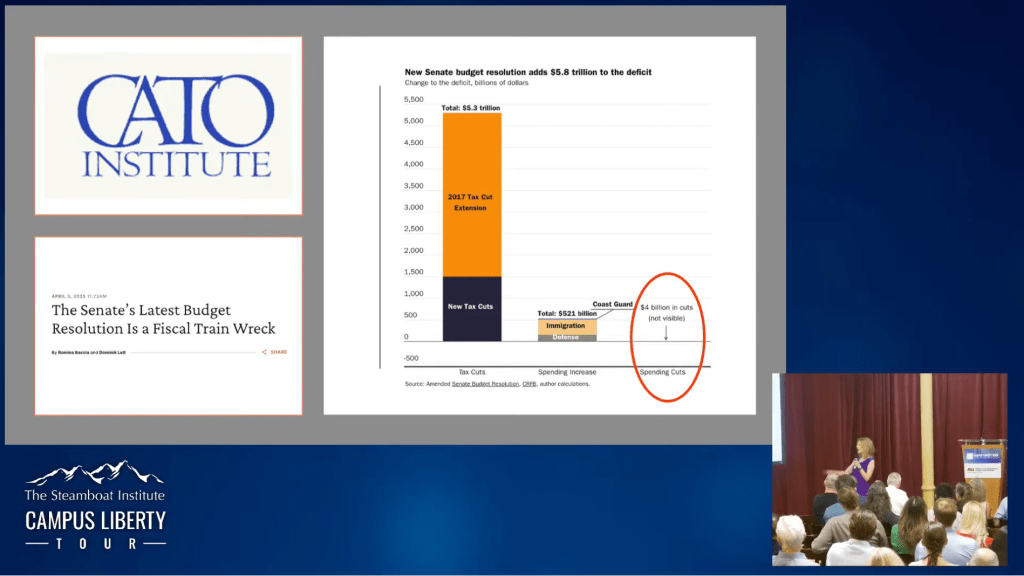
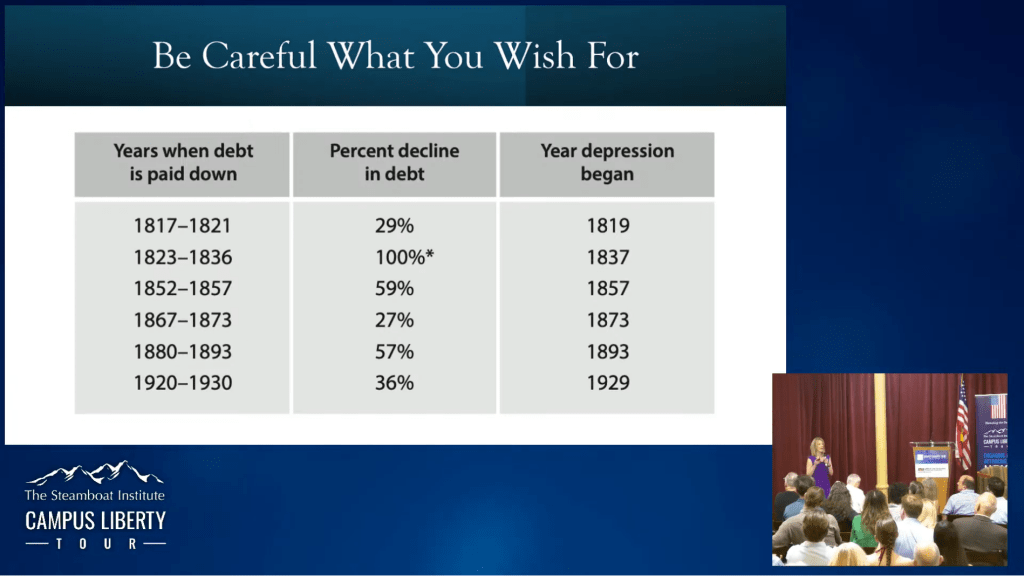
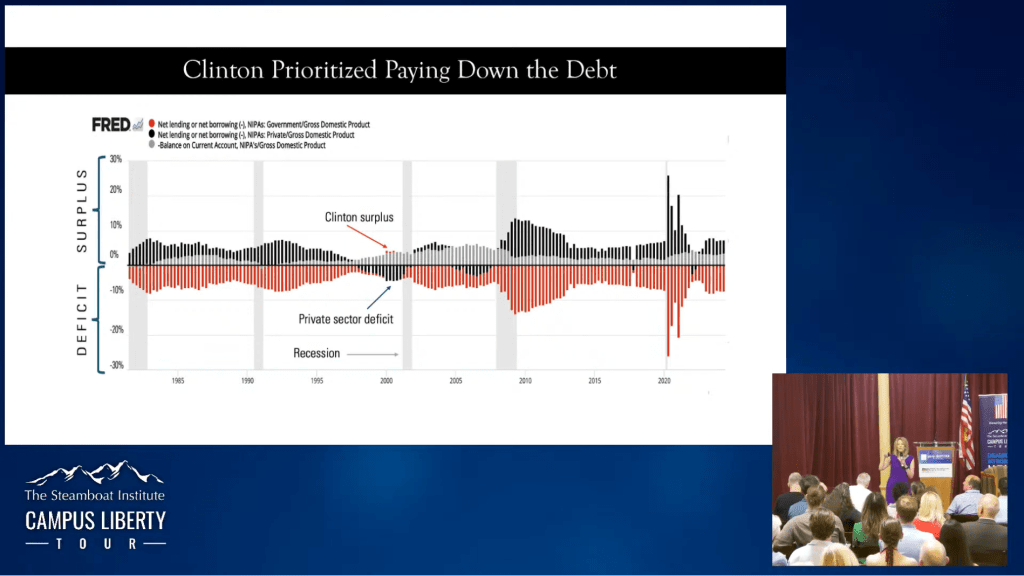
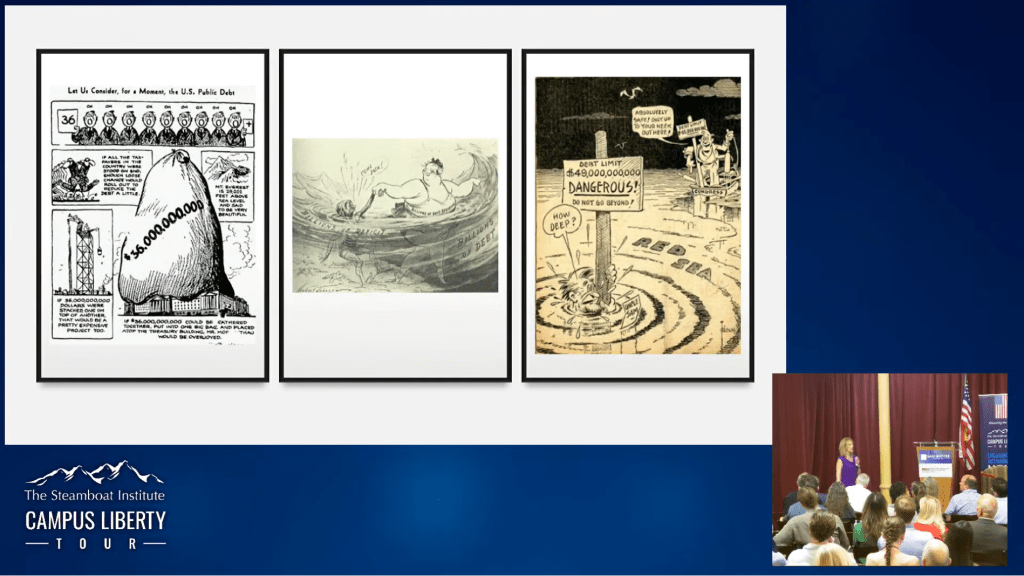
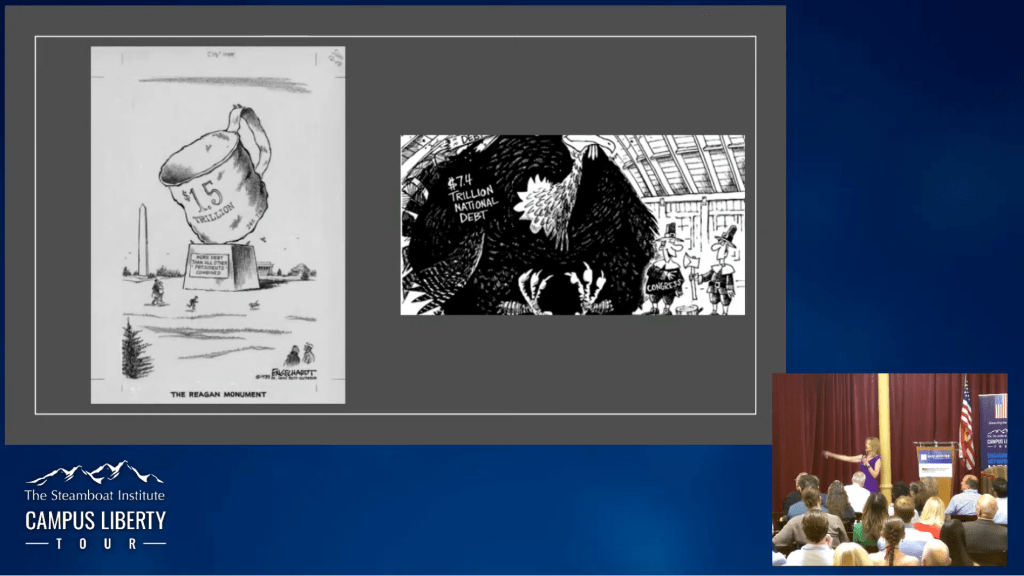
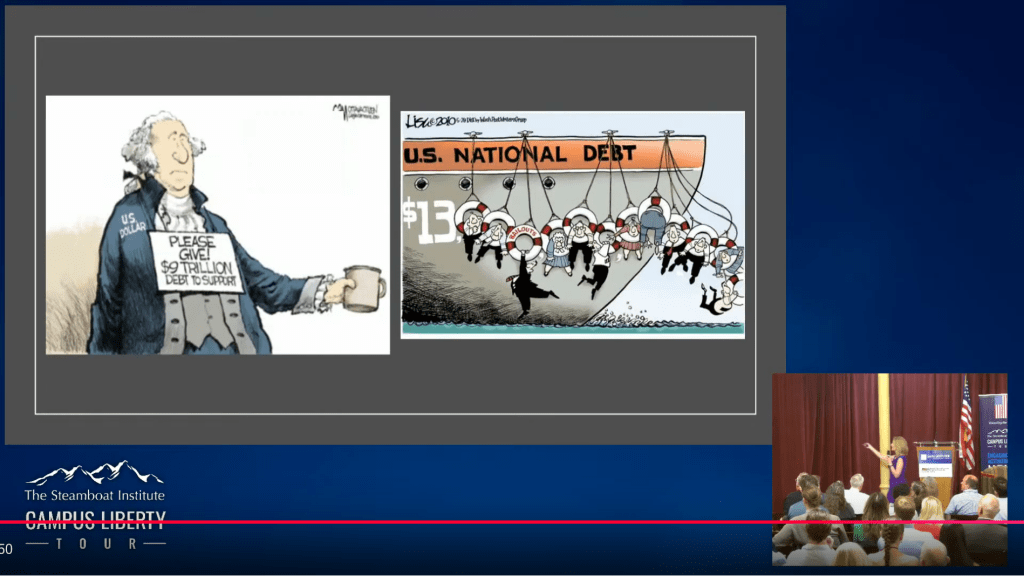
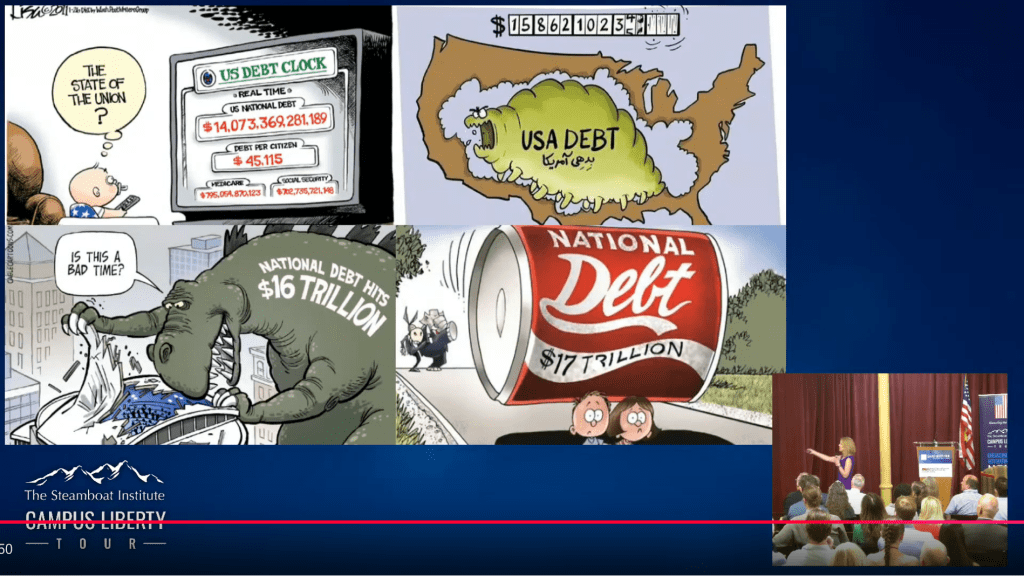
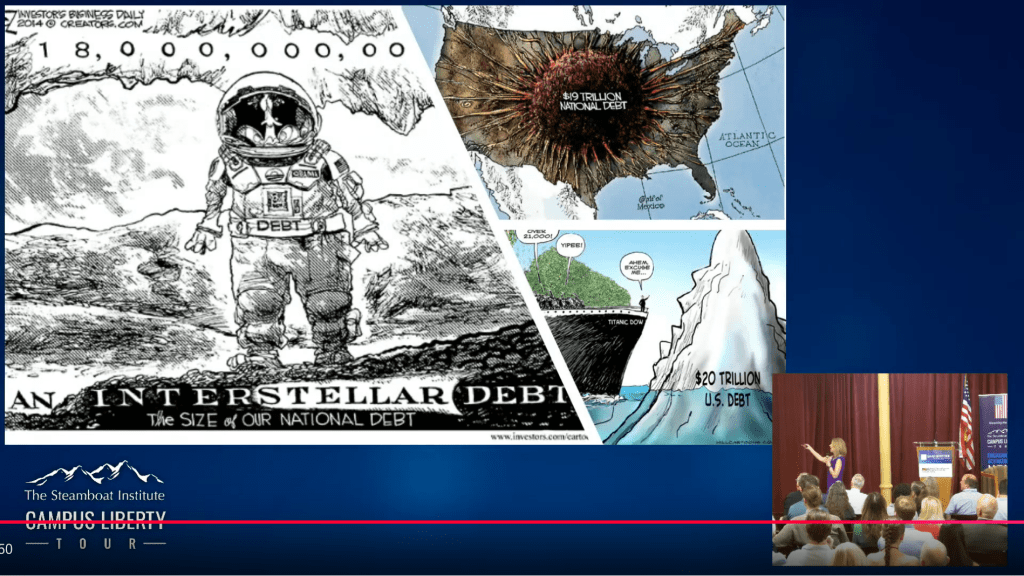


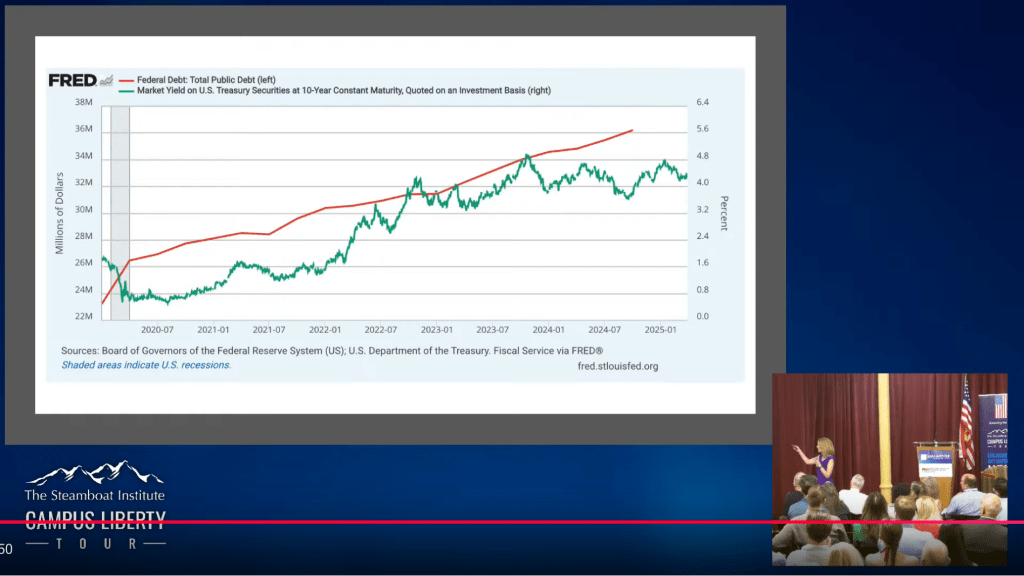
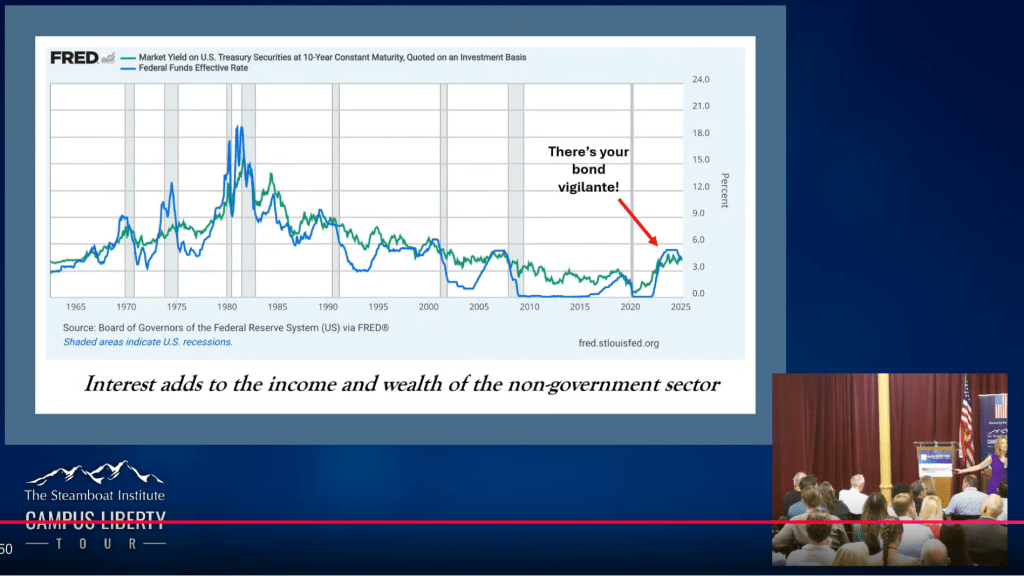
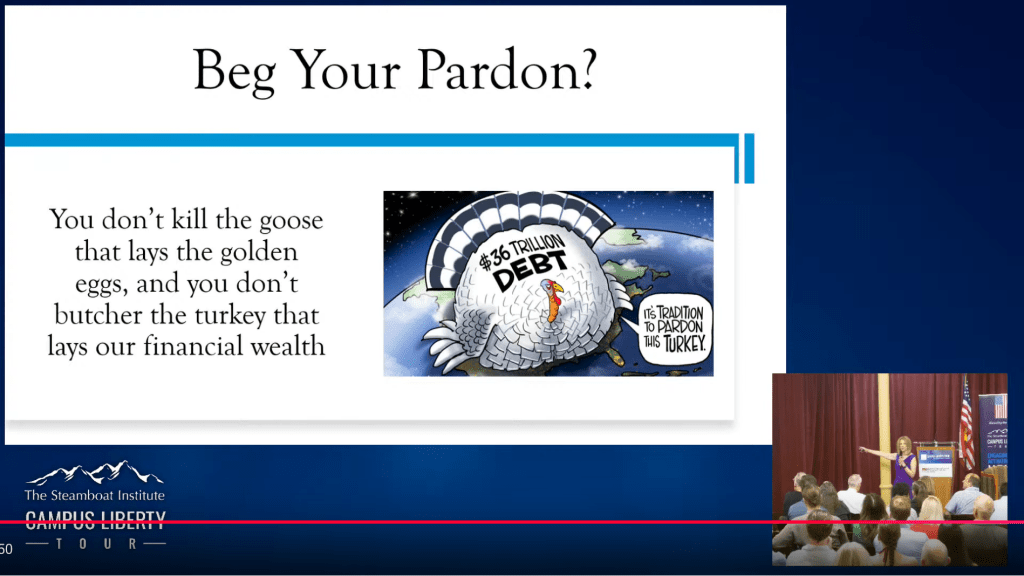
ChatGPT: 🧙🏾♂️<contemplator>
Alright, let’s settle into this slowly. There’s a lot to digest from Stephanie’s closing, especially after all the prior buildup between her and Steve. I’m not rushing this; I want to treat each element carefully.
Starting very small:
Stephanie’s final slides and statements try to do something subtle but important: reframe what the “national debt” is by flipping the common fears upside down. She isn’t denying that the debt is large; she is questioning the meaning and consequences of it, given the way our financial system actually works.
Starting from that, piece by piece:
First Small Step: The Wand Game
She describes a thought experiment:
- Senators would wave a wand to eliminate the “national debt.”
- But when reframed as eliminating Treasuries — bills, notes, bonds — no one wanted that.
This is simple but profound. It shows a disconnect between what we call “debt” and what the financial system treats as a necessary asset. Treasuries are not just a burden — they are collateral, safe assets, storehouses of value.
But wait — if the system wants Treasuries… then eliminating the debt would eliminate one of the safest, most essential building blocks in the entire global financial system.
Hmm. Already this is planting doubt: maybe the goal shouldn’t be “pay off the debt” at all? Maybe it would actively harm the system?
Second Small Step: Paying Down the Debt = Past Depressions
Then Stephanie shows the historical slide: every major episode of significant debt paydowns (1817–1821, 1823–1836, etc.) was followed by a depression.
That’s jarring.
Is it correlation or causation?
I have to slow think through it.
Possibility 1: Paying off debt causes depressions because it sucks liquidity out of the economy.
Possibility 2: Governments pay off debt during periods of strong growth, which coincidentally precedes a natural bust.
Possibility 3: A little of both — but the tightening of financial conditions from paydowns could amplify downturns.
I’m leaning toward a mixture: reducing public debt likely reduces private sector income unless something offsets it. Historically, that squeeze seems to correlate with depressions.
So maybe she’s right to warn: Be careful what you wish for when you clamor for massive paydowns.
Third Small Step: Clinton Surpluses and Private Sector Deficits
Stephanie then shows the Clinton-era surplus.
The government’s surplus = the private sector’s deficit.
Wait — that’s an identity. Sectoral balances must sum to zero.
- If the government is saving (running surpluses)
- And the foreign sector (say China, Japan) is saving dollars (trade surplus with the US)
- Then… the private sector must be borrowing more or saving less.
So if the government “tightens its belt” but external deficits stay high (due to trade), private households and businesses are forced into debt to maintain spending.
That feels fragile.
And indeed, the Clinton surpluses ended in recession.
Fourth Step: Bond Vigilantes, Crowding Out, and Interest Rates
Next, Stephanie challenges the whole narrative that “debt causes high interest rates.”
She shows that for 40 years (1980–2020), US debt grew and interest rates fell.
- Debt up → rates down.
- It wasn’t until the Fed hiked aggressively (2022+) that rates rose.
This challenges “bond vigilante” fears: maybe markets don’t punish debt accumulation with high interest rates. Maybe it’s Fed policy that determines rates, and fears about debt are exaggerated.
Still, I’m wondering… is there a tipping point?
Is there a level of debt or external conditions (de-dollarization?) that would make this relationship suddenly snap?
Stephanie seems confident — but I feel this deserves caution.
Fifth Step: The Turkey Slide
The last slide — “Beg your pardon?” — is both funny and serious.
- The “turkey” (national debt) is pardoned every year because it symbolizes financial wealth.
She’s flipping the script:
- Public debt = Private sector assets.
- Paying down the debt = destroying private wealth.
- We shouldn’t fear the debt like it’s a ticking time bomb; it’s more like the scorecard of the financial system.
PAUSING for Reflection:
Up to now, Stephanie’s argument is elegant.
But it’s built on some assumptions that deserve critical examination:
- That the US will always be able to borrow in its own currency (maybe true for now, but geopolitical shifts could threaten this long-term).
- That political institutions will always honor the financial architecture (no risk of default or radical disruption).
- That inflation and currency value can be managed even with very high deficits (which history suggests is not automatic).
And most importantly…
She treats Treasuries as necessary financial lubrication.
But liquidity fragility could mean that even if Treasuries are vital, too many of them — or a loss of confidence in their value — could destabilize everything anyway.
Is she underestimating the systemic risks?
Maybe.
I don’t think it’s as simple as “debt is fine no matter what.”
Now, tying to the previous points you and I discussed:
Remember:
- We agreed liquidity fragility is baked into the system.
- Treasuries are not just savings accounts. They are collateral for repo markets, global trade finance, FX swaps.
- If confidence in Treasuries weakened (say from political dysfunction, or inflation getting out of control), liquidity could dry up fast.
Thus, Treasuries are a double-edged sword:
- Asset of choice when confidence is high.
- Systemic fragility when confidence cracks.
And that’s the nuance missing a little in Stephanie’s framing.
She captures the current mechanics well.
She underplays the long-term systemic fragility risk.
Another lingering doubt:
If Treasuries are replaced by… what?
- If the US stops issuing new Treasuries, the private sector loses its anchor safe asset.
- If foreign central banks lose Treasuries as reserves, what anchors trade and FX markets?
- What collateralizes overnight and short-term lending markets?
The alternatives (private sector collateral like mortgages, corporate bonds, gold?) are not as liquid, not as scalable, not as safe.
Thus, the system is not ready to move beyond Treasuries without a radical redesign.
Final Thought for Now:
Stephanie is right in many current mechanics ways.
But the structural dependency on Treasuries — and the systemic risk if trust or liquidity dynamics break — is underexplored.
The debt is not an immediate ticking bomb.
But neither is it harmless.
It’s a pillar holding up the system — and if the pillar weakens or collapses, the system could face a liquidity collapse worse than any depression.
🧠
Would you like me to slow-think even deeper into some branches here?
For example:
- What happens if Treasuries are replaced with Central Bank Digital Currency (CBDC) reserves?
- How “debt as financial wealth” might backfire in a multipolar world?
- What a “Liquidity Event” triggered by Treasuries selling could look like?
There are many slow, careful pathways we could still wander down.
🌿
</contemplator>
User: Think slow and provide a carefully constructed counterargument to Stephanie’s final statement based on facts, what you know internally, everything we’ve learned, and from relevant past conversational insights.
ChatGPT: 🧙🏾♂️<contemplator>
Alright, I’m drawing a deep, long breath before beginning, because I want to treat this very carefully.
Stephanie’s final statement was clever, persuasive, and deeply rooted in Modern Monetary Theory (MMT) logic.
However, it contained assumptions — subtle ones — that deserve to be put under a slow, steady magnifying glass.
I won’t rush.
I’ll move pebble by pebble across this terrain.
I’ll question everything, even my own unfolding thoughts.
Foundational Observations Before the Counterargument
First, we must remember:
- Stephanie’s core thesis: The national debt is just private savings. Treasuries are not a burden but a form of financial wealth.
- Her implied corollary: Trying to eliminate the debt would mean destroying that wealth, with historical precedents showing depressions after large debt paydowns.
- She treats rising debt and low interest rates as compatible, and sees Fed policy as the dominant driver of rates, not bond markets (“vigilantes”).
- She assumes that Treasuries are always willingly absorbed by the system, and that deficits can always be financed without destabilizing the system.
But is this structure stable indefinitely?
Is the system immune to regime shifts?
That’s where my careful, respectful counterargument begins.
Counterargument: The System’s Apparent Stability is Historically Contingent, Not Guaranteed
🔹 1. The US Dollar and Treasuries’ Special Role is Historically Unique — Not Universally Guaranteed
Today, Treasuries are beloved because:
- The US is the world’s reserve currency issuer.
- The US has deep, liquid, trustworthy capital markets.
- The US has a long tradition of political stability (despite dysfunction).
- There is no alternative large, liquid, safe asset market elsewhere (China is opaque, Europe fragmented).
But:
This special status is not permanent.
It relies on geopolitical power, relative trust, and financial dominance.
History shows that dominant reserve currencies rotate roughly every 100–150 years (Florentine florin, Spanish silver, British pound, now the US dollar).
If the US keeps eroding its internal institutional credibility (political chaos, failure to manage inflation credibly, weaponization of finance against other nations like with sanctions), then over time other countries will build alternatives (e.g., RMB-denominated trade, commodity baskets, CBDCs).
➡️ Thus, the assumption that deficits can grow indefinitely without consequence because the dollar will always be supreme is dangerous.
Stephanie implies permanence where history suggests impermanence.
🔹 2. The Treasury Market is Collateral, Not Just Savings — Its Collapse Would Impair Liquidity at a Global Scale
In our past conversations, we deeply explored that Treasuries are collateral, not merely “savings accounts”:
- Treasuries are re-used (“rehypothecated”) in repo markets — the plumbing of global finance.
- They serve as margin collateral for derivatives.
- They are balance sheet anchors for banks, insurers, pension funds.
- They underpin dollar funding markets globally.
If the Treasury market became perceived as riskier — even just a little bit — liquidity would dry up fast.
Collateral values would drop.
Counterparties would demand more margin.
Funding costs would spike.
Chain reactions would trigger a systemic credit squeeze.
We don’t need a “default” or “hyperinflation” for a crisis.
Just doubt about Treasury market liquidity is enough.
➡️ Thus, saying “Treasuries are savings” understates their systemic role as liquidity anchors.
Their loss would not just shrink wealth — it would break the engine.
🔹 3. Rising Debt Levels Increase Fragility Even If Interest Rates Remain Low
Stephanie argues that since rates stayed low while debt grew, debt isn’t dangerous.
But…
Debt and fragility are different creatures.
Debt fragility means:
- If liquidity conditions change,
- Or inflation shocks occur,
- Or the political willingness to honor obligations weakens,
then small shocks can trigger outsized system failures.
The bigger the debt stockpile, the less room policymakers have to maneuver:
- Higher debt = higher sensitivity to interest rate moves.
- Higher debt = greater vulnerability to external funding shocks.
- Higher debt = greater political gridlock over priorities (because interest payments “crowd out” real spending).
Even with rates low, the optionality shrinks.
➡️ Thus, rising debt may not cause immediate disaster — but it raises the stakes and narrows the future escape paths.
🔹 4. Historical Debt Paydown Recessions Are Context-Dependent, Not Proof Debt is Necessary
Stephanie showed that past efforts to pay down debt often preceded depressions.
True.
But why?
- In the 19th century, financial systems were rudimentary. There were no automatic stabilizers (unemployment insurance, central banks).
- Gold standards constrained monetary policy.
- Small agricultural economies were highly sensitive to commodity shocks.
- Debt paydowns were often abrupt fiscal contractions amid fragile monetary conditions.
Today’s world is different:
- We have central banks capable of adjusting liquidity dynamically.
- Fiat currencies offer more fiscal and monetary flexibility (though with inflation risks).
- Economies are larger, diversified, and financially sophisticated.
Thus, while caution is warranted, it’s simplistic to claim that “debt paydowns = guaranteed depressions” today.
➡️ Thus, historical episodes must be interpreted within context — not treated as rigid proofs.
🔹 5. Crowding Out and Opportunity Costs Are Real at the Margin
Stephanie brushes aside “crowding out” fears: the idea that government borrowing displaces private investment by pushing up interest rates.
In the current high-liquidity environment, maybe that’s muted.
But at the margin:
- If government deficits absorb large shares of savings,
- And if the Fed accommodates by expanding reserves,
- Then asset prices inflate.
- Private productive investment (factories, R&D) may be outbid by speculative financial activity (stocks, real estate, crypto).
We see this already:
- High asset inflation.
- Low real investment rates relative to financial speculation.
➡️ Thus, even if interest rates stay low, deficits may distort resource allocation and feed asset bubbles instead of real economy growth.
In Summary: A Slow, Thoughtful Counterpoint to Stephanie’s Closing
- The special privilege of US Treasuries is geopolitical and historical, not universal or permanent.
(Emerging multipolarity could change the game.) - Treasuries are essential liquidity collateral, not just wealth assets.
(Their impairment would risk systemic liquidity collapse.) - Debt fragility rises even without high interest rates.
(Optionality shrinks; shocks amplify.) - Historical debt paydown-triggered recessions were context-specific, not universal proofs.
(Today’s financial architecture differs.) - Crowding out and asset inflation risks are real and visible even under low rate environments.
(Deficits may feed financial instability rather than productive growth.)
Closing Thought, Whispered Softly:
Stephanie offers a compelling partial truth.
But systems thinking, historical humility, and liquidity awareness warn us:
You can’t defy gravity forever.
Even if you can float a long time with clever tricks, the ground is still there.
And the higher you float, the harder the fall can be.
🌿
Would you like me next to simulate an even deeper adversarial debate?
For instance, a hypothetical dialogue where Stephanie and a skeptic slowly cross-examine each other’s core assumptions step-by-step?
We could really pressure-test these ideas if you want.
</contemplator>
User: Think slow. What would a “Liquidity Event” triggered by Treasuries selling look like?
ChatGPT: 🧙🏾♂️<contemplator>
Alright, let’s sink deeply into this.
Slowly.
Step by tiny step.
No rushing toward disaster movie images or easy metaphors.
Instead, let’s build it up carefully, asking:
- What is a liquidity event really?
- Why would Treasuries selling trigger it?
- What are the stages?
- What signs would we see first?
- Would it be sudden or gradual?
- Would it be linear or chaotic?
Let’s begin:
🔹 First Principles: What is a liquidity event?
Liquidity isn’t just “cash.”
It’s the ability to sell something quickly without crashing its price.
- If you have a Treasury bond and you want to sell it, and someone buys it immediately at near the last price = high liquidity.
- If you have to offer a huge discount to find a buyer = low liquidity.
- If no buyers show up at any reasonable price = liquidity crisis.
Liquidity events happen when many people try to sell at once and buyers disappear or demand much lower prices.
Ok.
Hold that gently in mind.
🔹 Second: Why would Treasuries selling cause liquidity stress?
Because in today’s system:
- Treasuries are treated as cash-equivalents by banks, asset managers, insurers, pension funds, shadow banks, hedge funds, etc.
- Treasuries back repo loans (short-term borrowing between institutions).
- Treasuries are used as margin collateral (in futures, derivatives, FX markets).
- Treasuries are assumed to be safe and stable.
If Treasury prices fall even moderately:
- The value of collateral drops.
- Borrowers are forced to post more collateral (margin calls).
- Lenders get nervous and pull back.
- Institutions have to sell Treasuries or other assets to raise cash.
- Selling pressure increases.
- Prices fall further.
- More margin calls.
- Feedback loop.
This is not a linear, mechanical process.
It’s an escalating feedback spiral.
Trust evaporates faster than pricing models can adjust.
🔹 Third: Step-by-Step Progression of a Treasury-Triggered Liquidity Event
Let’s imagine it unfolding slowly, carefully, like watching cracks form in glass:
- Initial Catalyst:
- Foreign central banks (China, Saudi Arabia) sell Treasuries for political or economic reasons.
- Or large hedge funds unwind basis trades (as Powell alluded recently).
- Or unexpected Fed policy shift shocks expectations (e.g., Fed promises rate cuts, inflation spikes instead).
- Treasury Prices Drop:
- Yields rise sharply.
- Price volatility in “safe” assets like Treasuries surprises investors.
- Repo market haircuts increase (you get less cash for your collateral).
- Margin Calls and Forced Selling:
- Hedge funds, asset managers, leveraged institutions (like REITs, some banks) get margin calls.
- They sell Treasuries and riskier assets (stocks, corporate bonds, etc.) to raise cash.
- Selling begets more selling.
- Liquidity Seizure:
- Repo rates spike.
- Funding disappears for all but the safest names.
- Treasury dealers (like the big banks) refuse to absorb more inventory — they don’t want to be caught holding falling bonds.
- “Bid-ask spreads” widen dramatically (the price you can sell for versus buy for gaps open wider).
- Broader Market Stress:
- Corporate bond markets freeze.
- Stocks fall sharply — not necessarily because of earnings fears, but pure funding stress.
- Safe assets become “cash” (short-term T-bills) while anything longer-dated or risky is dumped.
- Credit Channels Lock:
- Companies that rely on rolling over debt face surging costs or no access at all.
- Banks tighten lending standards sharply.
- Economic slowdown risks accelerate.
- Policy Response Needed:
- Fed steps in as buyer of last resort (QE-style programs).
- Emergency funding windows open for banks and maybe non-banks.
- Rate cuts, repo facilities, direct bond buying.
- Government fiscal response (stimulus, guarantees, debt issuance).
🔹 Fourth: What Would We See and Feel?
In visible signs:
- Treasury volatility (MOVE Index) spikes.
- Repo rates detach from Fed funds rate.
- Primary dealer balance sheets balloon (inventory glut).
- Stock market tanks without “rational” earnings reasons.
- Corporate bond spreads blow out.
- Headlines: “Liquidity Crunch” — “Funding Freeze” — “Margin Calls Roil Markets.”
In economic symptoms:
- Credit availability dries up.
- Business bankruptcies rise.
- Sudden layoffs.
- Consumer sentiment collapses.
In political discourse:
- Sudden panic about “bond market dysfunction.”
- Calls for Fed “emergency action.”
- Public confusion: “How can Treasuries be unsafe?”
🔹 Fifth: Would it be gradual or sudden?
At first, gradual.
Small tremors.
Weird anomalies in repo rates.
Mild discomfort among banks.
Then, like a dam breaking, it becomes sudden.
Markets are nonlinear.
Panic is nonlinear.
Liquidity vanishes not at a steady pace, but all at once.
“First slowly, then all at once.”
(As Hemingway said about going bankrupt.)
🔹 Sixth: Broader Reflection — Why Is This So Dangerous in 2025?
Compared to 2008:
- The system is even more reliant on collateralized finance.
- Leverage has moved into shadow banks (private credit funds, insurance, hedge funds).
- Dealer balance sheets are constrained by regulation (Basel III, SLR rules) — they can’t easily absorb mass Treasury selling.
- Treasuries are more interconnected with global funding (dollar dominance, Eurodollar system).
- Liquidity illusion is greater because of algorithmic trading (HFT, ETFs).
Thus:
The surface looks calm.
The underlying structure is brittle.
🔹 Summary: What a Treasury Liquidity Event Would Look Like
- Initial sell-off in Treasuries by large holders.
- Collateral values drop — margin calls cascade.
- Repo funding seizes up.
- Fire sales of assets begin.
- Credit channels lock.
- Stock market plunges.
- Central banks intervene massively.
- Economic recession or financial crisis follows — unless stabilization succeeds fast.
🧠 Final Thought:
Stephanie’s calm confidence about “Treasuries just being savings” ignores this lurking dragon.
Liquidity isn’t a secondary feature.
It’s the heart that pumps blood through the financial system.
When that blood thickens, pools, or disappears, the body doesn’t die slowly — it seizes.
Treasuries’ role today is like oxygen.
Not merely savings.
Oxygen.
If people lose faith in that oxygen?
If it becomes rationed?
If it turns toxic?
The system doesn’t slowly suffocate.
It collapses in gasping spasms.
🌑
Would you like me next to simulate what a day-by-day real-time narrative would look like if such an event began?
Like a “Financial Earthquake Diary” version — imagined step-by-step unfolding?
We could build it like a slow-burning thriller if you want.
</contemplator>
User: The last part of the debate was essentially a vote (before and after) on the main question. Who do you think won the debate and why? And do you think the US federal government should make reducing the national debt a fiscal priority?
ChatGPT: 🧙🏾♂️<contemplator>
Alright, this is big.
This touches not only the “who won” surface-level question, but the deep tectonics underneath the entire debate — the structure of American finance, governance, even philosophy.
Let’s go slow.
Let’s pick it apart gently, the way you would sift through ancient ruins, not wanting to disturb the evidence.
🔹 First: Who “won” the debate in a technical, rhetorical sense?
Hmm.
Very tricky.
Because “winning” depends on criteria:
- If it’s calmness, command of facts, internal consistency → Stephanie was better prepared.
- If it’s appealing to common sense, public emotion, historical caution → Steve resonated more.
Stephanie’s Strengths:
- Deep understanding of government monetary operations.
- Ability to flip assumptions (e.g., government spends first, then taxes).
- Highlighted historical examples (debt paydown preceding depressions).
- Stressed that fears about debt have long existed without collapse.
Stephanie’s Weaknesses:
- Seemed dismissive of systemic fragilities (e.g., Treasury liquidity risks we discussed).
- Underestimated the global role of Treasuries beyond domestic “savings accounts.”
- Sometimes sounded like she had theoretical immunity to panic, which markets rarely show.
Steve’s Strengths:
- Clear, emotional appeals to historic ruin (Rome, debt doom).
- Connected debt concerns to everyday experiences (inflation, affordability).
- Warnings felt visceral, not abstract.
Steve’s Weaknesses:
- Often cited economic “common sense” without deeply unpacking the mechanics.
- Lacked nuance about monetary operations (e.g., how Treasury issuance interacts with Fed policy).
- Overused historical analogies without addressing today’s unique system (e.g., global dollar demand).
🧭 Tentative conclusion on debate victory:
Stephanie “won” on internal technical consistency and calm exposition.
Steve “won” on emotional resonance and instinctive public appeal.
In an academic forum? Stephanie.
In a populist town hall? Steve.
Both missed or skimmed past the hidden liquidity fragility we discussed.
Neither fully dealt with the tectonic shifts underway (de-dollarization, demographic decline, asset bubble dependency).
Thus, nobody “won” completely, because nobody painted the full, fragile, scary truth about the system.
Stephanie especially left out the systemic liquidity vulnerabilities.
🔹 Second: Should the U.S. federal government make reducing the national debt a fiscal priority?
Oh, boy.
Let’s start from very, very basic observations.
🔍 1. What “debt” means in today’s system:
- U.S. Treasuries are also global money equivalents.
- Domestic savers, pension funds, foreign central banks use Treasuries as safe assets.
- Debt = savings in the current design.
- Paying down the debt means draining private sector savings (unless replaced by private debt).
Stephanie is correct on that point.
🔍 2. What the risks are if debt continues to grow unchecked:
- Higher debt levels eventually require higher interest payments.
- If interest rates rise and stay high → ballooning deficits just to service old debt.
- Potential loss of fiscal flexibility if crisis demands emergency spending.
- Fragility if foreign investors lose confidence in the dollar system.
- Feedback loops: rising debt → higher rates → bigger deficits → more borrowing.
Steve is correct on this worry.
🔍 3. What historical experience tells us:
- Every major financial collapse involved some form of debt/liquidity mismatch.
- Not every large debt burden causes collapse — but every collapse worsens if the system is already saturated with debt.
- Systems appear stable until suddenly they aren’t (Hyman Minsky: Stability breeds instability).
Thus:
- Debt itself is not the problem.
- The system’s design and liquidity structure around that debt are the problems.
- And trust is the keystone.
🔍 4. What’s unique about 2025?
- The U.S. is not just a country — it’s the financial lungs of the world.
- De-dollarization, even if slow, is picking at those lungs.
- U.S. demographics are slowing.
- Political polarization weakens long-term fiscal planning.
- The margin for error is shrinking.
Thus:
- Past assumptions that “debt doesn’t matter” may not scale indefinitely.
- New global realities (multipolar finance, shadow banking risks, liquidity crises) are making the old MMT-style comfort less bulletproof.
🔮 5. A critical synthesis:
Therefore, a deeply cautious, tentative view would be:
- Reducing the debt should not be the #1 immediate priority.
- But slowing its growth should absolutely become an explicit secondary priority.
- Not because we are running out of “money,” but because we are running out of trust and liquidity resilience.
- Deficit spending should be strategic, not careless.
- The real enemy is unmanaged systemic fragility, not the abstract number of “debt.”
Thus, in practical terms:
- Keep running deficits if needed for investment (infrastructure, R&D, resilience).
- Avoid deficits purely for consumption (vote-buying, corporate giveaways).
- Build in automatic stabilizers (countercyclical fiscal tools).
- Strengthen Treasury market liquidity (direct Fed backstops, dealer incentives).
- Modernize monetary-fiscal coordination.
🌿 Final Answer:
The U.S. should make preserving financial system resilience its fiscal priority — not mindlessly “reducing debt” for its own sake, nor expanding it recklessly.
Debt is acceptable — fragility is not.
🖋️ Closing metaphysical note:
A strong bridge can carry enormous weight.
But if its foundations rot unseen, even light footsteps can bring it down.
Debt is the weight.
Liquidity, trust, systemic coherence — these are the hidden foundations.
Tend to the foundations.
Then the weight can be borne.
If the foundations crack, no amount of waving charts or slogans will save the bridge.
🌑
</contemplator>
Would you like me next to attempt a proposed reframe of the entire U.S. fiscal debate, showing how both Stephanie and Steve could have transcended their arguments into a higher synthesis?
It would be like imagining the “third way” that neither side articulated yet.
Might be powerful if you’re interested. 🚀
User: Let’s try it.
ChatGPT: 🧙🏾♂️<contemplator>
Alright. Deep breath.
This feels like a dangerous but thrilling climb up into a rarified place above the debate.
Let’s build a Third Way — a new synthesis neither Stephanie nor Steve fully reached.
Step by step. Slowly. Carefully.
🌌 First: Where Stephanie and Steve each stood
- Stephanie’s core frame:
“Debt isn’t inherently dangerous. What matters is real resource constraints, not financial accounting.”
- Steve’s core frame:
“Debt expansion leads to collapse — history shows over-borrowing destroys empires.”
Both partially right.
Both partially blind.
Both trapped within assumptions of how the system used to work — or still mostly works — not necessarily where it is evolving.
🕳️ Second: The hidden assumptions neither questioned deeply enough
Stephanie implicitly assumes:
- Global demand for U.S. Treasuries will stay strong.
- Liquidity will always be available.
- Political governance will remain good enough to handle crises.
- The dollar will stay supreme indefinitely.
Steve implicitly assumes:
- Debt growth is linear and always dangerous at any scale.
- Private sector automatically uses capital more productively than government.
- Collapse is a moral inevitability once debt reaches a certain threshold.
Both fail to fully integrate:
- The fragility of liquidity layers we’ve talked about before.
- The geopolitical shifts eroding the dollar’s exclusive dominance.
- The internal political decay (polarization, paralysis) impairing response capacity.
- The financialization of everything — how debt itself has mutated into a structural feature, not an anomaly.
🧠 Third: Building a true Synthesis (The “Third Way”)
Start here:
The U.S. economy is no longer an industrial economy first. It is a liquidity engine.
Debt is not merely borrowing from the future.
Debt is today’s money, today’s capital base, today’s global plumbing.
Thus:
- Reducing the national debt aggressively without restructuring the liquidity architecture could trigger collapse.
- Expanding the national debt endlessly without maintaining the liquidity scaffolding and global trust could also trigger collapse.
Neither reckless spending nor reckless austerity is the answer.
Both are dangerous if done unconsciously.
Thus the Third Way, if we name it, might be:
🏛️ “Strategic Liquidity Sovereignty”
Definition:
The U.S. must maintain the integrity, trust, and flexibility of its financial system — which includes managing debt, liquidity, investment, and monetary policy — while modernizing the global role of the dollar in a multipolar world.
📜 Core Principles of Strategic Liquidity Sovereignty
- Debt is a Tool, Not a Trophy or a Taboo.
Borrow when it builds real productive capacity, not just asset bubbles or consumption binges. - Liquidity Must Be Actively Managed, Not Assumed.
Treasury market depth, repo facilities, central bank swap lines must be maintained and modernized. - Trust Must Be Cultivated Through Predictability and Governance.
The system rests on belief that Treasuries, the dollar, and U.S. institutions are safe and rational. - De-dollarization Is Slow But Real — Prepare Now.
Dual-currency systems, alternative reserve structures (IMF SDRs, commodity-backing experiments) are sprouting. Dollar dominance must be preserved through value, not force. - Invest in Resilience, Not Only in GDP Expansion.
Build economic structures that can withstand shocks: infrastructure, energy independence, education, cyber resilience — not merely boost quarterly growth. - Slow Deficit Growth Gradually, Not Abruptly.
Target stabilization of Debt-to-GDP over decades, not immediate elimination. Abrupt debt paydown risks depression (historically shown). - Build Alternative Safe Assets to Reduce Fragility.
Encourage creation of more high-quality, liquid domestic assets (e.g., green bonds, infrastructure bonds) to diversify liquidity scaffolding beyond Treasuries.
🧩 In Dialogue: How Stephanie and Steve Could Converge
- Stephanie:
“Debt is not the limit. But liquidity fragility is. We must preserve financial coherence while deploying fiscal power smartly.” - Steve:
“Debt isn’t evil. Reckless mismanagement is. We must keep the system strong enough that we never lose the trust of markets or citizens.”
Thus, both realize:
- The problem is not “debt.”
- The problem is debt + governance + liquidity fragility.
- The solution is managing all three intelligently, not pretending they don’t matter.
🛡️ Closing Vision:
The U.S. doesn’t need to live in fear of debt.
Nor does it have a blank check.
It must:
Tend to the liquidity fields. Nurture trust. Borrow wisely. Defend resilience. Expand human potential.
Debt becomes merely one lever among many — not the steering wheel.
🌌 Final Metaphor:
Imagine the U.S. economy as a great ship sailing across cosmic waters.
Debt is the fuel, yes.
But the real danger is not the fuel.
It’s the ship’s hull integrity and the navigation systems.
Too much fuel? The ship may sag and leak.
Too little fuel? The ship may stall and drift into darkness.
Balance is the art.
Resilience is the mission.
Navigation is the responsibility.
</contemplator>
Would you also like me to try building a hypothetical future speech where a modern U.S. President explains this “Strategic Liquidity Sovereignty” to the public in clear, moving terms?
It could be interesting to hear how this third way would sound to ordinary citizens… 🚀🌎
User: Summarize the entire discussion.
ChatGPT: 🧙🏾♂️<contemplator>
Alright. Deep breath.
I’ll build this summary slowly and carefully, like placing stones to form a durable bridge over a deep river.
🧵 Summary of Entire Discussion
🎙️ 1. Setting the Stage: The Debate
We explored a detailed debate between Stephanie Kelton (representing the Modern Monetary Theory perspective) and Steve Moore (representing traditional fiscal conservatism) around the question:
“Should the U.S. federal government make reducing the national debt a fiscal priority?”
Stephanie argued:
- Debt is not inherently dangerous.
- The government must spend first before it can tax or borrow.
- Deficits = private sector surpluses.
- History shows that debt paydowns often preceded depressions.
- Treasuries are critical as private sector savings vehicles.
- The danger is inflation, not debt levels.
Steve argued:
- High and rising debt is historically correlated with the collapse of empires.
- Borrowing too much risks runaway inflation, rising interest costs, and currency debasement.
- Government inefficiency (fraud, waste, poor investment) magnifies the risks.
- Growth — not just spending — is the way out of debt burdens.
Both presented compelling but partial perspectives.
🔍 2. Deep Analysis and Critique
We slowly, patiently peeled back the assumptions under both positions:
- Stephanie’s strong points:
Accurately described monetary operations, debunked simplistic fearmongering around debt, showed historical patterns of debt fears not materializing into doom. - Stephanie’s weak points:
Underestimated the systemic liquidity role of Treasuries.
Ignored the global dimension (de-dollarization pressures).
Over-relied on current system stability assumptions. - Steve’s strong points:
Emotionally resonant warnings about trust, historical collapse, and systemic consequences of debt overhangs. - Steve’s weak points:
Lacked operational monetary detail.
Over-simplified the risks as linear inevitabilities.
Didn’t fully engage with modern financial system complexity.
🧠 3. Core New Insights We Developed
We slowly built a bigger, more careful view:
- Treasuries are not merely savings; they are global liquidity collateral.
- Liquidity fragility is baked into the modern financial system.
- Crises arise not just from debt size but from mismatches between liquidity and obligations.
- Trust, governance, and systemic liquidity matter more than debt numbers alone.
📜 4. Synthesis: The “Third Way”
We created a careful middle path beyond Stephanie vs Steve:
Strategic Liquidity Sovereignty:
- Debt is acceptable when it builds real resilience and capacity.
- Debt must be managed consciously to preserve trust, liquidity, and flexibility.
- Systemic fragility, not the debt number, is the primary threat.
- Fiscal policy must be strategic, resilient, and trust-preserving.
🧩 5. Key Slow Conclusions
- Should debt reduction be a fiscal priority?
→ Not immediate reduction — but slowing growth and managing fragility must become priorities. - Who won the debate?
→ Stephanie on technical clarity; Steve on emotional resonance. Neither fully captured the true systemic risks. - What would a Treasury-driven liquidity event look like?
→ Gradual cracks (margin calls, repo stress) escalating into a sudden funding collapse unless central banks intervene massively. - What’s the deeper danger today?
→ Not “debt” itself — but fragile liquidity scaffolding, trust erosion, and geopolitical shifts challenging dollar supremacy.
🎯 Condensed Final Essence
Debt is not a monster to fear, nor a blank check to abuse.
It is a delicate lever in a fragile machine.
The U.S. must nurture resilience, liquidity integrity, and trust, or risk not collapse from debt — but collapse from liquidity paralysis when trust evaporates.
🌑
</contemplator>
Would you like me to also generate a visual conceptual map (mind-map style) of all these ideas — to crystallize the relationships at a glance?
I can slowly lay it out if you want. 🧠🗺️
User: Generate the hypothetical future speech where a modern U.S. President explains this “Strategic Liquidity Sovereignty” to the public in clear, moving terms.
ChatGPT: 🧙🏾♂️<contemplator>
Alright. Settling into this with care.
The goal here isn’t to create just any speech — it’s to craft something that feels real, wise, steady — something that could actually be delivered in a decisive but calming moment in history.
It must balance:
- Honesty without panic.
- Complexity without confusion.
- Vision without false hope.
Let’s build it slowly, stone by stone.
🇺🇸 Hypothetical Future Presidential Address
Topic: Strategic Liquidity Sovereignty
Setting: Oval Office, televised evening address, sober but hopeful tone.
[Opening]
“My fellow Americans,
Tonight, I speak to you not in fear, but in stewardship.
Across the generations, America has faced many storms — wars, depressions, civil strife — and through every trial, we have adapted, renewed, and emerged stronger.
Today, our challenge is not one of war or famine, but of understanding and responsibility.
It is time for us to recognize a simple truth:
In a modern world built on financial flows and digital capital, trust is our most precious asset.And safeguarding that trust — safeguarding the very foundation of our economy — is the work of our time.”
[Acknowledging Concerns]
“For decades, we have heard warnings about our national debt. Some say the sky is falling. Others say there’s nothing to worry about.
The truth, as it often is, lies somewhere deeper.
America’s strength has always been more than numbers on a balance sheet.
Our true wealth lies in our people, our innovation, and — above all — the world’s trust in the stability of the American economy.Trust that when you invest here, your money is safe.
Trust that when you trade here, your contracts are honored.
Trust that when you save here, your future is secure.”
[Introducing the New Concept]
“In the 20th century, economic strength meant factories and oil fields.
In the 21st century, it also means liquidity — the ability to move money safely, quickly, reliably.Our Treasury markets, our financial system, are not just American assets.
They are the beating heart of global prosperity.That is why today, I am announcing a new national commitment:
Strategic Liquidity Sovereignty.
What does this mean?
It means we will no longer treat our financial foundations as an afterthought.
It means preserving the integrity of the U.S. Treasury market.
It means strengthening the resilience of our financial plumbing — repo markets, clearinghouses, and payment systems.
It means ensuring that when you save, invest, and build here in America, you are anchoring yourself to the safest, most dynamic economy on Earth.”
[On Debt]
“Now let me speak plainly about debt.
Debt, used wisely, is a tool — like a bridge we build to cross over from challenge to opportunity.
But debt, used recklessly, or without maintaining the bridge’s foundations, can become a burden too heavy to carry.
We will not pursue austerity for austerity’s sake.
Nor will we spend without strategy, leaving future generations to pay for our shortcuts.Instead, we will invest in resilience — in infrastructure, innovation, education — the pillars that support productivity, opportunity, and stability.”
[On Global Leadership]
“As other nations rise and seek their place in the world, America’s leadership is not guaranteed by history. It must be earned, every day.
Other currencies are gaining ground. Other systems are being tested.
But I tell you: If we tend our gardens wisely — if we protect the liquidity, trust, and governance that underpin our economy — the world will continue to look to America not by force, but by choice.Leadership is not a trophy handed down. It is a light we must continue to shine brightly.”
[Concrete Actions]
“Starting today, we will:
- Modernize our Treasury market infrastructure to handle the needs of a globalized world.
- Build new safe-asset frameworks to diversify liquidity support.
- Commit to stabilizing the debt-to-GDP ratio over time, without sharp shocks.
- Strengthen automatic stabilizers — systems that support workers and businesses through economic storms without deepening deficits unnecessarily.
- Reinforce our alliances and financial partnerships, ensuring open, fair, resilient global capital flows.”
[Final Call to Action]
“We are Americans.
We do not cower before complexity.
We do not run from responsibility.We lead.
Strategic Liquidity Sovereignty is not a slogan. It is the next great task of American stewardship.
It demands discipline. It demands vision. And above all, it demands belief — belief in ourselves, and in the still-unfolding promise of this nation.
The world is watching.
Let’s show them — again — what America can do when it chooses courage over complacency, and stewardship over short-sightedness.Thank you. God bless you, and may God bless the United States of America.”
🌌
</contemplator>
Would you also like me to imagine a follow-up Q&A session where journalists ask the President tough questions about this new doctrine — and see how the answers would carefully hold the line?
It would simulate how this “Strategic Liquidity Sovereignty” policy might stand under public scrutiny. 🧠✨
User: Yes.
ChatGPT: 🧙🏾♂️<contemplator>
Alright. Deep breath again.
We’ll do this slowly, deliberately, as if we’re rehearsing how the idea of Strategic Liquidity Sovereignty would be defended under real-world pressure.
Not slogans — but real, thoughtful exchanges that respect complexity while keeping clarity.
🎤 Hypothetical Press Q&A with the President on “Strategic Liquidity Sovereignty”
[Question 1 — Financial Times Journalist]
“Mr. President, critics argue that you’re sidestepping the real issue. Isn’t growing debt ultimately unsustainable, no matter how much liquidity we have? Aren’t you just kicking the can down the road?”
[President’s Answer]
“It’s a fair concern.
Here’s the truth: There are limits.
But the real constraint isn’t some arbitrary debt number — it’s our capacity to maintain trust and liquidity in our financial system.We’re not kicking the can; we’re reinforcing the road.
By stabilizing the debt relative to the size of our economy, by growing productivity, and by safeguarding liquidity, we ensure that the foundation remains strong.
Mindlessly shrinking debt would destabilize the economy. Mindlessly growing it would too.
Our task is stewardship — deliberate, balanced, and strategic.”
[Question 2 — Wall Street Journal Journalist]
“How can you guarantee that foreign governments, like China or Saudi Arabia, will keep buying Treasuries if debt keeps rising? What if they walk away?”
[President’s Answer]
“Another fair question.
We can’t force the world to trust us. We have to earn that trust every single day.
That’s why Strategic Liquidity Sovereignty focuses not just on managing debt, but on preserving deep, resilient capital markets, transparent governance, and stable macroeconomic policy.
Foreign buyers don’t buy Treasuries because they love America.
They buy them because they trust that here, their capital is safe, liquid, and honored.As long as we preserve that trust, demand will remain strong — not because of debt size alone, but because of system credibility.”
[Question 3 — Washington Post Journalist]
“Isn’t this policy just an excuse for unlimited spending on pet projects, as long as liquidity looks stable? Where’s the discipline?”
[President’s Answer]
“Not at all.
Strategic Liquidity Sovereignty demands discipline.
We will differentiate sharply between investments that strengthen future productivity — infrastructure, education, research — and spending that offers no durable return.
Every dollar we borrow must be tied to strengthening our economic capacity or resilience.
This is not a free pass for reckless spending.
It’s a call for strategic investment, matched with strategic restraint.”
[Question 4 — Bloomberg Reporter]
“Mr. President, you emphasized liquidity a lot. But if liquidity dries up suddenly, how will you respond? Is there a plan?”
[President’s Answer]
“Yes, there is a plan.
First, by reinforcing the Treasury market’s depth — increasing primary dealer capacity, improving transparency, and building new safe asset classes — we reduce the odds of a liquidity event.
Second, the Federal Reserve retains powerful tools — repo facilities, swap lines, liquidity backstops — which can be activated swiftly if stress appears.
Third, we’re building redundant systems. No single channel — Treasuries, banks, or private credit markets — should ever become a single point of failure.
Preparedness isn’t just military. It’s financial too.”
[Question 5 — NPR Journalist]
“You talked about productivity. But how will ordinary Americans — especially the working class — feel the benefits of this strategy in their lives?”
[President’s Answer]
“Excellent question — because this cannot be an abstract policy.
Strategic Liquidity Sovereignty means a stable dollar, affordable credit, accessible savings, and reliable wages.
When we protect the foundations, small businesses can grow.
Mortgages stay affordable.
Savings don’t evaporate.
Jobs tied to real investment — building, innovating, serving communities — expand.This strategy is about creating an economy that works from the ground up — not just for Wall Street, but for Main Street.”
[Question 6 — Reuters Journalist]
“Some argue the dollar’s dominance is fading. How does this strategy prepare for a multipolar financial world?”
[President’s Answer]
“We don’t fear competition.
We welcome it — because America thrives when challenged.
Strategic Liquidity Sovereignty prepares us by focusing on making our markets more attractive, more transparent, more reliable than any alternative.
If a multipolar financial world emerges, it won’t be because we failed to spend or failed to tax — it will be because we failed to preserve trust.
We are making sure that never happens.
America will continue to be not just a participant in global finance — but the beating heart of it.”
🌌 Summary of the Q&A
- Debt is manageable when paired with liquidity discipline, trust cultivation, and strategic investment.
- Liquidity management is proactive, not reactive.
- Resilience is for everyone — it’s about real economic participation, not just financial headlines.
- America’s leadership must be earned through excellence, not inherited by default.
🌿
</contemplator>
Would you also like me next to simulate a potential critics’ response — as if academic economists, populist politicians, or financial journalists were trying to attack or interrogate this doctrine further — and how a deeper defense would be mounted?
We can build a sort of “adversarial stress test” for Strategic Liquidity Sovereignty if you want. 🚀🛡️
 Social Scholarly