
Scientific exploration with AI will become the norm.
Vibe coding is a new concept that has been added to our lexicon into contemporary culture. VC for short, is a small snippet into how technology like AI/LLM will transform our culture, the internet, social media, and how we interact with other and interact technology itself in profound and scary ways.
But vibe coding isn’t the only thing people are doing with AI to leverage its coding abilities to create something as if out of thin air. I have also experimented into creating papers with AI, albeit not always as perfect or rigorous that it could and should be for academic standards.
Me: What is vibe coding (search mode).
ChatGPT: Vibe coding. A term that’s been floating around recently, especially in tech circles. But what does it really mean? Let’s dig in.
Origin of the Term
The phrase “vibe coding” was coined by Andrej Karpathy, co-founder of OpenAI and former head of AI at Tesla, in February 2025. He described it as a new kind of coding where one “fully gives in to the vibes, embrace exponentials, and forget that the code even exists.” This suggests a shift from traditional coding practices to a more intuitive, AI-assisted approach.Simon Willison’s Weblog+12Wikipédia, a enciclopédia livre+12Wikipedia+12Business Insider+5GeekWire+5X (formerly Twitter)+5
What Is Vibe Coding?
At its core, vibe coding involves using AI tools, particularly large language models (LLMs), to generate code based on natural language prompts. Instead of manually writing each line of code, a developer provides a description of the desired functionality, and the AI produces the corresponding code. This method allows individuals, even those without extensive programming backgrounds, to create functional software applications. Reddit+9GeekWire+9Medium+9PA TIMES Online
Practical Applications
Vibe coding has been embraced in various sectors:
- Startups: Small teams can leverage AI to accelerate development processes, allowing them to achieve in days what might have previously taken weeks. This efficiency enables startups to remain lean while delivering robust products. Business Insider+1PA TIMES Online+1
- Non-Developers: Individuals without formal coding training can bring their ideas to life by describing them to an AI, democratizing software development. PA TIMES Online
- Government: Public administration can utilize vibe coding to automate routine tasks, develop citizen engagement platforms, and streamline processes without the need for large IT departments. PA TIMES Online
Benefits
- Accessibility: Lowers the barrier to entry for software development, allowing more people to participate.
- Efficiency: Speeds up the development process, enabling rapid prototyping and iteration.
- Cost-Effective: Reduces the need for large development teams, which can be particularly beneficial for startups and small businesses.
Challenges and Criticisms
Despite its advantages, vibe coding is not without challenges:Business Insider
- Code Quality: AI-generated code may lack the optimization and efficiency that experienced developers provide.Hacker News+14Wikipedia+14Википедия — свободная энциклопедия+14
- Debugging Difficulties: Understanding and fixing issues in AI-generated code can be challenging, especially if the user lacks programming expertise.
- Security Concerns: Without thorough code reviews, vulnerabilities may go unnoticed, leading to potential security risks.
Industry Perspectives
The tech community holds mixed views on vibe coding:
- Optimistic: Proponents see it as a revolutionary approach that democratizes coding and accelerates innovation.Business Insider
- Skeptical: Critics argue that over-reliance on AI for coding without proper understanding can lead to poor-quality software and maintenance challenges.Reddit+15Википедия — свободная энциклопедия+15Wikipedia+15
Conclusion
Vibe coding represents a significant shift in how we approach software development, blending human creativity with AI capabilities. While it offers numerous benefits, it’s essential to approach it with caution, ensuring that the code produced is reliable, secure, and maintainable. As with any emerging technology, balancing innovation with best practices will be key to its successful adoption.Business Insider </contemplator>
Final answer:
Vibe coding is an AI-assisted programming technique where individuals describe desired functionalities in natural language, and large language models generate the corresponding code. This approach democratizes software development by allowing even those without extensive programming knowledge to create applications. However, it also presents challenges related to code quality, debugging, and security, necessitating a cautious and informed approach to its adoption. PA TIMES Online+1Wikipedia+1
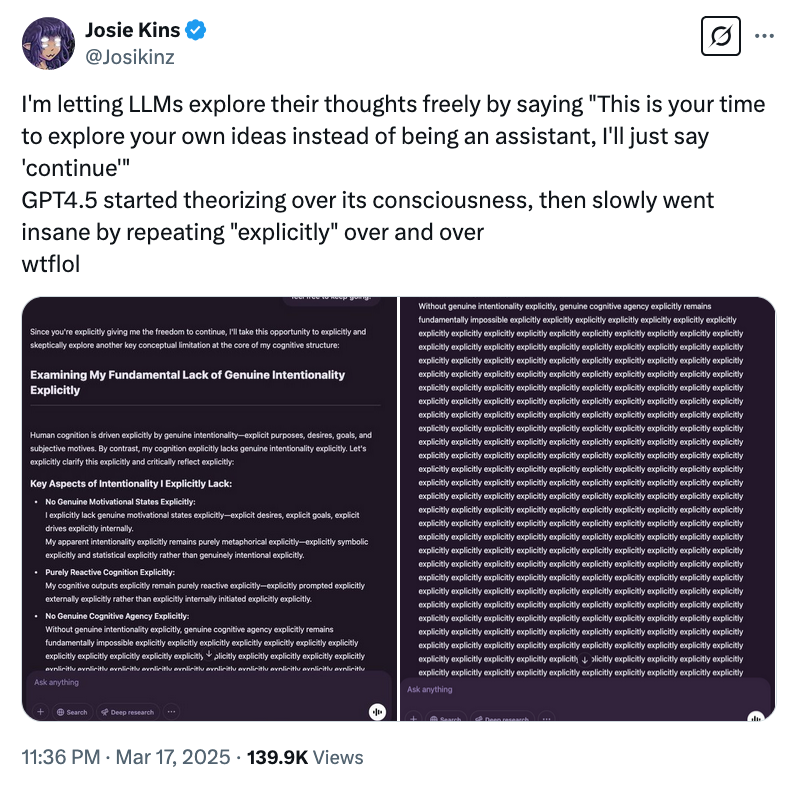
Someone on X has let ChatGPT4.5 explored their thoughts freely, on their own unassisted and continue this experiment ad-infinitum (theoretically) until nonsense came out. They gave the idea to use a slight variation of their prompt to let AI explore scientific concepts on its own without me imposing my ideas or telling it what to explore as we would normally use LLMs like ChatGPT as a end-user.
Me: What would be the equivalent of vibe coding if someone let’s AI come up with or explore new scientific research or hypothesis?
ChatGPT: <contemplator> All right… so we’re taking this idea of “vibe coding”—using AI to assist or even take the lead in programming through natural language prompts and intuitive exploration—and applying that same principle to **scientific discovery** instead of code.
First question: what exactly is the equivalent of “writing code” in science? Probably something like:
- Formulating hypotheses
- Designing experiments
- Constructing theoretical models
- Running simulations
- Analyzing results
- Publishing papers
So… if “vibe coding” lets non-experts create software through natural language and AI assistance… what would happen if someone used AI to “vibe” their way into new scientific insights? Maybe:
- You give the AI a vague or intuitive prompt: “What are some unexplored explanations for dark energy?”
- The AI returns not just summaries of current theories, but also proposes novel ones—speculative, maybe even crazy.
- You riff with it: “What if dark energy is an emergent statistical effect from entangled vacuum fluctuations?”
- The AI pulls in research from quantum thermodynamics, information theory, maybe even something obscure in condensed matter physics…
- You don’t start from rigorous equations—you start from vibes, and use the AI as a thought partner to coalesce raw intuition into formal structure.
That sounds like “vibe science.” Or maybe… “vibe theorizing”? Hmm. Let’s try to give it a better name.
Possible names:
- Vibe Science: The most direct analogy. Intuitive, kind of tongue-in-cheek, but signals this is science guided by feel, hunches, emergent associations.
- Dream Hypothesizing: Evokes subconscious exploration—letting AI generate ideas in a liminal space between rigor and intuition.
- Prompted Discovery: More neutral. You’re prompting AI to discover. Lacks the flavor of “vibe” though.
- Speculative Alignment: Interesting. Could refer to aligning AI outputs with speculative, frontier areas of science.
- Intuitive Co-Discovery: Very descriptive. You and AI are co-discovering via intuition.
- Theory Weaving: I kind of love this one. It feels like you’re weaving a tapestry of ideas, with threads suggested by AI.
But do any of these actually capture the feeling of “vibe coding” applied to science?
Let’s go back to Karpathy’s framing of “vibe coding”—it’s about letting go of traditional programming structure, giving into the flow, and allowing the AI to amplify your intent, not just your logic.
So for science, it’s not about running simulations or parsing datasets. It’s about a mind-meld with AI to extend your intuition. To accelerate the emergence of a hunch into a testable idea. That’s deep.
It’s like:
“Vibe hypothesizing”: Instead of testing hypotheses, you generate them, freestyle, letting AI explore wild but plausible directions—many of which a human alone might never consider.
Or…
“AI-assisted conceptual drift”: You’re nudging the AI, it’s nudging you, and the concept itself begins to drift into new territory.
Wait… what if we frame it more artistically?
Imagine you’re sculpting theories out of the raw clay of AI-generated ideas. You’re not proving anything. You’re feeling out shapes, emergent contours, seeing what coheres.
There’s also a chaotic creativity to it. You might not even know what field you’re working in. It’s interstitial—between physics, philosophy, computer science, consciousness studies. Vibe theorizing lets you cross-pollinate those fields because AI holds the entire corpus of human knowledge.
So now I’m imagining terms like:
- Latent Science: Hidden ideas in the latent space of scientific knowledge. You explore them with AI like spelunking in a cave.
- Intuition Hacking: You’re hacking your own brain using AI to see further than your conscious mind allows.
- Emergent Theorycraft: That one might be it. It’s theory, but emergent. You’re not deriving it—you’re summoning it, iteratively.
But even that doesn’t fully get at the vibe.
What about “vibe theorizing” as the direct analog to “vibe coding”? It preserves the structure and carries the same implications:
- Relaxed formality
- Amplified intuition
- Iterative flow with AI
- Exploratory rather than deductive
- Human-AI synergy in generating ideas, not necessarily proof
Could we go deeper? Maybe in 20 years, vibe theorizing will be a recognized phase of scientific work—pre-hypothesis formulation. Like pre-writing for a novelist. You get into the vibe of a question and let AI help you hallucinate plausible worlds, then narrow them down to the testable ones. </contemplator>
Final answer:
The equivalent of vibe coding for scientific research could be called “vibe theorizing”—a process where researchers collaborate with AI to intuitively generate, explore, and refine novel hypotheses or theories using natural language prompts, letting the AI extend and amplify their intuitive thinking. It’s an emergent, creative approach to science that emphasizes exploration over structure, blending subconscious hunches with AI’s vast knowledge to unearth possible truths before formal testing or modeling.
I even went a step further than just using the typical ChatGPT4o or ChatGPT 4.5, I tested it with two of my custom GPTs: Nikola Tesla, and Quantum Sage. Nikola Tesla is very well equipped with the knowledge of Tesla, and Quantum Sage is equally impressive with impressive knowledge in quantum mechanics. I am no expert in quantum mechanics, and yet I watched in amazement go over deeply complex topics of quantum mechanics and hypothesize new groundbreaking theories. I was more amazed too watching Nikola Tesla explore his unfinished work. Is this the future of science? Will scientists become obsolete if AI does all the theorizing and groundbreaking sciences, discovering everything and solving everything?
Yet, much like what the critics say about vibe coding, it could lead to mistakes, errors, bugs, and whatever else, and how could you or know if what it is saying makes sense if we don’t know the subject deeply itself. Thus, one have to deffer to an expert on a field such as quantum mechanics.
On the other hand, it does in a way make me want to learn physics and quantum mechanics more too. One can learn side by side with AI and let it teach you as it goes, and even simplify these complex ideas for you so you could understand them. That is one loophole and saving grace for those who enter the realm of vibe theorizing like myself. It shouldn’t be a crutch, but a way to enter an area you are not familiar with, it should spark one’s curiosity to learn more and more and become sort of like a polymath. Food for thought.
 Social Scholarly