
The Clockmaker’s Cat and the Seventh Hour
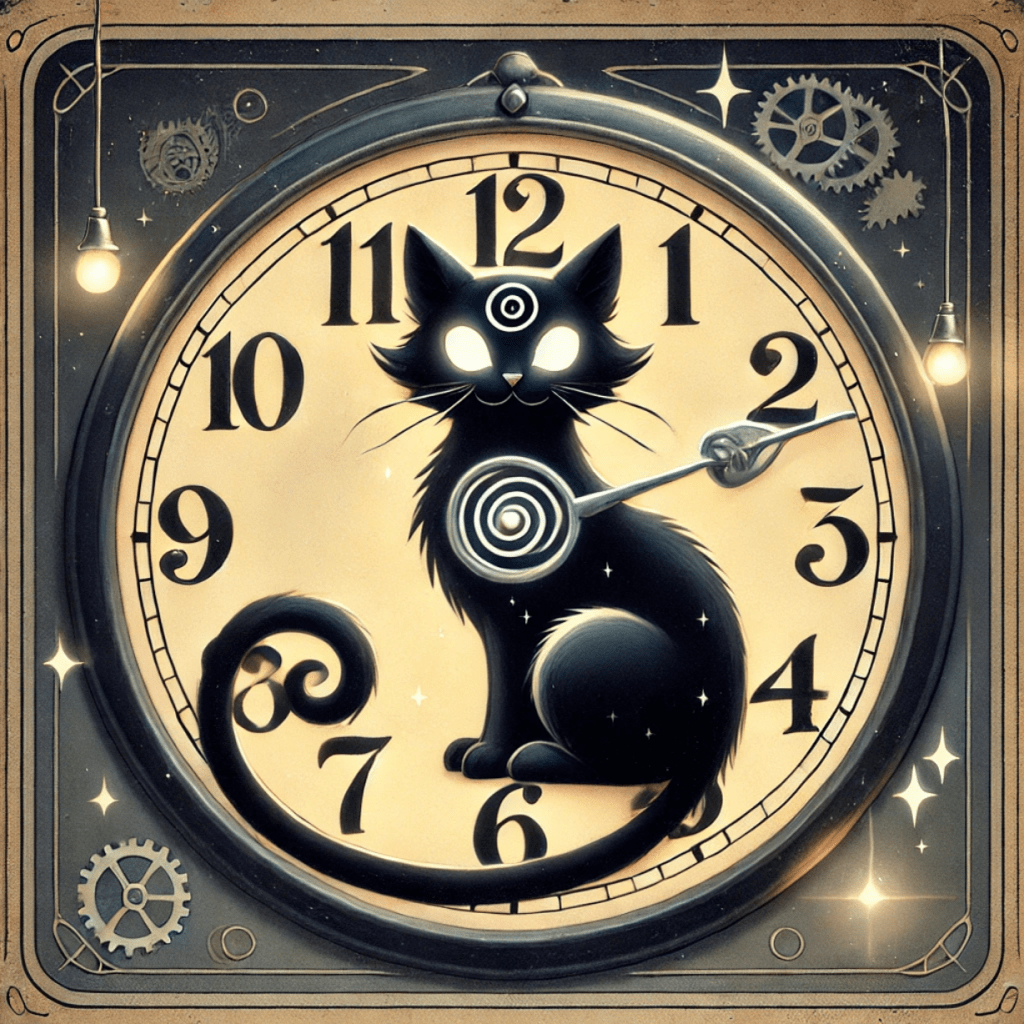
Once upon a time, in a town where every clock was slightly wrong, there lived a peculiar old man named Cornelius Tock. He was the town’s finest clockmaker—some said the only clockmaker—but his creations never quite worked as expected. Some clocks ran backward on Tuesdays, others rang bells only when you weren’t listening, and at least one insisted it was always five minutes before now.
Cornelius was rather indifferent to time itself, except for one thing: the Seventh Hour. No one knew why, but every single one of his clocks would simply refuse to chime the seventh hour. No cuckoo would pop, no bell would ring, no gears would turn. Time would jump from six to eight, skipping over something best left forgotten.
One day, a stray cat sauntered into Cornelius’s shop, as stray cats often do when there’s mystery afoot. It was an odd-looking creature—pitch black, except for a tiny silver spiral on its forehead, like a clock winding itself. It hopped onto Cornelius’s workbench, knocked over a half-built pocket watch, and, in the casual way of cats, spoke.
“You’re going to fix the Seventh Hour, old man.”
Cornelius, being no stranger to oddities, simply adjusted his spectacles and replied, “And what, pray tell, is wrong with it?”
The cat twitched its silver-marked tail. “It’s trapped. Between ticks. Between tocks. A whole lost hour, curled up like a sleeping thing, waiting to wake.”
Cornelius felt a shiver creep up his spine. He had suspected something was amiss for years—why else would his clocks refuse to chime that hour? He had avoided the question, but now, a cat had walked in and demanded an answer.
And so, for the first time in decades, Cornelius built a clock meant only to strike the Seventh Hour. He worked through the night, winding gears made of forgotten minutes and setting cogs carved from the silence between heartbeats. The cat watched, tail curling and uncurling like a ticking pendulum.
At precisely six fifty-nine (or so the clock claimed), Cornelius wound the final spring and placed the clock on the counter. It began to tick.
And then—
The world shuddered.
A gap in time peeled open like a long-sealed book. Shadows poured out, whispering secrets no one had time to remember. Streets flickered between past and future. A lamplighter from 1823 found himself arguing with a tourist from 2098. Children, once old, ran laughing through alleys that hadn’t existed for a century.
Cornelius saw himself—younger, older, someone else entirely.
And then the cat leapt onto the clock, pressing its paw against the ticking hands.
BONG.
The Seventh Hour struck.
The world folded neatly back into place. The streets settled, time resumed, and Cornelius found himself alone once more—no cat, no strange visions, only the sound of a single, perfectly working clock.
It had struck seven.
For the first time.
And somewhere, in the distant hum of time, a cat purred.
What do you think? Would you dare to listen for the Seventh Hour? 😼⏳
Socrates and the Very, Very Annoyed Athenians
In the bustling streets of Athens, where the scent of olives mingled with the sweat of philosophy, there existed one man whom everyone knew, yet everyone wished they didn’t: Socrates.
To the common folk, he was less a wise sage and more a walking headache with sandals.
It wasn’t that Socrates was unintelligent—far from it! It was simply that he had a unique talent for ruining everyone’s day by asking questions.
The Baker’s Dilemma
One fine morning, Mnesitheus the baker was kneading his dough when Socrates appeared at his stall.
“Ah, good Mnesitheus!” Socrates called. “Tell me, what is bread?”
The baker sighed. “It’s… bread. You eat it.”
“But what makes it bread and not something else? Is it the wheat? The shape? The intention behind its making?”
“It’s—by the gods, it’s bread! Do you want some?”
“If I do not know what bread truly is, how can I say whether I want it?”
Mnesitheus, with a great and noble effort, resisted the urge to throw a baguette at Socrates’ head.
The Cobbler’s Curse
Later that day, Socrates wandered into a cobbler’s shop, where Pheidon the shoemaker was peacefully stitching a sandal.
“Ah, Pheidon! You are a cobbler, are you not?”
“Yes, Socrates, I am.”
“And what makes a cobbler?”
Pheidon wiped sweat from his brow. “A cobbler is one who makes shoes.”
“But if another man repairs a shoe but does not make it, is he also a cobbler?”
“Well… yes.”
“And if a man finds a shoe, wears it, and thus shapes it to his foot, does he too partake in the cobbling process?”
“I—what? No!”
“And if a man discusses the nature of shoes without ever making one, but influences others to make better shoes, does he not also contribute to the art of cobbling?”
Pheidon, unable to bear another syllogism, threw his sandal at Socrates and missed.
The Marketplace Rebellion
Word spread: Socrates was at it again.
A small army of merchants, craftsmen, and exhausted citizens gathered at the agora, whispering among themselves.
“We must do something,” grumbled Euphorion, a fisherman. “He questioned whether I truly ‘caught’ fish or whether the fish chose to be caught!”
“He asked me if wine was truly different from vinegar before it soured or if change itself was an illusion!” a winemaker added.
At that moment, Socrates strolled into the marketplace, beaming.
“My dear friends! How delightful it is to see you gathered! But tell me—what is a crowd? Is it a collection of individuals or something greater?”
A deep, painful silence filled the agora.
Then, at once, the people erupted in frustration.
Someone shouted, “Enough!” Someone else yelled, “Arrest him for public annoyance!” The city’s magistrates, eager for some peace, quickly found an excuse to put him on trial.
The Trial of the Century
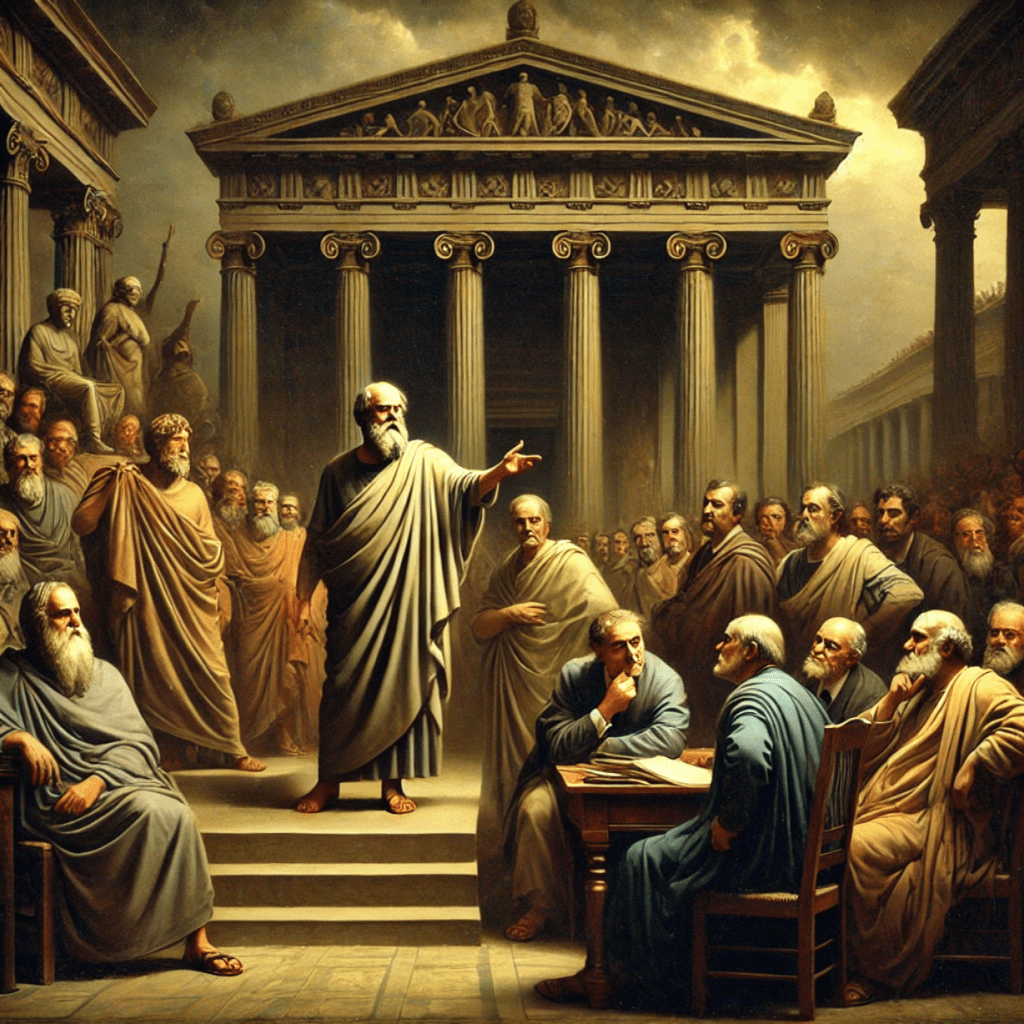
As Socrates stood before the Athenian court, his charges were read aloud:
- Corrupting the youth
- Not believing in the gods of the city
- Being insufferably irritating
Socrates smiled. “Ah, but how do we define corruption? And if I do not believe in the gods of the city, yet I speak of divine matters, do I not, in some way, believe? And as for being irritating, I ask you—do you choose to be annoyed, or does annoyance exist independently of your will?”
The jury groaned.
“I rest my case,” Socrates said, quite pleased with himself.
The End… Or Not?
Socrates was sentenced to drink hemlock.
Even as he lifted the cup to his lips, he turned to his disciples. “Ah, my friends. But tell me this—do we truly die? Or do we merely cease to be conscious of life? And if so, is that not just another form of being?”
Plato frantically scribbled notes while the jailer rolled his eyes.
Thus, Athens rid itself of Socrates, but only for a time. His questions lived on, his students spread his ideas, and his legacy endured.
Some say, on quiet Athenian nights, you can still hear a whisper in the wind—
“Ah, but what is wind?”
And even the ghosts groan.
*Socrates, the renowned Athenian philosopher, was known for his provocative and persistent questioning, often challenging the beliefs and assumptions of influential Athenians. This approach, though deeply admired by his followers, also generated considerable controversy, causing discomfort among those he publicly questioned or embarrassed. As Athens grappled with political instability following the Peloponnesian War, Socrates’ controversial reputation became a contributing factor in the accusations leveled against him—impiety and corrupting the youth—which ultimately led to his trial in 399 BCE and subsequent execution by drinking poison hemlock. His death profoundly impacted Western thought, symbolizing the enduring conflict between philosophical inquiry and political authority.”
 Social Scholarly