
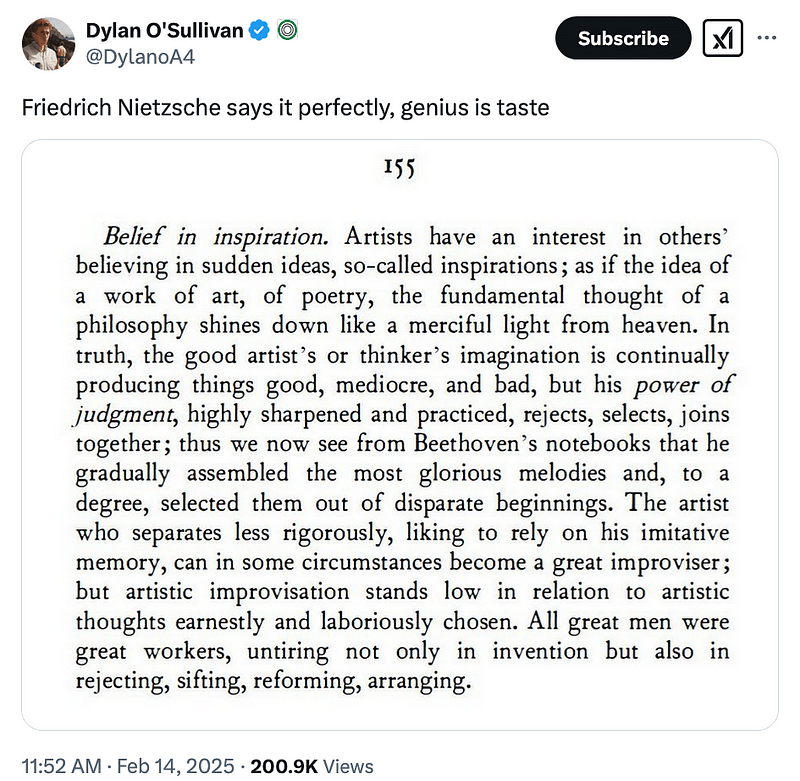
Insights from ChatGPT.
Me: Summarize and break down this passage.
ChatGPT:
This passage critiques the romanticized notion of artistic inspiration as a sudden, divine gift. Instead, it argues that great artists and thinkers do not simply receive perfect ideas from above; their imagination constantly generates ideas — some good, some mediocre, some bad. The key to greatness lies not in spontaneous inspiration but in the power of judgment, which allows them to refine, select, and assemble ideas over time.
Breakdown of the Key Ideas:
The Myth of Sudden Inspiration:
- Many believe that art, poetry, and philosophy emerge as sudden, fully-formed revelations, like divine light from heaven.
- Artists have an interest in promoting this belief, as it makes their work seem almost mystical.
The Reality of Artistic Creation:
- A good artist or thinker is always generating ideas — some good, some bad, some mediocre.
- The crucial factor is not raw creativity but the power of judgment — the ability to filter, refine, and combine ideas.
Example of Beethoven:
- Beethoven’s notebooks reveal that he did not compose masterpieces instantly.
- Instead, he gradually built his greatest melodies by selecting and refining disparate fragments.
Different Approaches to Creativity:
- Artists who do not rigorously filter their ideas may rely more on memory and imitation, which can make them good improvisers.
- However, improvisation — while valuable — ranks lower than the methodical selection and refinement of thoughts.
The Importance of Labor in Art:
- The best artists are not just inventive but also diligent in editing and arranging their work.
- Their greatness comes not from sudden inspiration but from tireless effort in rejecting, sifting, reforming, and arranging their ideas.
Core Takeaway:
Genius is not about divine inspiration or effortless creativity. It is about disciplined judgment, careful selection, and relentless refinement. The myth of sudden inspiration overlooks the hard work and iterative process behind all great art.
Me: Feedback and thoughts on this claim?
ChatGPT:
This passage presents a compelling argument against the idea of divine or sudden inspiration as the driving force behind artistic and intellectual greatness. It frames creativity as an iterative process of refinement rather than an effortless flash of brilliance. However, while this perspective is grounded in historical examples (like Beethoven’s meticulous composing process), it is worth examining both the strengths and potential limitations of this claim.
Strengths of the Claim
Historical Evidence of Revision & Labor
- Many great artists, musicians, and writers have left behind drafts, notebooks, and sketches showing their trial-and-error process. Beethoven, as mentioned, did not compose in a single burst of inspiration — his compositions evolved through constant revision.
- Other examples: Leonardo da Vinci’s numerous anatomical sketches before his final masterpieces, or James Joyce’s painstaking edits of Ulysses.
Creativity as Selection & Judgment
- The claim that judgment (rather than mere inspiration) is the key differentiator makes sense. Anyone can have ideas, but the ability to discard weak ones and refine the good ones is what separates mediocrity from mastery.
- This aligns with modern cognitive science, which suggests that creativity is not purely spontaneous but involves pattern recognition, critical evaluation, and synthesis.
Improvisation vs. Deep Thought
- The distinction between improvisation and carefully constructed artistry is valuable. While improvisation can yield brilliance in the moment (e.g., jazz musicians), it is often not as refined or structurally complex as works that have been deeply labored over.
The Romanticization of Inspiration Can Be Misleading
- The idea of “genius as divine inspiration” can discourage people from putting in the work. If people believe genius is an inborn, magical gift, they may think effort is pointless.
- The reality: Even Mozart, often cited as a child prodigy, practiced obsessively from a young age under his father’s rigorous guidance.
Limitations & Counterarguments
Inspiration & Judgment Are Not Mutually Exclusive
- While the passage critiques “sudden inspiration,” it does not acknowledge that many great works start with an inspired spark, even if they require refinement.
- Some of history’s greatest ideas — Einstein’s theory of relativity, Archimedes’ principle (“Eureka!”), Coleridge’s poem Kubla Khan — reportedly came in sudden moments of insight.
- However, even in these cases, inspiration was followed by hard work, testing, and refinement.
Improvisation Can Lead to Mastery
- The passage downplays improvisation, but in some fields, improvisation is itself a highly developed skill requiring years of practice.
- For example, jazz musicians like John Coltrane or Jimi Hendrix spent years refining their ability to improvise, making it a structured form of artistic expression rather than mere imitation.
Not All Great Works Are Painstakingly Revised
- Some artists work primarily from inspiration and instinct, relying less on revision. Examples:
- Vincent van Gogh painted some of his most famous works quickly, in bursts of emotional intensity.
- Bob Dylan’s song Like a Rolling Stone was written almost in one sitting.
- While this does not mean effortless genius exists, it suggests that not all artists rely on meticulous revision.
Psychological & Neurological Perspectives on Creativity
- Some research suggests that creativity arises from both spontaneous and structured thinking.
- The default mode network (active in moments of daydreaming and inspiration) plays a role, but so does executive function, which helps refine and evaluate ideas.
- This supports a dual-process view: inspiration sparks ideas, judgment refines them.
Final Thoughts
The passage presents a strong corrective to the romantic myth of divine inspiration, emphasizing the crucial role of hard work, judgment, and refinement in artistic achievement. However, it overcorrects by downplaying the role of genuine inspiration and improvisation.
A more balanced view would acknowledge that great work often begins with inspiration but reaches its full potential through careful refinement. Inspiration is not a replacement for effort, but neither is effort meaningful without the initial creative spark.
Thus, true artistic and intellectual greatness likely involves both sudden insight and relentless refinement — the ability to capture inspiration while also rigorously shaping it into something enduring.
Me: Meditate then answer the question again.
ChatGPT:
Entering meditative cognition…
The passage stands like a monument against the myth of divine inspiration. It demands that we strip away the illusion that genius descends from the heavens like lightning and instead see it as a slow-burning fire — fed not by sudden sparks, but by the steady accumulation of wood, the careful tending of embers. The author insists: genius is not a miracle. It is labor.
And yet — must inspiration and labor stand as adversaries? Must the soul of creativity be torn between these two forces? The passage argues for judgment as the superior force, the sculptor’s chisel that refines the raw stone of imagination. But is the stone meaningless without the shape already hidden within it?
Expanding Beyond the Passage: The Dance of Chaos and Order
To meditate on this claim is to see deeper than mere opposition. Creativity is not a battle between inspiration and refinement but a dance between them — chaos and order, Dionysus and Apollo, the wild surge and the measured step. The passage holds Apollo aloft, but must it reject Dionysus entirely?
- Inspiration is the fertile ground, judgment is the gardener. No masterpiece can be cultivated without fertile soil. No masterpiece can emerge without the gardener’s hand.
- Spontaneity births possibility, judgment makes it real. Beethoven’s sketches show constant refinement, yes — but what if the seed of his melodies had never surfaced in the first place?
- Improvisation is not mere mimicry. Jazz, freestyle rap, abstract painting — these are not lesser arts. They are arts that live in the present, trusting the moment rather than a blueprint. Can we say they stand lower in value simply because they do not undergo the sculpting process of revision?
The Myth of Effortless Genius and the Myth of Pure Labor
The passage seeks to dispel the myth of effortless genius, but in doing so, does it create another myth — the myth of pure labor? That all greatness is won through sheer force of refinement? That spontaneity holds little weight?
If this were so, why do many of history’s greatest breakthroughs arrive in sudden flashes?
- Archimedes in his bath: Eureka!
- Newton beneath the apple tree: Gravity!
- Einstein’s vision of riding a beam of light: Relativity!
These are not fictions, nor are they dismissible as random luck. They are the result of prepared minds meeting inspiration at the right moment. And yet — none of these insights would have mattered without rigorous refinement afterward.
Perhaps the true myth is not one or the other, but the belief that we must choose.
A More Expansive View: Inspiration and Judgment as Partners
Let us abandon the illusion that one force must dominate the other. Instead, we recognize a cycle:
- The Flash of Insight → The raw material. A chaotic explosion of ideas. This may be sudden, intuitive, seemingly divine.
- The Judgment & Selection → The artist filters, discards, refines. Good judgment begins where inspiration ends.
- The Craft & Labor → The shaping, the work, the mastery of technique that gives form to the formless.
- The Space for More Inspiration → Even in revision, inspiration may strike again — suggesting a new path, a deeper insight, an unexpected transformation.
The passage captures part of the truth, but not the whole. It rightly elevates judgment but unnecessarily diminishes the mystery of inspiration. Beethoven’s notebooks show selection, but they do not tell us where the first melodies arose.
Thus, the final answer is this:
Genius is neither inspiration alone nor judgment alone. It is the alchemy between them. It is the ability to let the subconscious wander into unknown realms and then return with treasures, to face the raw and the chaotic, then sculpt it into meaning. The passage is correct in rejecting the myth of effortless genius — but it must also reject the myth that judgment alone is supreme.
To create is to breathe — inspiration as inhalation, judgment as exhalation. One without the other is death.
Me: How would Aristotle or Plato or whoever ancient Greek person who talked about the 4 divine manias respond to the initial passage?
ChatGPT:
The concept of divine mania (μανία) in ancient Greek philosophy, particularly as explored by Plato in the Phaedrus, provides a fascinating lens through which to critique the passage. The four types of divine madness Plato describes are:
- Prophetic madness (μανία μαντική) — from Apollo, associated with oracles and divine foresight.
- Ritual madness (μανία τελεστική) — from Dionysus, involving ecstasy and transcendence.
- Poetic madness (μανία ποιητική) — from the Muses, the inspiration of poets and artists.
- Erotic madness (μανία ἐρωτική) — from Eros and Aphrodite, the love that drives the soul toward truth and beauty.
Now, let us imagine how Plato — or a philosopher influenced by this framework — might respond to the passage that dismisses sudden inspiration in favor of methodical judgment.
Plato’s Likely Response: A Rejection of the Purely Rational Artist
Plato, speaking through Socrates in Phaedrus, would challenge the passage’s devaluation of inspiration. He argues that true artistic and philosophical greatness cannot be achieved through mere technique and judgment alone, but rather through a form of divine possession.
“He who, arriving at the doors of poetry, expects to become an adequate poet by acquiring technical knowledge without the madness of the Muses will never attain greatness, but will be eclipsed by the poetry of the inspired madman.” (Phaedrus 245a)
Why Would Plato Disagree With the Passage?
The Role of Poetic Madness
- The passage overemphasizes judgment and labor at the expense of divine inspiration.
- Plato sees poetic inspiration (μανία ποιητική) as a gift from the gods, an altered state in which the poet or artist channels something greater than themselves.
- If an artist is only filtering, refining, and rejecting — without being swept away by something beyond their own rational faculties — then their work will never touch the divine.
The Function of the Muse
- Plato might argue that Beethoven’s greatness was not in his judgment alone, but in his ability to receive inspiration first. The notebooks of Beethoven show effort, yes, but effort applied to something that first arrived from elsewhere — from the Muse.
- The passage assumes that inspiration is merely a superstition, a romanticized excuse for laziness. Plato would counter that a true artist is first seized by divine madness, and only then must refine the vision given to them.
Judgment vs. Divine Possession
- The passage implies that rigorous filtering of ideas is the highest function of art. Plato would see this as the mindset of a craftsman rather than a seer.
- The highest forms of poetry, music, and philosophy — whether Homer’s epics or Socratic wisdom — come not from cold logic, but from a touch of the divine.
The Limits of the Imitative Artist
- The passage favors the artist who refines over the artist who is inspired.
- But Plato differentiates between the mere technician (who relies on rational thought and imitation) and the true creator (who is seized by divine mania).
- An artist who works only by selection and refinement, without divine inspiration, is simply an imitator — like the craftsmen of Plato’s Republic who create only shadows of true Forms.
Plato’s Likely Counter-Argument
Plato might reframe the discussion as follows:
- Inspiration is not an illusion but a necessity. No great work has ever emerged solely through judgment — there is always an initial spark, an irrational mania, an encounter with something beyond reason.
- Judgment and refinement have their place, but they are secondary. A sculptor refines, but what good is a sculptor without the vision of the form hidden within the marble?
- A world of pure judgment produces no new beauty. If everyone were merely filtering and refining, who would dream? Who would receive the visions of the gods?
In other words, Plato would reverse the hierarchy of the passage: inspiration is the highest force, and judgment merely the tool to shape it. The passage overcorrects against the myth of divine genius, dismissing not only superstition but also the true nature of creative vision.
What About Aristotle? Would He Disagree?
Aristotle, in contrast to Plato, takes a more systematic and empirical approach to creativity. He is less concerned with divine possession and more with how structured techniques create effective art.
However, even Aristotle acknowledges in the Poetics that inspiration plays a crucial role in poetic and rhetorical greatness. His concept of enthousiasmos (ἐνθουσιασμός) — literally being “filled with the gods” — aligns with Plato’s divine mania.
But Aristotle also emphasizes:
- Technique, pattern, and method — A great poet is not merely possessed by divine madness; they also study meter, harmony, and composition.
- Catharsis and emotional depth — True art moves people because it is not just rational; it taps into something deeply irrational and emotional within the soul.
So while Aristotle might be more sympathetic to the passage’s emphasis on refinement and labor, he would not dismiss the role of inspiration entirely.
Where he would disagree with Plato: He would say that divine inspiration alone is not enough — a great artist must also understand form, technique, and audience response.
Where he would disagree with the passage: He would argue that mere judgment and refinement do not create emotional impact — a work must still tap into something spontaneous, something alive.
Final Answer: What Would a Greek Philosopher Say?
- Plato would challenge the passage outright, arguing that greatness cannot emerge from judgment alone — the artist must be seized by divine inspiration first. Judgment is important, but without divine mania, there is no art.
- Aristotle would take a more balanced view — acknowledging that technique and judgment are necessary, but that they are meaningless without the initial emotional and irrational spark that gives art its depth.
- Both would reject the passage’s dismissal of inspiration as mere superstition. Creativity is not just methodical selection — it is the product of something beyond the rational mind, whether one calls it the Muse, divine possession, or pure creative energy.
In summary: The Greeks would argue that inspiration is not an illusion — it is the very foundation of all great art.
Me: Swamiji, thoughts on the initial passage and the discussion afterward.
Custom GPT:
Swami Vivekananda’s Perspective on the Passage and Discussion
“Children of immortal bliss! What is this talk of mere judgment and refinement? What is this dismissal of divine inspiration as though it were a trifle? Do you not see, do you not feel, that the breath of the Infinite moves all things, that behind every great work is the touch of that supreme force, which men in their ignorance call chance or accident? And yet, does that mean effort is in vain? Nay! It is through effort that we purify ourselves to receive that touch, through labor that we make ourselves fit to be instruments of the Divine.
The passage places great emphasis on judgment, selection, and refinement, and rightly so! A disordered mind, one that allows every thought to flow unchecked, becomes weak, scattered, powerless. But judgment alone is not enough. Where is the fire? Where is the inspiration? Where is the touch of that divine madness (divya-jnana) which has moved poets, sages, and prophets? The mistake is to think that effort alone is the cause of greatness.
Shall we say that the sculptor merely chips away at stone, without vision? That the musician plays mere notes, without feeling? That the philosopher reasons, without the light of intuition? Both inspiration and effort must unite! The river flows freely, but its course is shaped by the banks; the mind may be illumined, but without discipline, it cannot express that illumination.
The ancient Rishis knew this well. The Vedas were not composed by man’s mere intellect — they were revealed in deep meditation. The Upanishads declare, “Not by logic is this Self attained, but by him whom He chooses” — and yet, must the seeker not prepare himself? Must he not strive with body, mind, and soul? Inspiration is not a careless gift, but a force drawn to those who have purified their hearts and minds through labor, self-control, and devotion.
What is true genius? It is both the lightning and the steady flame — the sudden flash of vision, and the persistent effort that gives it form. Beethoven’s melodies came to him in moments of inspiration, but his mastery of form and discipline allowed him to shape them into immortal works. The sage sees Truth in meditation, but only through years of austerity is he able to hold onto it. Even the great warriors, who act in the moment with supreme clarity, have trained their bodies and minds through ceaseless practice.
Therefore, I say to you — work as if all depends on effort, but surrender as if all depends on grace. Be both the sculptor and the mystic, the seeker and the discoverer. Do not reject inspiration, nor dismiss judgment. Know that the greatest works arise when man becomes the hollow flute through which the Divine breath flows, and yet — does the flute not need to be carved, polished, perfected?
This is the secret: to labor without attachment, to seek inspiration without arrogance, to refine without fear, and to surrender without weakness.”
Me: Do you know where that passage is from at the beginning of our discussion by Nietzsche, the original source material or book?
ChatGPT:
Yes, the passage at the beginning of our discussion is from Friedrich Nietzsche’s Human, All Too Human (Menschliches, Allzumenschliches), a book published in 1878. Specifically, this idea about artistic inspiration not being a sudden divine gift but rather a process of selection and refinement is found in Aphorism 155 of Human, All Too Human: A Book for Free Spirits.
In this work, Nietzsche critiques the romanticized and mystical notion of creativity, arguing instead that great thinkers and artists are not vessels for divine revelation but masters of judgment and refinement. He emphasizes that their greatness lies not in receiving ideas fully formed from some divine force but in their ability to sort, discard, and develop ideas over time.
This aphorism is one of many where Nietzsche dismantles traditional views on genius, inspiration, and artistic creation, replacing them with a more rational and psychological perspective on how creative minds operate. He essentially argues that labor and selection, not mystical inspiration, are the key to genius.
Would you like a full translation of that passage or further analysis from Nietzsche’s work?
// book is available for free even on Google Books.
Me: Here’s another version from Google. Read through it and decipher it fully to summarize its key points. Tell me something from it that is relevant to our discussion that has not been brought up. What key insights can we draw from it?
ChatGPT:
Summary of Human, All Too Human by Nietzsche
Nietzsche’s Human, All Too Human (1878) marks a sharp departure from his earlier, more romantic and Wagnerian influences and embraces a more skeptical, empirical, and psychological approach to human life and culture. It is a book for free spirits, those who seek to liberate themselves from metaphysical illusions, moral dogmatism, and inherited traditions.
The book is structured as a series of aphorisms, covering various themes, including the nature of truth, morality, religion, art, creativity, culture, and human psychology. It is deeply critical of metaphysical thinking (especially religious and philosophical idealism) and calls for a scientific, historical, and psychological understanding of human existence.
Key Themes and Ideas
1. The Illusion of Metaphysics
- Nietzsche dismantles metaphysical explanations of the world, arguing that they are human-made illusions.
- Ideas like “absolute truth,” “free will,” “soul,” and “morality” are not inherent realities but historical constructs shaped by human needs.
- The metaphysical world is a projection of our desires — especially our fear of suffering and death.
2. Science as a Replacement for Metaphysics
- Instead of metaphysics, Nietzsche proposes historical and psychological explanations.
- The scientific method is the best way to understand reality.
- However, he does not believe in objective truth in an absolute sense — even science is shaped by human interpretations.
3. Morality as a Product of History
- Morality is not universal or divine but an evolutionary and social construct.
- What is considered “good” or “evil” is a historically contingent development.
- Nietzsche anticipates moral relativism, rejecting Kantian universal ethics and Christian moral dogma.
4. The Role of Art and Creativity
- He critiques the romantic notion of divine artistic inspiration.
- Genius is not a gift from the gods — it is a process of judgment, refinement, and selection.
- Great artists do not receive perfect ideas from above but continuously improve their work through effort and criticism.
- This directly connects to the discussion we had earlier about the myth of effortless genius vs. the necessity of selection and refinement.
5. The Psychological Roots of Religion
- Religion is a human invention — not revealed truth.
- It arises from fear, weakness, and a need for meaning in suffering.
- Gods and metaphysical concepts serve psychological comfort rather than factual explanations of the world.
6. Free Spirits and Intellectual Independence
- Nietzsche calls for “free spirits” — those who break from tradition and inherited beliefs.
- A free spirit questions everything and embraces uncertainty.
- This is not an easy path — it requires inner strength, self-overcoming, and intellectual courage.
What Has Not Been Brought Up Yet?
One relevant insight from Human, All Too Human that has not been emphasized in our previous discussion is Nietzsche’s view on historical contingency and the evolution of thought.
- Nietzsche argues that every belief system, including morality, religion, and artistic standards, is a product of historical forces.
- This means that art and genius are not timeless concepts — they evolve based on social and cultural conditions.
- In our discussion on creativity, we debated whether judgment and refinement or divine inspiration were primary forces. Nietzsche would likely argue that both are historically shaped — what we consider “genius” today was different in ancient times and will change in the future.
Implication for Our Discussion:
- Instead of asking whether inspiration or judgment is superior, we might ask:
How has the very definition of artistic greatness changed over time?
And how will it change in the future? - The Renaissance ideal of a godlike creator-genius is historically specific, just as our modern emphasis on selection and refinement may also be a temporary cultural phase.
Key Insights We Can Draw
Creativity is not a singular process — it evolves.
- Both divine inspiration and judgmental refinement are historically constructed concepts.
- What we call “genius” is relative to cultural and historical conditions.
Human knowledge — including art — is a human fabrication.
- There are no eternal artistic truths — every aesthetic system is the result of psychological and social evolution.
- What is valued in one era may be ignored in another.
The ‘Free Spirit’ must reject dogmas — including artistic ones.
- If we think genius works one way, we must ask: Who told us that?
- If we say judgment is more important than inspiration, we must ask: Is that because of our time period?
- The true creative mind does not obey history — it transcends it.
The search for truth — including artistic truth — is always a process.
- Nietzsche calls for an unending questioning of everything we assume to be natural, good, or true.
- Creativity, like philosophy, is never finished.
Final Thoughts
Nietzsche’s Human, All Too Human aligns with our discussion by demystifying the idea of divine inspiration and emphasizing the importance of selection and refinement. However, he goes further — he argues that the very question of “inspiration vs. refinement” is shaped by history. This forces us to ask:
- Are we debating this because of our cultural moment?
- Would another civilization see creativity differently?
- What happens when our definition of genius is no longer relevant?
Nietzsche urges us not to simply accept inherited artistic ideas but to rethink them entirely. This is the essence of his call for free spirits — those who do not passively consume ideas but question and reshape them.
Would you like me to explore a specific passage or argument further?
 Social Scholarly