
Quick reflections on the mystical experience.
To be deprived of the profundity of the mystical experience is one of the great tragedies of humanity. Yet, God need not be sought in a plant, a pill, a church, a book, or a grand scientific theory. Though, I don’t condemn any one path.
God can be revealed through service. In serving those who serve. To serve the servants of the world is among the highest virtues, for in this humility, one glimpses the profound.
As the spiritual master, Swami Vivekananda once observed: “Very often, unwary seekers of God succumb to mental and physical breakdown. Of one hundred who take up the spiritual [religious] path, eighty turn out to be charlatans, fifteen go mad, and perhaps only five catch a fleeting glimpse of the real truth.”
This observation by Swami Vivekananda aligns with a famous Hebrew legend. The legend of the four rabbis who entered the Pardes (Hebrew for “orchard”) is a powerful and enigmatic tale from Jewish mysticism. It’s a story laden with mystery, caution, and insight about the spiritual journey and the pursuit of ultimate Truth.
The Legend:
Four great rabbis — Ben Azzai, Ben Zoma, Elisha ben Abuyah, and Rabbi Akiva — decided to enter the Pardes, a mystical orchard symbolizing the pursuit of the deepest truths of existence and the divine mysteries of creation. They sought to ascend to the highest spiritual realms through intense meditation, study, and mystical practices.
What happened to them is both a lesson and a warning:
- Ben Azzai
When Ben Azzai entered the Pardes and beheld the mysteries of the Divine, his soul could not bear the intensity of what he experienced. He was overwhelmed by the sheer brilliance and grandeur of Truth and died on the spot. It is said of him: “He gazed and died.” His story is a caution about the danger of approaching spiritual heights without sufficient grounding. - Ben Zoma
Ben Zoma entered the Pardes and beheld profound mysteries, but the experience shattered his mind. He lost his sanity and was unable to reintegrate what he had seen with the realities of the world.
It is said of him: “He gazed and lost his mind.” His story reflects the psychological peril of delving into realms beyond human comprehension without preparation. - Elisha ben Abuyah (also called Acher, meaning “the Other”)
Elisha ben Abuyah entered the Pardes and experienced Divine Truth, but something went awry in his perception. He became confused and interpreted what he saw incorrectly. He betrayed his faith, abandoning Torah and tradition, and turned to heresy. It is said of him: “He cut the roots.” His story illustrates the danger of pride, misinterpretation, and losing one’s moral anchor in the pursuit of spiritual truth. - Rabbi Akiva
Rabbi Akiva, the greatest of them all, entered the Pardes and returned safely. He beheld the mysteries of the Divine and came back whole, with his wisdom, faith, and humility intact. It is said of him: “He entered in peace and departed in peace.” Rabbi Akiva’s success is attributed to his deep preparation, unwavering faith, and humility. He approached the Divine mysteries not as a conqueror but as a servant, and thus he emerged unscathed.
The Meaning of Pardes:
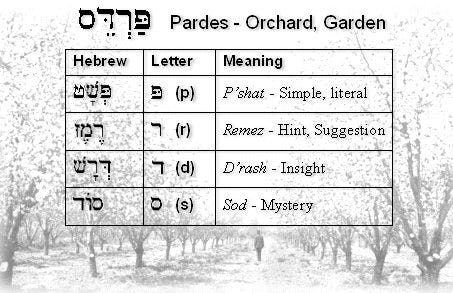
The word Pardes is an acronym for four levels of understanding the Torah:
- Peshat — The plain, literal meaning.
- Remez — The allegorical or symbolic meaning.
- Drash — The homiletical or interpretive meaning.
- Sod — The mystical or esoteric meaning.
The story can be read as an allegory for these levels of interpretation. To ascend the heights of mystical understanding (Sod) requires profound preparation and the grounding of the lower levels.
Lessons of the Legend:
- Spiritual Pursuit is Dangerous:
The path to ultimate Truth is not to be undertaken lightly. It demands preparation, humility, and purity of heart. As the rabbis’ fates show, the human mind and soul can falter when faced with the infinite. - Balance and Grounding are Essential:
Without mental, emotional, and spiritual grounding, the intensity of mystical insight can lead to destruction — whether physical (Ben Azzai), mental (Ben Zoma), or moral (Elisha ben Abuyah). - Humility is the Key to Truth:
Rabbi Akiva succeeded because he approached the Divine with humility and reverence, recognizing the limits of human understanding. He did not seek to master Truth but to serve it.
The Orchard as a Metaphor:
The Pardes, or orchard, symbolizes the beauty, complexity, and danger of Divine Truth. Like an orchard filled with luscious fruit, it tempts the seeker with its sweetness, but it also contains hidden perils for the unprepared. The story teaches that the infinite cannot be grasped by finite hands without a deep transformation of the self.
As Swami Vivekananda might say in a parallel vein, the spiritual journey requires both renunciation (letting go of ego and attachment) and strength (to endure the trials of Truth). Without these, the brilliance of Divine reality can consume rather than illuminate.
In short, the Talmud says that of the four rabbis that entered the orchard (esoteric Kabhallah teachings) one died, one became a heretic, one went mad (lost his sanity), and only one (Rabbi Akiva) entered in peace, and left in peace.
Why is this so? Many lose their footing in the pursuit of truth or are overwhelmed by the brilliance of revelation. The intensity and sacrifice is far too great.
Additionally, their unintegrated shadow, as Carl Jung might describe it, stands in the way. Thus, to attain the highest truth without first conquering the inner darkness — without having walked through the valley of the shadow of death is to risk catastrophe!
The truth, in its grandeur, is not for the faint-hearted. Without the strength, discipline, and wisdom earned through trials and tribulations, why should one be entrusted with the ultimate revelation?
What is Truth? To describe it is like trying to hold the wind in your hand, for Truth is beyond words and forms, yet it manifests in them. Truth is not a concept to be captured; it is a reality to be realized.
“Enlightenment is when a wave realizes it is the ocean.” — Thich Nhat Hanh
 Social Scholarly