
At the height of the COVID pandemic in the United States and across the world, people became aware of the phrase “essential workers.” Essential workers were considered the backbone of the economy, the oil or energy to keep the economic machine up and running smoothly. In other words, most of the working class. The word ‘essential’ is a very vague and subjective term that can apply to nearly or if not anyone. According to the Merriam-Webster online dictionary, essential means of the utmost importance: basic, indispensable, necessary. But who or what is essential, or for that matter, non-essential to capital markets?
Economist Dr. Susanne Trimbath (famously known as “Queen Kong” by meme stock apes) shared her ‘unpopular’ opinion (from Wall Street’s point of view) of short sellers, and I would go as far as to say that she believes that they are non-essential to the stock market. She finds it discomforting when articles glamorize short-sellers and paint them as important or vital to the market, especially when it is stated how “essential they are to make markets efficient and for price discovery. It begs the question: Are short-sellers essential for a well-functioning and healthy market? Are they worthy of the praise that they receive for their contributions to equity markets and at the other end, are their vilification justified?
Short-sellers, for the most part, feel they are wrongfully vilified and misunderstood. Some do recognize the bad apples that tarnish the industry, while others reveal their invaluable role to markets. Jim Angel, a finance professor at Georgetown University, agreed that people who have an incentive for things to go wrong should be identifiable. However, he pointed out that short sellers serve a useful purpose: They help to prevent stocks from being overvalued. “And an overvalued stock is nobody’s friend,” Angel said. “To a certain extent, short sellers are the bearers of bad news, and a lot of times, people want to shoot the messenger.”
Personally, I get a bit annoyed by the way financiers like short-sellers are often portrayed as geniuses, like when they are defended in arguments in which the defenders will often reference the Enron fraud and praise the so-called gracious short-seller Jim Chanos for saving the day by exposing this fraud. Yet, the collapse of Enron still managed to hurt many people in the end since they lost a lot of money, while at the same time, short-sellers (like Jim Chanos) profited in their misery. Few ever mention Sherron Watkins, the whistleblower in that story was an insider within the company, and the journalist Bethany McLean, who wrote an article months before Enron’s collapse titled, “Is Enron Overpriced?” As one person on X (formerly known as Twitter) puts it, “Short sellers are there to take out the trash.” Another commented by saying, “There is noble short selling. I saw it a few times in my life and made money out of it once an analyst comes with his due diligence (DD), writes his paper, and is right. There are some scams out there, and the only way to expose them is with DD, paper, public, and huge short.”
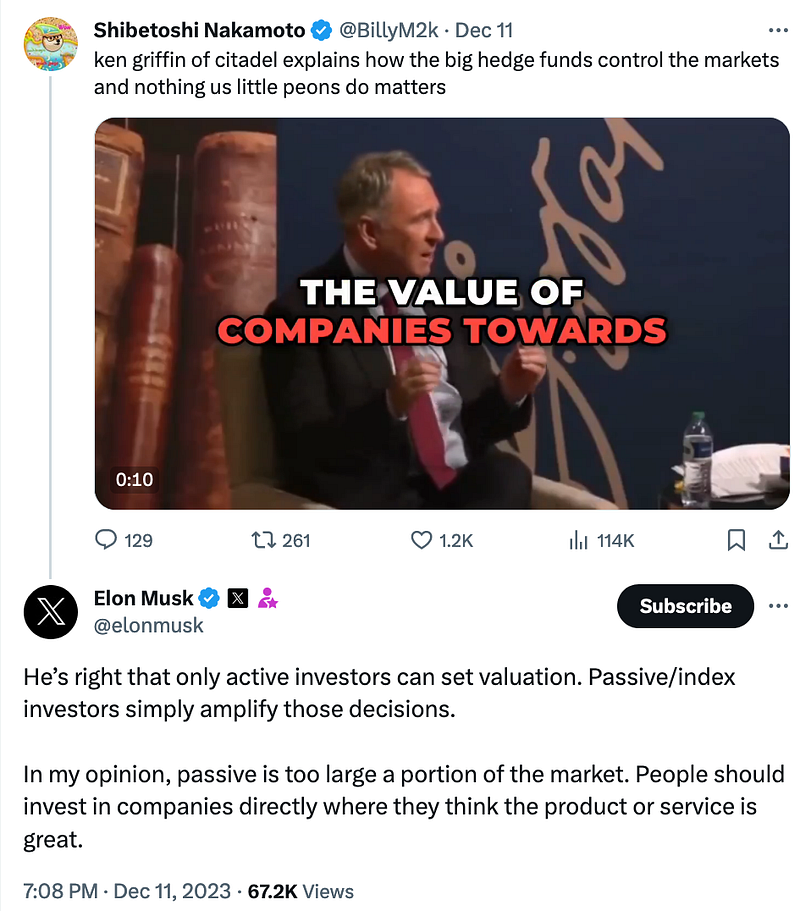
Now, I don’t mind short sellers who serve the purpose of exposing fraud, keeping companies honest, and also profiting handsomely from the overvaluation of securities. Ken Griffin, the hedge fund manager of Citadel Advisors, recently discussed the important role that firms like his play in keeping the price of securities honest or finding their true value and equilibrium. It was on X where people shared a clip that reached ~1 million views, which got many in an uproar over Griffin’s statements. However, the clip posted on social media and shared is disingenuous and misinterpreted when compared to the full context of the video. In the same interview with David Rubenstein, Ken Griffin was asked for a piece of simple investment advice given his success as a hedge fund manager over decades — a harmless question. He gave the typical answer of a 60/40 stocks/bonds portfolio and adjusted based on someone’s age; “passive index funds and passive bonds make a lot of sense” he said.
Griffin continued in the David Rubenstein interview (~34:19):
“Passive investing is actually rooted in the theory that markets are efficient. And that markets are efficient because active managers setting the prices of securities. Firms like Citadel, firms like Fidelity, firms like Viking Global, Capital Research; we’re all running large teams of people that are engaged in fundamental research trying to drive the value of companies towards where we think they should be valued. And passive investing, in a sense, enjoys the market efficiency that we create each and every day. One of the things that’s frustrating in Washington D.C. is actually the regulatory weight being placed on active managers by the SEC, who are at this moment, introduced fifty new rules in proposal or final form over the last roughly 18 months. It’s almost as if they’re in a Jihad against active management and the active allocation of capital in the United States. That hurts passive investors, that hurts the ability for companies to raise capital at the right price to create jobs and to build factories. You asked what would I change in Washington. I would ask that our agencies run through the lens of how do we embolden American businesses to win to win. And when we attack Financial Services firms which employ a tremendous number of Americans who manage wealth for people all over the world these are high-paying jobs where the individuals involved are paying a lot of of taxes. I almost scratched my head like if the progressives don’t want people who make money and who pay taxes, then how will they ever fund their dream, like I can’t reconcile that.”
In my view, on the one hand, Ken Griffin is telling a general truth about the conventional wisdom of market efficiency and the benefits passive investors (no thanks to John Bogle) receive from active managers.
Michael Burry, who famously shorted the housing market, agrees with this perspective of passive investing and the role of active investors. Even the new CEO of Twitter, Elon Musk, commented on the video clip and agreed with the statement. Musk’s reply was, “He’s right that only active managers can set valuation. Passive/index investors simply amplify those decisions. In my opinion, passive is too large a portion of the market. People should invest in companies directly where they think the product or service is great.” Elon Musk has discussed this issue before with others, so this was not a random passing comment without real deep thought behind it.
Moreover, this gets into the weeds of the contentious Efficient Market Hypothesis (EMH). The Efficient Market Hypothesis (EMH) is a theory that suggests financial markets are efficient and incorporate all available information into asset prices. According to the EMH, it is impossible to consistently outperform the market by employing strategies such as technical analysis or fundamental analysis. With the popularity of index funds/ETFs, there has been a large influx of passive/index investing. But with this large flow of passive investing, it can be argued that it is offset by active managers (i.e. short sellers) for price discovery, in other words, when the price stock is overvalued, over-inflated, or in bubble territory.
What individual investors that grew from the meme stock phenomenon on x.com were in an uproar and angry about, was Ken Griffin’s statement appeared more sinister than it seemed when he said they (i.e., hedge funds) controlled/set prices. I by no means want to defend him, but I’m obligated to stand for truth. His statement has to be put into context. If one watches that section of the video, and not just the small clip, then one will understand why he said what he said. The vitriol towards Ken Griffin (justifiably so to some extent) is in large part due to the massive empire he rules over owning a hedge fund and other entities like his market-making firm Citadel Securities, which takes a large chunk of order flow from their market making business in equities, and being a part of the spotlight in the GameStop debacle of 2021 when the buy side of a dozen meme stocks was temporarily disabled or halted for many enthusiastic retail traders, likewise this includes institutional investors looking to capitalize in on the action.
However, in the Rubenstein interview, my gripe with Ken Griffin’s response is his deliberate rosy narrative of financial institutions like hedge funds that are actively trading like those that utilize different kinds of trading strategies and algorithms such as mid or high-frequency trading at the speed of light. So Mr. Griffin here tells a half-truth or deliberately omits all of the ills or faults of the industry he is a part of. He left out the part where active managers (most are not able to beat the index investing S&P 500) and short hedge funds a few of which have allegedly conducted illegal activities.
Ken Griffin himself is called into question in his role on whether or not he is participating in illegal market conduct and fleecing the public, especially retail investors buying through Payment for order flow brokerage apps. In a recent SEC press release, “According to the SEC’s order, for a five-year period, it is estimated that Citadel Securities incorrectly marked millions of orders, inaccurately denoting that certain short sales were long sales and vice versa.” There’s a really important reason why the SEC has proposed or passed all these new regulations that Ken Griffin complains about. For one, it is to stop or better catch any illegal activities like market manipulation.
In her blog, Dr. Susanne Trimbath said, “As an example of their “essential” nature, the article refers to “The Big Short,” about “‘misfits, renegades and visionaries’ who bet against overvalued mortgage-backed debt at the centre of the story.” Did they prevent the financial crisis? Did they blow the whistle against unsavory market participants? No! They won a lot of money on their bets. How, exactly? Is that “essential” to the functioning of capital markets?” I disagree with Trimbath’s assessment of the short sellers who profited enormously from the housing crash/2008 crisis. I agree mostly with her views of short selling and market making in general and their negative impacts on the market. In particular, I strongly agree with this statement she made, “Short-selling as an investment strategy requires some potential point in the not-too-distant future when actual shares are purchased in the open market for repayment of the stock loan. In today’s financial system, there is no due date for a stock loan.” The “no-due date for a stock loan” leaves room for potential issues for short-selling abuses such as illegal naked short selling.
Now, I don’t put short-sellers on a pedestal. However, I have to commend a few of them from the 2008 crisis who profited from the housing crash for their contrarian thinking, and meticulous work like Michael Burry buried reading piles of documents/filings through his computer. Burry thought many people would figure out what he was up to when he placed a large bet against the housing market, yet a few did. Although I would add, that Burry didn’t outright yell that the “sky was falling” as much as he probably thought he did; this refutes his self-identification or labeling as a Cassandra–a person whose accurate prophecies, generally of impending disaster, but are not believed. Burry stated in a New York Times piece, “I entered these trades carefully. Suspecting that my Wall Street counterparties might not be able or willing to pay up when the time came, I used six counterparties to minimize my exposure to any one of them. I also specifically avoided using Lehman Brothers and Bear Stearns as counterparties, as I viewed both to be mortally exposed to the crisis I foresaw.” Burry deliberately didn’t negotiate with the two biggest firms that had the biggest collapses in the financial crisis.
Michael Burry’s NYT article was a well-constructed critique that exposes the entire folly in government and Wall Street for enabling the real estate bubble, especially whom articles dubbed “ Three Marketeers” or the “Committee the Save the World” (i.e., Alan Greenspan, Larry Summers, and Robert Rubin) lackadaisical role as the most influential economists at the helm of the country when the house of cards crumbled. Burry said, “Instead, our leaders in Washington either willfully or ignorantly aided and abetted the bubble. And even when the full extent of the financial crisis became painfully clear early in 2007, the Federal Reserve chairman, the Treasury secretary, the president, and senior members of Congress repeatedly underestimated the severity of the problem, ultimately leaving themselves with only one policy tool the epic and unfair taxpayer-financed bailouts. Now, in exchange for that extra year or two of consumer bliss we all enjoyed, our children and our children’s children will suffer terrible financial consequences.”
The warnings of the housing bubble and impending crash did not come from short sellers as Susan Trimbath argued. The select few that sounded the alarm were regulators, economists, and educators like Dean Baker, Peter Schiff, Robert Shiller, and Brooksley Born. I mean, why would short sellers warn of danger? How would they benefit if more people knew? Short sellers wouldn’t benefit as much if they told everyone, so they stayed hushed to profit enormously on this bet, because if everyone else knew of their placed bets, then their profits would greatly diminish when the pie has to be shared with others doing the same bet.
Again, Dr. Susanne Trimbath believes short sellers are not essential for market efficiency or price discovery. “It is when investors want to purchase shares that are not available or to sell shares that are not in demand, that price discovery occurs that enhances market efficiency.” In her other blog post, it is noticeable the influence from one of her professors, “In his 1997 book, How Markets Work, Dr. Kirzner explains quite elegantly the process of price discovery through disequilibrium: “Disequilibrium prices generate direct disappointment of plans…. Such disappointment can be expected to alert entrepreneurs to the true temper of the market,” (The Institute of Economic Affairs, London, Second Impression 2000, p. 45). Market makers in general and short sellers in particular disrupt this process by altering the appearance of supply and demand for the shares of companies. Each time a market maker steps in to purchase shares that no one wants to buy or sell shares that no one wants to divest, they send disinformation into the market. This reason alone should call into direct question any arguments based on the view of financial product trading as a “marketplace.”
I was unaware of Dr. Kirzner and his theories. But with the help of ChatGPT, I was able to simplify Dr. Kizner’s theory of disequilibrium, “Dr. Kirzner’s concept of price discovery through disequilibrium in simple terms means that market prices are found not when things are stable and balanced (equilibrium) but rather when they are imbalanced (disequilibrium). He suggests that prices are determined through a process where market players, especially entrepreneurs, respond to opportunities or gaps in the market. These gaps or imbalances are what drive entrepreneurs to take actions that eventually lead to the discovery of the ‘right’ price for goods or services in the market.” In the context of markets, ChatGPT replied:
“Market context, equilibrium refers to a state where supply and demand for a product or asset are equal, leading to stable prices. Disequilibrium, on the other hand, occurs when supply and demand are not in balance, causing price fluctuations. Equilibrium represents a theoretical state of perfect balance, while disequilibrium reflects the more common real-world scenario where market conditions are constantly changing and adjusting.”
So it’s a matter of stable versus unstable prices of securities and the role of all forms of information play a factor in the price of securities, including the increase of the supply of shares which misprices a company’s stock.
Other than the point Trimbath made of the disinformation (even misinformation) short-sellers and market makers can produce in the market for the price of securities or short sellers borrow stocks with no end time horizon, meaning holding a short position for long periods like months and years (which I agree), I don’t think it’s a strong enough argument to completely remove them from the picture. I do get really tired of people defending market-making as a source of providing liquidity.
While I share many of the same sentiments and goals as Susanne Trimbath, apes or frustrated household investors regarding short-selling and bringing integrity back into markets, I cannot entirely agree with Trimbath’s views from the two specific blog posts. Short-sellers aren’t morally inclined or obligated to warn of impending doom, and market makers may play a role in smoother market transactions where there is a buyer for every seller – sometimes as the last resort. Active managers or traders are incentivized to find faults in the market, find or exploit inefficiencies, and thus reduce them. Of course, this doesn’t excuse any issues or wrong-doings they may exploit like destroying companies who didn’t deserve it with coordinated abusive naked short-selling. Short-sellers, whether right or wrong matters not, can profit tremendously from irrational exuberance. They bring balance to an overly optimistic market. Yet, it is the bad short-sellers, the ones who cheat and lie that are the ones who give the entire group a bad reputation. I respect the ones who are diligent in their work like the Michael Burry’s of the world. Market reform is important, and more people have been aware of it ever since the meme stock incident, the family office Archegos Capital Management blowup, or issues with leverage in the repo market. It is on Congress and the regulatory agencies, as well as public feedback to work in tandem to fix these issues, to dismantle regulatory capture, and Self Regulatory Organizations (SROs) like FINRA to bring transparency and integrity to the government and the financial market.
 Social Scholarly