
If you paid attention to the news, you probably have seen a wave of labor strikes across the United States. There’s the Writers’ Strike that started on May 2nd, 2023, and is ongoing. Now, the actors have joined the picket lines when negotiations fell apart with Alliance of Motion Picture and Television Producers (AMPTP). As the Actor’s Union President Fran Drescher mentioned, the celebrity element adds to its popularity and visibility. Although this union strike is important and everyone is paying attention because it is happening all over, not just them, she added. What is next could be UPS workers who are organizing and are set to strike for what may be the biggest U.S. strike in 60 years.
If it’s not clear enough, screenwriters are the backbone and extremely important to the entertainment industry. Without them there is no film with a story and dialogue. To make a largely successful film in Hollywood, it takes a village. This includes writers, actors, editors, producers, directors, marketers, designers, and the list goes on and on. Nonetheless, they are struggling like many of the rest of the working class with the rise of the cost of living, adding on top of that, the nagging inflationary pressures as a byproduct of government policies, as well as businesses and people’s adaptation during the global pandemic that caused prices to rise.
Labor strikes are nothing new. It’s been a part of American history, and it really picked up in the 20th century. One of the most compelling labor movements was the Newsboy strike of 1899, where a bunch of paperboys took on the giants of the newspaper industry, Joseph Pulitzer and William Randolph Hearst. The reason these kids united is because of price hikes imposed upon them, which I’d imagine ate away from the little they’ve earned. Indeed, there was a time when child labor was common and not outlawed. A time, unlike today, with those at the top of industries, was wholly taking advantage of working-class people. The owner class (capitalists) made lots of profits and left the rest of the population with breadcrumbs.
The compartmentalization of industrialism and the division of labor has that kind of negative adverse effect. All in the name of efficiency and growth. At the same time, it may hinder many workers from lifting themselves out of poverty and prevent them from going to school to get more educated since their primary focus is survival to pay for rent and food. You may remember seeing somewhere, perhaps in history class, the tenement slums of New York City’s past, just to give you a vivid picture of the harsh conditions many immigrants endured. But there is an argument to be made that the power of free enterprise has allowed many people, to some degree, and a few people to a large degree, upward economic and social mobility. One must still acknowledge the persistent poverty because of the high cost of living in many areas for rent and so forth since the dawn of the Industrial era. It’s truly a strange paradox for poverty, amongst plenty, can sort of co-exist.
The underlying root cause for workers’ grievances boils down to one thing, the maldistribution of wealth. I’ll start at the micro level and use the writer’s strike as a prime example for the remainder of this opinion piece. What are the writers’ grievances? Set aside, for now, the fact that they are also fighting for their future to not get replaced by Artificial Intelligence (AI) or Large Language Models (LLM) like ChatGPT and the scanning for their likeness as a one-time payment to be used forever. Their main concern is their diminishing or non-existent standard of making a decent living. In other words, the rising or high cost of living where they reside, whether in New York or in California, and other places has put a tremendous toll on the writers to survive. The basic need for human survival is a roof over our heads and food on the table.
Writers and actors have an absolute right to be compensated fairly by getting a nice chunk of the pie (wealth). It must be negotiated first individually, and when that fails, it must be figured out collectively, and that could be in the form of a union. If you look back in history, Ronald Reagan was a union president of SAG-AFTRA. Yes, the same guy who was labeled anti-union when he was president because he broke up some unions. Looking back and studying history, not everything is black and white, and there’s nuances to the original MAGA (Make America Great Again) before Donald Trump stole the slogan from him.
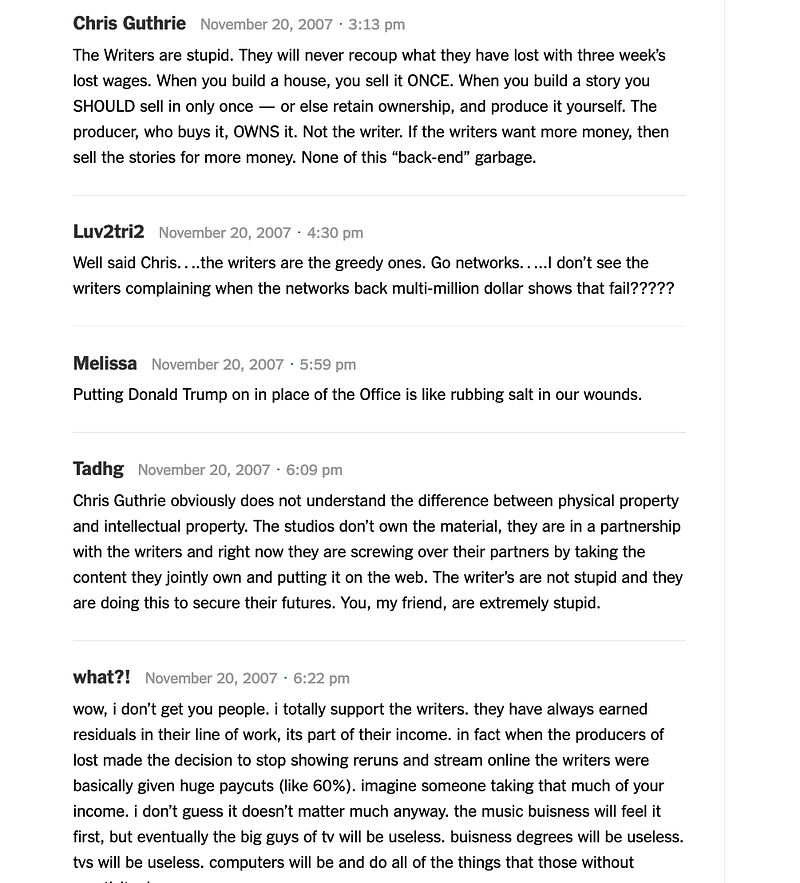
In the 1960s, Ronald Reagan played an important role for actors to get paid in residual payments. Residuals should have been negotiated properly back in 2007 when the last writers’ strike occurred, and when Netflix burst into the scene with streaming to disrupt the entire entertainment industry. I’m sure the industry giants saw that there was going to be a dwindling in sales of physical copies such as DVDs, meaning less money from that stream of revenue. It was no different when Apple came out with iTunes and disrupted the music industry since it became an alternative for consumers to buy as opposed to physical music albums or CDs. There’s a New York Times article from 2007 about the previous writer’s strike, and every now and then, one can gain insight from the comment section, so I went and checked it out. What stood out for me was the prescient comment of a particular person (what?!), who was slightly off when they thought the jobs of creators (i.e., writers, artists, etc.) were not in jeopardy by computers or wait for it…, by AI. The person’s comment said,
“wow, i don’t get you people. i totally support the writers. they have always earned residuals in their line of work, its part of their income. in fact when the producers of lost made the decision to stop showing reruns and stream online the writers were basically given huge paycuts (like 60%). imagine someone taking that much of your income. i don’t guess it doesn’t matter much anyway. the music buisness will feel it first, but eventually the big guys of tv will be useless. buisness degrees will be useless. tvs will be useless. computers will be and do all of the things that those without creativity do.”
One issue with streaming services is the obscureness of their revenue and profits. I mean, sure, you can probably go through Netflix’s 10-K report and figure out how they make money. In contrast, as Snoop Dogg once pointed out in a rant, disgruntled over starving artists because of music streaming like Spotify, he said for him the billions plays in streaming numbers are not adding up to the amount artists gets paid. Unlike in the box office in theaters that are visible and transparent for all to see. The box office numbers don’t lie, and everyone who pays attention is aware of how much a movie like Avatar (2009) made, which was the first film to earn more than $2 billion.
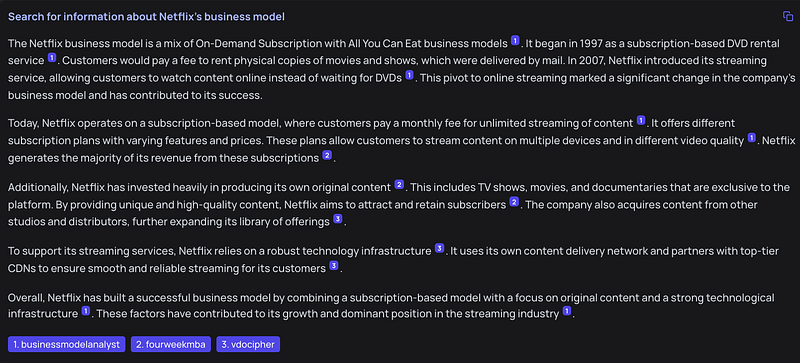
With transparency, you can make a case and settle on how everyone in the production of a film should get compensated. In the same way, music streaming services negatively impacted music artists’ source of income, there needs to be more accountability on how the money is distributed fairly for music artists, writers, and actors to continue doing their art. A streaming service like Netflix business model is reliant on subscription based. How is it that they are able to pay certain stars and comedians a hefty amount of money upfront or in the back end, yet many others are compensated pennies in residuals. I know what that is. It’s called getting screwed over! Streaming services, and these big film companies shouldn’t be a big black box to figure out where the flow of money is going towards.
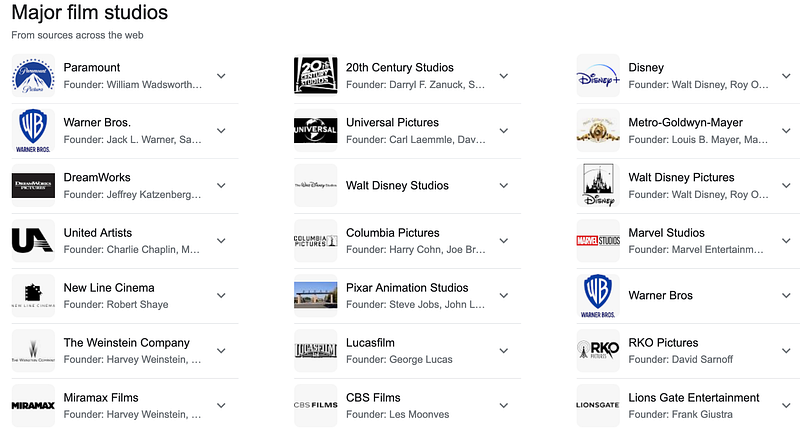
Let’s take a look at the companies (employers) involved that are in conflict with the writers (employees). Some of the major film studios are Paramount, Warner Brothers, Dreamworks, 20th Century Fox, and so on and so forth. These are the decision-makers and have ultimate control, aka the big bosses, but like Friedrich Hegel’s slave-master dialect, producers rely on their workers. It’s a two-way street.
I had a small back-and-forth with someone I follow on Twitter who is passionate about this topic as I am. For me, it’s because one of my interests is understanding the social inequality and inequity. He said,
“Streaming platforms are no more than a digital serving tray. The only value they have is exclusivity and enough capital and assets to be a bank. They dictate what you watch based on their needs and not yours. They are turning Hollywood into a 3rd world sweatshop.”
My reply,
“That’s a funny last great line. But we have to make a distinction. Many Hollywood Studios are owned by the very companies that own the streaming services. To prevent Netflix’s dominance, they’ve made and controlled their own. The writers became an afterthought and suffered.”
I didn’t totally agree with his tweet, but I found the last line very telling. It’s definitely a love-and-hate relationship between streaming services and their customers regarding what gets made, what’s popular, and what remains because of its popularity. I don’t believe streaming platforms turned Hollywood into a third-world sweatshop. However, they have made many who work in Hollywood, in particular those who are not as visible or at the bottom of the ladder, experience a similar income stream or wages to a third-world sweatshop. However, it has to be put in context because, in those third-world countries, the workers can manage to live somewhat on their particular wages, compared to the ridiculously high cost of living in an area like California or New York City. The pay for many of these writers and actors is not as ludicrous as it use to be to solely rely on a film gig, which is why they are forced to work elsewhere.

The streaming wars are another major issue that has pushed the needle forward, and thrown more salt in the wound. Whereas before streaming, the model was more centralized. People had access to a whole bunch of channels if they paid for cable television, and both cable and local channels were primarily backed by advertisers. Writers were able to get more work, involved in more episodes, projects, hence paid or compensated more. Compared to the current streaming business model with fewer episodes and projects, thus less paid. But ever since Netflix became a threat to the other companies, the major corporations took a massive gamble by creating their own streaming services to make sure they can compete and perhaps survive against Netflix and others fighting for market share, and relying on the subscription-based model. There’s nothing wrong with taking a risk, but when it backfires, it will certainly you will have to face the repercussions.
QUESTION 1: How much has producing a film changed over the years to make a profit? Are films profitable?
https://www.thedigitalfix.com/matt-damon/dont-make-movies-like-used-to
QUESTION 2: Who are getting paid within the company itself like Netflix that steers away from creators receiving better compensation?
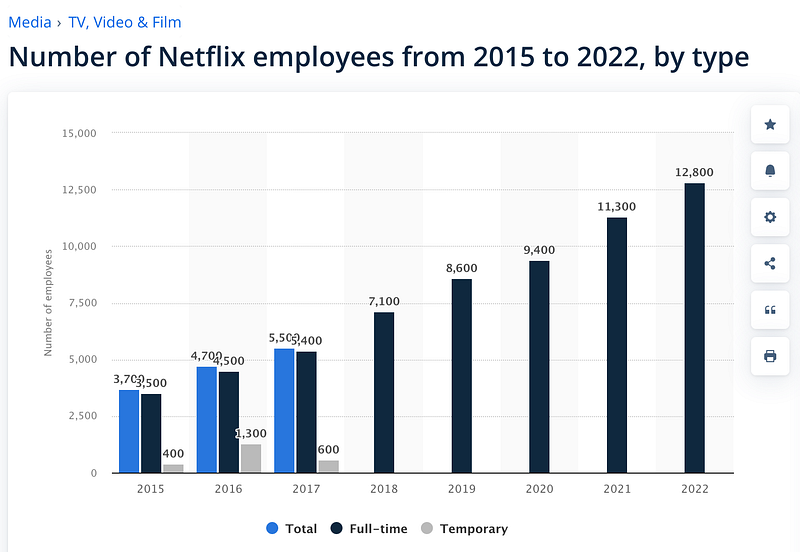
Below is a graph and an AI summary of Netflix employee numbers, their roles, and business model to get a clearer picture.
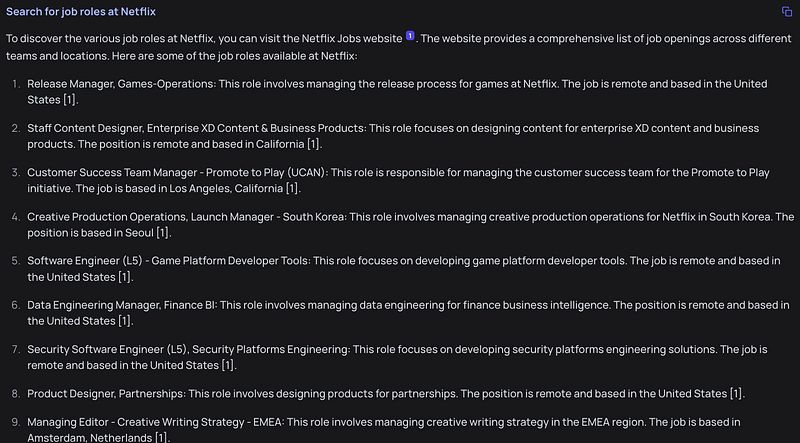
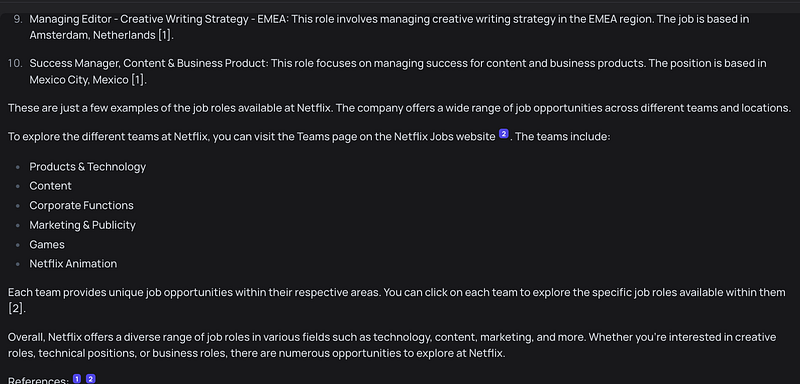
Another dilemma is how these companies know that having control of intellectual property (IP) gives one a huge advantage, therefore consumers suffer when having to subscribe to different streaming services in order to watch their favorite TV shows and movies. For example, if I’m a huge fan of Marvel, it may only be exclusive to Disney Plus and that would be my only option. I wouldn’t be surprised if more and more people get fed up and choose piracy over paid subscription due to the amount of money having all these different streaming services and you can blame it all because of this fragmented entertainment economy.
Competition is good until it is not. Competition can be healthy, but too much of it becomes unhealthy and that’s where collaboration and intervention can step in. The residuals talk was not properly negotiated for the writers, and it is also because these companies are not making as much to pay more in residuals since they are paying everyone else in between. I mean, I’ve seen some abhorrent numbers for these writers and actors getting paid pennies in residuals for popular shows. It’s unjust and must be solved!

The biggest sin is the greed of all parties involved. Those at the top of a company, like the CEO, executives, and board of directors don’t want a pay cut. Normally, it is up to the shareholders to decide that. I know the CEO of Disney, Bob Iger was receiving a lot of backlash because of his comments on the writers’ strike, and people pointed out the millions he makes and the super-yacht he owns. That’s a lack of self-awareness and empathy. I can’t totally fault him, but he is a part of the problem. Hell, nobody ever asks for a pay cut not even laborers. Hence, wealth cannot be shared and distributed more fairly and evenly with everyone else in these companies when a large chunk is paying for the corporation itself to keep on running like the executives and CEO receiving a large chunk of that god-damn sweet cherry pie (wealth).
To add injury to insult, unions like the WGA (Writers Guild of America), unbeknownst to them, are fighting against their own interests when they demand higher wages from the companies, or in the form of governmental policies. I will argue tooth and nail that the minimum wage has been harmful to everyone in society because it sets a floor price for income distribution, which hurts everyone’s standard of living in the long run. That’s why I can not be in favor of a minimum or maximum wage. Meaning, no cap for the rich, and no floor for the poor. Prices, whether it is for goods or human labor have to be negotiated and flexible like the trading of stocks to find the equilibrium. We’ve seen what fixed prices have done to oil with Ronald Reagan in the 1980s. Now, only imagine the harm that fixed incomes or fixed wages has done to the labor force.
For Americans to have a higher standard of living, the minimum wage must be abolished. But someone may ask, how can we prevent the bosses from abusing their power and giving low wages to their workers? That’s when unions and the courts can step in and negotiate with the bosses, find what is fair to share, and spread the wealth more evenly across the board and not just board at the top. Negotiate a fair income for people that don’t get abused by horrible contracts. It cannot be done by enacting harmful policies. The minimum wage is seen as a simple, size-fit-all solution, but it adds to the inflationary pressures of the prices of goods and services, decreases the number of people employers can hire, and has more negative unintended consequences. The famous economist, Milton Friedman does a great job explaining and debating in various videos on why the minimum wage is harmful for the very people it is aimed to help. Although he strongly opposes unions primarily for the same reason people criticize special interest groups, who are only interested in the proposals that benefit themselves, which can be at the detriment of others.
Furthermore, at the macro level, you have Capitalism. Yes, the dirty word people love to throw around. You either hate it or love it, I’m in between as usual. Because of capitalism, we have become more dependent on each other rather than self-reliant. Capitalism promotes interdependence but also leaves some room for individuals or families to become independent to sustain their living. If you cannot grow or hunt for your own food, you are automatically dependent on others. If you cannot build a house, you are dependent on others to build it for you. If you cannot cook or feed your family, again you will be like a beggar. Education is the building block to form these skills and more. However, education is not enough of an equalizer like Horace Mann thought it would be, at least not in practice in the American educational system. Besides that point, no country is fully capitalist, and it shouldn’t be. That’s why we have nonprofits, social programs, or government programs as a safety net to protect anyone who falls down through the cracks.
Moreover, let’s go to the heart of capitalism, the engine that runs it which is capital markets. Don’t get me wrong, people are the capital of capitalism and you need the engine, the conductors and passengers to increase the pie (wealth) of a society. You also need an energy source (oil, coal, solar, etc) to make the engine work. Likewise, the churning of people keeps the capital market’s engine running. For example, in the early development of capitalism, slave (free) labor helped produced enormous profits for the oppressors like the wealth that was amassed in the US and Europe. Today, companies have unrealistic standards of maximizing value / profits for shareholders. The motto is to “maximize shareholders’ value.” That by itself seems like a reasonable, fine, and justified proposal. It seems like the healthy part of capitalism. However, the shareholders (typically BlackRock, and Vanguard) can be ferocious and imposes their will, and that in turn makes a company gamble or adapt to a new market. Like the way, these entertainment companies were forced to adapt to streaming. So to satisfy their shareholders, a company could ultimately end up hurting their employees when they don’t meet Wall Street’s expectations and quarterly earnings. The bar is set really high, and yes business fluctuates. But it becomes a vicious cycle that ends up not only hurting the workers but finally hurting the entire company.
Streaming services like Netflix have decentralized the film industry and decentralized the revenue and/or profits. They’ve now become ultra-middlemen and the wealth is divided up even more amongst the workers of the companies, who were not a part of the production but are the main distributors providing a service to bring the film to the audience at home. The economic rent that has been siphoned away from the creators, is a model that is not so different in the way Wall Street has siphoned away much of the wealth of the country for decades if not since its inception. Although people argue much of the profits gained go to pension funds, retirements, and so forth. Yet, what I see is many of those on Wall Street, like the banks, investment bankers, and fund managers are making enormous sums of profits and bonuses and I ask myself how come? It is mostly because of the success of Corporate America and the entrepreneurial spirit, but it also has the Federal Reserve reimbursing the “Too big to fail” banks and firms when a gamble of theirs goes wrong like in the 2008 financial crisis. Not to mention, these hedge funds, venture capitalists/private equity (sometimes referred to as vulture capitalists) can also win on the downside or the destruction of a company, or the collapse of a nation, but that’s a whole other story.
To reiterate a previous point, the main engine of capitalism which is capital markets, aka Wall Street, plays a major role of being the middleman and a burden that’s taking away the rewards that should be going to the creators in the film industry. You have these major film studios that are tied to the companies that are publicly traded like Disney, Amazon, Warner Brothers, etcetera, In corporate America the slogan is “to maximize shareholder’s value.” This means that a company’s primary goal is raising its stock price. There should be a balance between the shareholders (owner-class) and the employees (working-class) of the company. Why can’t these entertainment companies share their shares with their employees? And a balance in the economic sense does not always necessarily mean that everyone gets paid the same from top to bottom.
Labor strikes have become all so common because of the wide gap between the rich and the poor. The maldistribution of wealth brings only social strife. It’s no different from when it occurred in the French Revolution, or the US in the 1920s which led to a big boom and bust, and the Great Depression that followed. The United States is the wealthiest nation in the world. There are enough resources and wealth for everyone. We cannot go backward with the wrong proposals and way of thinking that will hurt everyone in the long term. Writers deserve better negotiations for their residuals and contracts. The minimum wage should be repealed. Finally, the CEOs, executives, board of directors, and workers need to develop a better relationship with each other for their art to live, for their company to survive, and for the industry to continue to thrive.
A quick side note: Policies, insurance companies, the Federal Reserve, Wall Street, Silicon Valley, and regular folks have been instrumental in retarding the housing market, like the 2000s housing bubble (speculation of properties), and during the pandemic, adding to the misery of the younger generation from easily obtaining and buying a home, and pushing up the cost of living higher. That is a project for another time as the housing market seems to be on a downtrend.
Other sources to consider:
- Main Causes of the Great Depression, Paul Alexander Gusmorino.
- The main causes of the Great Depression according the Milton Friedman.
https://fee.org/articles/the-great-depression-according-to-milton-friedman/
- Demythologizing Newsboys — A Review of “Crying the News.”
- How to Unf★ck Finance, New Economic Thinking.
One of the best lectures giving by Monetarist Economist, Milton Friedman. — Who Protects the Workers?
- Adkins v. Children’s Hospital (1923)
- The Constitutionality of Minimum Wage: The Legal Battles of Elsie Parrish and Frances Perkins for a Fair Day’s Pay, By Margaret Murphy ’23 Advised by Professor Joseph Fronczak
 Social Scholarly