
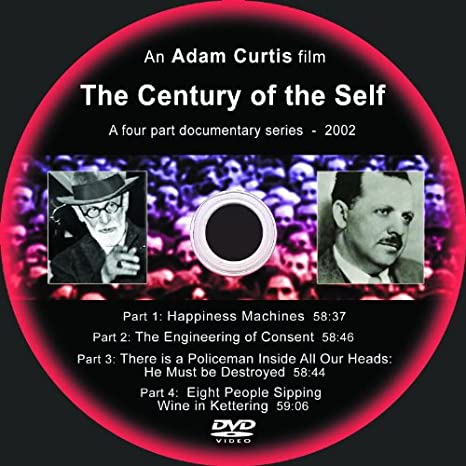
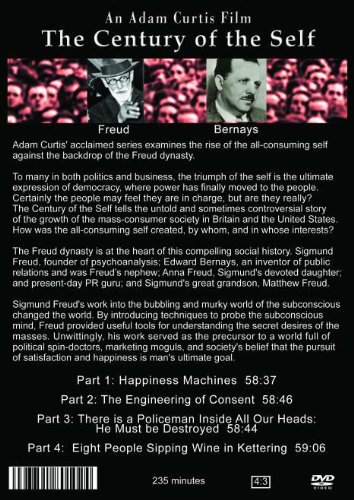
The Century of the Self is probably one of the best documentaries ever made. I saw it a few years back, and it changed my whole perspective, and I rewatched it recently having more experience and knowledge of history, social theory, and psychology. It talks about the influence of Sigmund Freud’s ideas on the twentieth century, and Freud’s nephew, Edward Bernays, who ran with these ideas to not only influence, not just persuade, but a much stronger and nefarious adjective, “manipulate” the masses. He invented Public Relations. Yet, in reality, this was nothing new, he merely changed the word Propaganda to Public Relations, thus inspiring a whole new discipline. You can get a unique understanding of the last century through this lens.
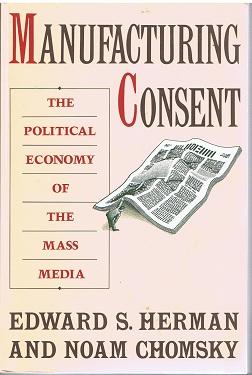
I’m still genuinely amazed at how this film still stands up today. Of course, many things were left out that I think would help us understand that century better. Nevertheless, it gets to the essence of propaganda, socially engineering consent, or what Noam Chomsky and Edward S. Herman would call manufacturing consent. We can still see it today with the propaganda of Capitalism, or any other form of ideology, and this is coming from someone who is pro-capitalist. At the same time, I still do not ignore the glaring flaws of our way of living in a neoliberal, capitalist, and semi-democratic world. Ideologies like Communism from the philosopher (social theorist) Karl Marx have been painted and attacked so negatively by the government, the mainstream media, and other pundits. When you actually study different ideas like Marx’s, you start to realize, hey there are some valid points here and there that maybe shouldn’t be overlooked and other terrible ideas. Be that as it may, just because there are new ideas that challenge the status quo, it does not mean they should be disregarded and discarded. Some people are afraid of change, but change is inevitable. We see the evolution of technology, in nature, in culture, and in ourselves. So why is it harder to see it in ideas and the way we organize socially?
I would want people to transcend dogmas and transcend their beliefs, and this does not mean abandoning their traditions or their held beliefs, but being fluid by challenging one’s own views. You can always adjust beliefs like the way Bruce Lee took what he liked from different martial arts styles to create his own style. In the same way, science is always improving on previous findings, or the way technology constantly innovates, note that ideas and values can also improve and evolve with the times.
Opening remarks of Alexander Berkman Archive
What is Communist Anarchism? Chapter 25. The Idea is the Thing.
“Did you ever ask yourself how it happens that government and capitalism continue to exist in spite of all the evil and trouble they are causing in the world?
If you did, then your answer must have been that it is because the people support those institutions, and that they support them because they believe in them.
That is the crux of the whole matter: present-day society rests on the belief of the people that it is good and useful. It is founded on the idea of authority and private ownership. It is ideas that maintain conditions. Government and capitalism are the forms in which the popular ideas express themselves. Ideas are the foundation; the institutions are the house built upon it.”
 Social Scholarly