
Milton Friedman famously said, “Inflation is always and everywhere a monetary phenomenon in the sense that it is and can be produced only by a more rapid increase in the quantity of money than in output.”
“Monetary economist Milton Friedman made this line famous after stating it in a talk he gave in India in 1963. In a trivial sense, of course, the statement is true. Inflation, by definition, means that money loses its purchasing power and, therefore, is a monetary phenomenon. But Friedman meant much more. After having defined inflation, in that same talk, as a “steady and sustained rise in prices,” Friedman argued that one could not find inflation anywhere in the world that was not caused by a prior increase in the supply of money or in the growth rate of the supply of money. His statement was an empirical one, not a logically necessary one, and most professional economists, still in the thrall of John Maynard Keynes, did not agree with Friedman. But within a decade, the evidence from the United States and other countries had convinced most economists that Friedman was right.” source: https://www.hoover.org/research/inflation-true-and-false
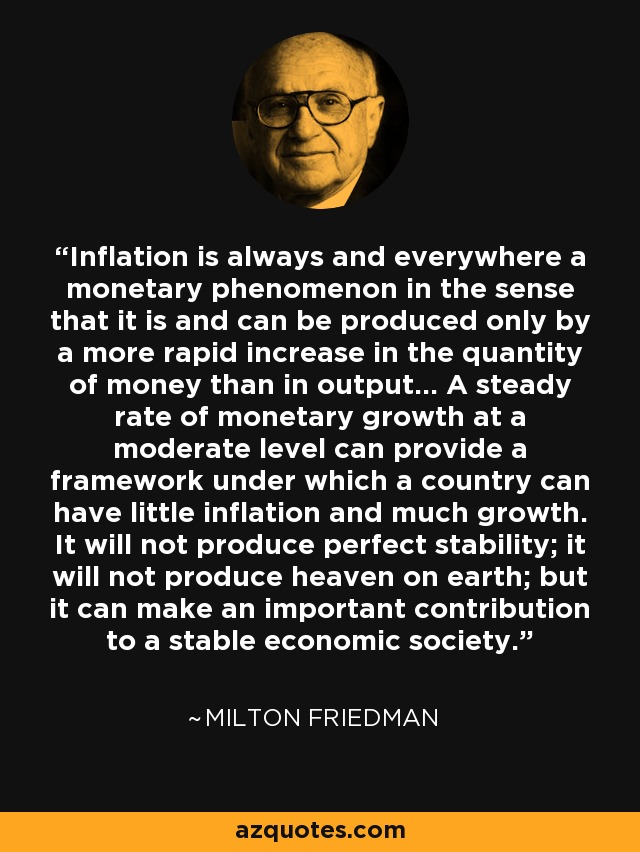
I value Milton Friedman’s views because he contributed enormously to economics, and he’s been right more often than wrong, as Ben Bernanke would know by studying economic depressions. Although no economist is perfect, listening to multiple views is essential. I’ve heard people argue social sciences like economics are not a perfect science. My reply is what really is a perfect science? Even the natural sciences have flaws, and it is with the scientific method that it gets perfected to wither out truth from fiction. Plus those sciences like physics and chemistry have content that is much older than social science to draw from, as far back as antiquity. Social sciences like sociology and psychology have been steadily improving since they really took off starting in the early 19th century. In short, any subject matter is a learning process that builds up from previous knowledge. Bashing a subject over another is pure ignorance.
One issue of many I have with Friedman’s arguments such as the one about individual stockholders having control of corporations, if they are discontent with let’s say Exxon mobile they can withdraw their money (Milton Friedman on Phil Donahue #2), I find this instance to be not entirely true, but a half-truth. Much has changed during that time because large institutions, whether that’s hedge funds or a large entity like Vanguard or BlackRock have become major stockholders of several companies, thus having majority control over any individual. Institutional investors own over 50% of the company Exxon Mobil! There’s no democracy in many of these corporations, only an illusion of a democratic system, there’s no individual choice (a power in individual numbers), but an illusion of choice. The majority of people’s life savings, whether a pension or 401(k), go to these institutions who then do passive or active investing for them instead. The creator of Vanguard, John (Jack) C. Bogle published an article in the Wall Street Journal (2018) of his concerns, with the subheading reading: The father of the index fund says it’s probably only a matter of time before they own half of all U.S. stocks; ‘I do not believe that such concentration would serve the national interest.’ This is exactly what has occurred in corporate America, which spills over to the political area where the government is more concerned with large corporations rather than helping small businesses or the average folks.
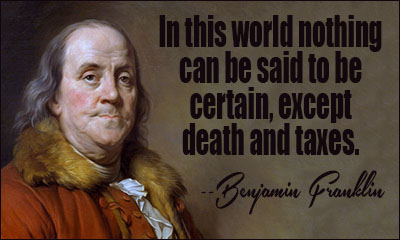
I’ve also heard the argument that we can’t tax the rich because they are the ones who provide the jobs, and if you tax them that means they will hire fewer employees, etc., or basically the tax increases on the rich will negatively affect everyone else in either taxes or costs, which I entirely disagree with. There are many outrageous tax loopholes like the carried interest tax loophole that have been addressed before and other ways the rich or people avoid paying less in taxes. Let’s not forget the economy is ever-changing, like the gig economy with freelancers who have little to no benefits and must file their taxes as a business owner. It goes back to when Ben Franklin said, “In this world, nothing can be said that’s certain, except death and taxes.” The quote basically means that death and taxes are loathed but unavoidable; no matter who you are. Overall, the United States is losing $1 trillion in unpaid taxes every year, which means someone is avoiding it, and it may mean that individuals within both the working class and the rich are the culprits.
 Social Scholarly