
This thought came across for me today, in which I remember seeing somewhere of a commonly held belief that, one shouldn’t be in search of the meaning of life because you will never find it. My view is that this does not apply to everyone. As I can only speak for myself, that the very search for meaning is what gives me a life’s purpose. Otherwise, I wouldn’t know what would be the point for me to keep on living. I like to dive into the mysteries of life and think about philosophical matters, which is why I admire scientists like physicists and astronomers on the front-lines of uncovering truths. Even if I never find the meaning of life, it still brings me great pleasure to be in this immeasurable pursuit.
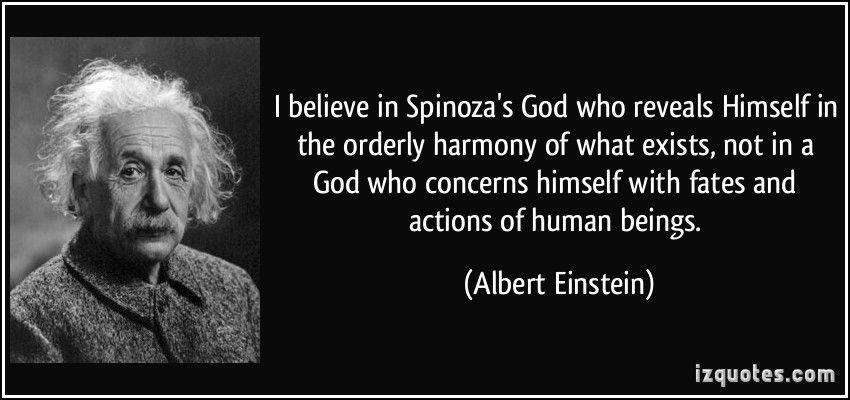
Another point is from a quote from Albert Einstein, “I believe in the Spinoza’s God who reveals himself in the harmony of what exists, not in God who concerns himself with the fate and doings of mankind.” In this quote, Einstein was referencing Baruch Spinoza, and although I have never read any of Spinoza’s works, this hits home because I can relate to his idea. I grew up Catholic and went through the process of baptism and communion, and then as a teenager, I gradually departed from it. After that, I searched elsewhere and found what God really meant was nature, the sense of the harmonies and chaos of the universe. Although I was raised in a city, which meant I spent little time in nature, I still appreciated those few times wandering in nature. I found an appreciation of nature through works of literature like poems, listening to music, and pure observation. With this new conception of God, which is more aligned with a Buddhist or Hindu view of reality, I find it much more liberating compared to the rules and rituals that are found in all the various religions across the world. I no longer need a church to find God, as comedian Eddie Griffin said, “They say the body is the temple, I’m walking in church right now”, and expounding on his profound statement, the whole universe is as well. It is with this liberation that I can appreciate many of the religions and read what they all have to say that’s worthwhile, discard what I find useless or problematic with my lifestyle, and at the same time not be constrained by any of them. (The same philosophical approach Bruce Lee used for his own martial arts discipline).
The only religion that I closely aligned with or pertained to, which I would refer to as not really a true religion- would be science, which is the pursuit of truth and knowledge. I would consider myself an agnostic, and even with this notion, I hesitate to identify myself as agnostic because labels are like yourself putting on a straitjacket. Why would I put myself in another straitjacket, when I’ve just gotten out of one when I have broken the chains from the indoctrination of the catholic faith. Science gives me the tools and wisdom to be open-minded and uncover what is true. In other words, science is creative freedom with a structure to find the truth. It is why it transcends religion, considering it allows the individual to pursue their own interests with little to no strong-held beliefs. Nevertheless, religion has its purpose; this is by no means me trying to put down people for their religious beliefs. I find religion fascinating, the devotion people have, the complexity of it, the irony, and the contradictions that arise, to me they are all valuable from a sociological and psychological perspective.
All in all, what I’m left here to say is that I’m in awe of life, but it is not to say I’m joyous or depressed, or optimistic as opposed to pessimistic. Instead, I’m a combination of the dualities, of all the shades of grey, and the multitude of colors that lay in between them. I’m in awe more specifically with the meaning of reality. I find bliss in nature, music, reading, conversations, and when looking in the eyes of people who have a sparkle in their eyes. The act of searching for meaning, to crack the code of the universe is my life’s purpose. Some people may have already known the meaning or have solved it. And suppose some religions did solve the mysteries, it doesn’t matter because I want to find it for myself to feel the fulfillment for discovering it as well, on my own, and with my own set of skills. If I don’t or do go through that process of self-discovery or world-discovery, I can feel validated that I have lived a meaningful life.
P.S. I find that many comedians are more in touch with reality than many people who follow a religion. It is laughter that happens spontaneously that holds true beauty. As I’ve observed, it is similar to the teachings and training that comes out of Zen Buddhism, of being spontaneous. Real laughter has those zen-like qualities, a true spirit of oneself. Zen Buddhists have this distinct kind of laugh of (obnoxiously loud) not taking life so seriously, and perhaps it is because, to them, life is a comedy. Zen Buddhists have this bright or peaceful attitude towards life and do not see it as a heavy burden, and can reach nirvana or this idea of feeling light on their feet. I believe laughter has healing qualities, not physical healing but mental. Such as certain music can have the same healing effect on some people, as laughter has on some. It is probably why many famous comedians (not all) have tragic upbringings, and yet, they use comedy as a coping mechanism or a healing tool for their traumas. As they say, “laughter is the best medicine”, who knew we should take this idea seriously, but then again, the lesson here is to not take it too seriously. In other words, why so serious?
 Social Scholarly